
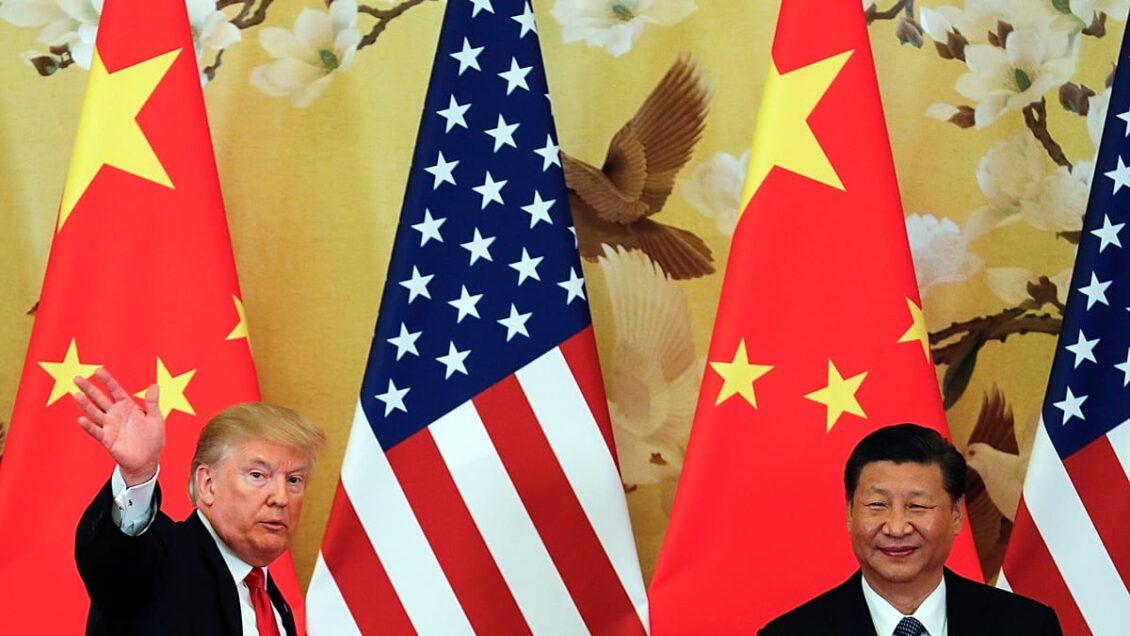
As US President Donald Trump arrives at Beijing ’ on Wednesday for a three-day summit to be completed on Friday, even symbolism alone is of paramount importance.
This was Trump’'s first official visit to China since his previous visit to ’ in early 2017, nearly nine years ago.
The geopolitical background of this visit is much more unstable than at the time. The Iran war has shaken global energy markets, disrupted shipping routes and renewed concerns over a broader regional tension.
Meanwhile, China has sought to position itself as a source of economic continuity and diplomatic stability by strengthening trade ties between Southeast Asia, the Gulf and parts of Africa and Latin America ’.
In addition to its participation in the Middle East ’, the United States is actively consolidating its influence in the Western Hemisphere “ through the renewed ”Monroe Doctrine’.
The Trump administration effectively removed the Venezuelan regime from China ’ through military action, economically pressured the Cuban administration to the brink of collapse through sanctions, and with many Latin American and Caribbean countries, “A created a new security coalition called ’'s Shield.
American strategy has reintroduced military and economic priority in the region with the aim of reducing Chinese influence and securing critical supply chains. For example, the United States and China are currently in a heated dispute over port control in the Panama Canal.
The U.S. is still richer, but China has reshaped the global economy
Since Trump’'s 2017 visit to China in ’, the United States has continued to lead the global economy.
According to IMF’'s latest estimates released in April, US nominal GDP’ is expected to exceed $30 trillion (25.5 trillion euros) in 2026’, while China’ is expected to exceed about $20 trillion (17 trillion euros); This is the turn of the global economy. and represents his share of ’.
The U.S. and China have been ranked in the top two in nominal GDP rankings for over a decade; But while the difference is huge, China is shrinking as it grows faster.
According to IMF figures, China’'s real GDP annual growth rate has averaged 5.48 percent since 2017’'s, USA’'s 2.5 percent and the world's 3.26 percent. In fact, the Chinese economy is growing at twice the rate of its American rival and well above the global growth rate.
ChinaOne of the key contributors to ’'s above-average performance was that it was the only major country to end 2020’ with economic growth after the COVID-19 pandemic ravaged the global economy.
China ’'s annual real GDP growth for this year %4,4, USA’nin %2.3 and the world. %It is expected to be 3.1.
China also surpassed the U.S. ’ in purchasing power parity (PPP) in 2016 to have a larger share of the global economy, and since then the gap has widened further. The measure is adjusted to domestic price levels and reflects the true scale of production and consumption in an economy.
This shift underscores how China’ has become central to global production, supply chains and commodity demand.
However, the living standards between the two countries are still quite different.
IMF estimates that by 2026 the U.S. ’'s GDP per capita will be over $94,000’ (€79,850), while China's is close to $15,000’ (€12,750) and the world's is almost $16,000 (€13,600).
Despite decades of rapid growth, China's economy still faces structural challenges such as poor domestic consumption, high youth unemployment, a slowdown in the real estate sector and demographic pressures due to an aging population.
Supply chains and export-related conflicts
The latest debate over supply chains was triggered in April when U.S. Secretary of State Marco Rubio ’ accused China’ of committing ’bully ’ by detaining dozens of Panama-flagged ships after China’ overturned contracts earlier this year allowing Hong Kong“'s CK Hutchison company to manage two port terminals.
Despite several rounds of negotiations last year, trade tensions remain at the heart of the U.S.-China relationship.
Although both countries eased some tariffs and export restrictions in late 2025’, disputes remain over semiconductors, electric vehicles, artificial intelligence and access to critical minerals.
US President Donald Trump's list of business leaders attending ’'s trip to China underscores the main issues discussed. The group of more than a dozen senior executives includes Elon Musk, departing Apple CEO Tim Cook and Nvidia CEO Jensen Huang.
The Trump administration has restricted the sale of Nvidia’'s H200 AI chips to China’e, citing the possibility that they could be used for military purposes. Exports are limited under a number of conditions, such as third-party testing to verify performance capabilities before shipping to Chinese customers.
Since then, Nvidia has been lobbying the White House ’ to lift restrictions.
In general, Washington accuses Beijing’i of using state subsidies and industrial policy to distort global markets, while Chinese officials argue that U.S. export controls are designed to slow China’'s technological development.
China’'s external reserves
Beijing has significant financial firepower as it continues to grow.
According to data from the Chinese State Foreign Exchange Administration, as well as reports from the state-run Xinhua news agency, China’in foreign exchange reserves amount to more than $3.2 trillion (€2.8 trillion), continuing to be the world's largest foreign exchange reserves.
These funds provide policymakers with a significant capacity to manage financial volatility and support the Chinese yuan or renminbi.
The U.S. has relatively smaller reserves but continues to benefit from the global dominance of the dollar, which remains the primary currency used in international trade and central bank reserves.
Gold assets reflect another dimension of competition. According to the World Gold Council, the United States officially holds the largest national gold reserve of more than 8,100 tons.
However, as Beijing seeks to divert its reserves from dollar-denominated assets and strengthen long-term confidence in the yuan, China has steadily expanded its own holdings in recent years.
As of this month, the People's Bank of China has entered an 18-month buying streak, China's central bank's longest non-stop gold buying spree. Total stocks have reached new records and are over 2,300 tons.
Artificial intelligence and military spending have become central battlefields
Economic rivalry between Washington and Beijing is increasingly inseparable from military and technological rivalry.
According to data released last month by the Stockholm International Peace Research Institute (SIPRI), the top three countries in the world that spend militarily are the United States, China and Russia, respectively, which together account for the global total of is ’ini.
2025’te US spent $954 billion (EUR 810.3 billion); This figure is actually about the same as the previous year. %It was 7.5 lower, but this was due to the fact that no new financial aid to Ukraine’ya was approved.
The country has still increased investments in nuclear and conventional military capabilities in order to maintain its dominance in the Western Hemisphere ’, which is set as the priorities of the new US National Security Strategy, and to deter the Indo-Pacific ’ of China.
Expenditure approved by the U.S. Congress for this year has already risen to over $1 trillion (849.4 billion euros); This is according to 2025’e %5Represents an increase of more than ’, and US President Donald Trump, if ’'s latest budget proposal is accepted, could jump even further to $1.5 trillion (1,275 trillion euros) in 2027’.
SIPRI estimates that ’'s defense budget for 2025 is around $336 billion, but some analysts believe that broader spending on security could technically push the real figure even higher.
While China has rapidly modernized its military over the past decade by expanding its naval capacity, missile systems and cyber warfare capabilities, the United States still maintains a significant advantage through its global alliance network, including NATO partnerships and security ties with Indo-Pacific ’te Japan, South Korea and Australia.

Taiwan remains the most sensitive issue in the relationship. Beijing sees the autonomous island as part of its territory and has repeatedly criticized US ’'s military assistance to Taipei’.
Washington argues that maintaining stability in the Taiwan Strait ’ is vital to regional security and global trade flow, especially given Taiwan ’'s central role in advanced semiconductor production.
Technology, that is, artificial intelligence, has emerged as perhaps the defining field of competition.
The U.S. has significant strengths in advanced chip design, aerospace, software and research capacity. Meanwhile, China has established dominant positions in the fields of electric vehicle batteries, renewable energy infrastructure, telecommunications equipment and industrial production.
According to Bruegel and SNE Research ’, Chinese companies now have the capacity to produce solar photovoltaics globally. %More than 90’ and the global EV battery market %It makes up more than 70’.
These sectors are seen by Beijing as strategically important for future economic impact.
At the same time, Washington has tightened restrictions on advanced semiconductor exports due to concerns over artificial intelligence and military applications.
Trump ’'s visit, therefore, will likely be judged not on urgent agreements, but on whether competition helps prevent further deterioration of relations between the two powers, which are increasingly shaping global trade, investment and security.
The U.S. remains the dominant military and financial force backed by the global role of the dollar and the depth of American capital markets.
But China has become a systemic competitor with industrial scale, export access, and state-sponsored investment capacity that could impact supply chains, infrastructure, and geopolitical alignments around the world.
For Beijing, the summit offers an opportunity to reflect confidence and stability amid wider international uncertainty. For Washington, this is a test of whether ’ can continue to shape the economic and strategic rules of an increasingly multipolar world.


