
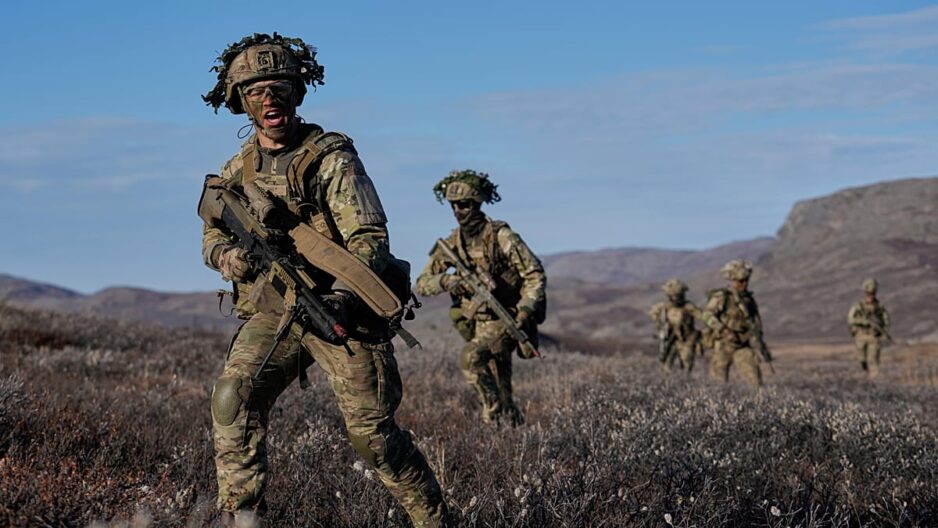
EuropeFive sectors benefiting from the explosion in ’'s defense spending

After decades of seeing military budgets as a pen to be quietly cut or ignored, Europe has decided it wants to defend itself on its own terms.

The turning point was Russia’'s full-scale invasion of Ukraine’ in 2022’, but the showdown had been going on for years. According to the European Defence Agency ’, AB’'s defense spending increased from 218 billion Euro’ in 2021 to an estimated 381 billion Euro’ in 2025’te; And that's only in four years. %That's an increase of 75’.

According to the Stockholm International Peace Research Institute ’ne (SIPRI), global military spending reached a record $2.9 trillion that year; The main driving force was the European ’; %It increased by 14 to $864 billion (742 billion euros). For the first time since 1990, Germany has exceeded the target of 2% ’ of NATO’'s GDP, reaching 2.3% ’.

Then came the political mechanism to make it permanent. AB’'s ReArm European Plan, officially Preparatory 2030, the European Commission aims to unlock €800 billion in defence investment, with ’ raising up to €150 billion in funding from capital markets through a new tool called SAFE (European Security Action).

The escapist clause in the Stability and Growth Pact now allows member states to increase defense spending outside of normal financial rules. The Committee on Defense Budgets %It estimates that a 1.5’ GDP increase could create nearly 650 billion euros in fiscal space in four years.

A handful of sectors are reaping the fruits of this, as leading members of AB’ take action to revive previously delayed military production.

FILE – German Defence Minister Boris Pistorius and Australian Defence Industry Minister Pat Conroy during a visit to Rheinmetall Defence in ’, Australia, 27 March 2026

1. Manufacture adjacent to defense

’'s traditional defense contractors, – Rheinmetall, Leonardo, Saab, and the like, are living a seemingly unreasonable moment a decade ago, at a time when defense stocks were seen as politically awkward investments.

EU ammunition production capacity alone increased from about 300,000 rounds per year in 2022’ to an estimated 2 million by the end of 2025’; This is a rate of industrial expansion that, according to the Financial Times and the European Parliament Think Tank ’, exceeds peacetime growth rates by three times.

Domestic orders linked to the defense industry in ’ compared to already high levels after the occupation in late 2025’ %Increased by more than 50’.

The European Commission is now directing the funds specifically to expand the production lines of large contractors and shorten delivery times for some air defense systems, which currently span several years.

The structural problem is that the European ’'s defense market was never originally properly integrated; According to the Munich Security Conference, only contracts that have been awarded in the past %9’u is given to suppliers from other EU member states; Domestic companies earned more than three-quarters of the total.

This is the inefficiency that the new wave of spending has so far sought to rectify with limited success.

Ukrainian soldiers of the – Khartia brigade launched a drone on Wednesday, May 20, 2026, towards Russian positions on the frontline in the Kharkiv region of Ukraine’.

2. Category: Drones

If there is one technology that the Ukrainian ’ has incorporated into the military thinking of the European ’, it is the drone ’. It's cheap, disposable, deadly, and produced by Russia at a pace that ’'s own industry has yet to reach.

The response was quick and expensive. France stocks explosive drones before 2030’ %Under the updated military planning law, including an increase of 400’, it pledged €8.5 billion to expand its stockpiles of ammunition and drones.

April 2026In ’, Germany and Ukraine signed a defence package of €4 billion, which includes agreements on joint drone production as part of a broader initiative to increase European autonomous system production.

The EU launched the European Drone Defense Initiative ’ni (EDDI) in early 2026, and aims to create a multi-layered, 360-degree counter-drone shield between member states by 2027.

Vector drone’u UkraineThe German company Quantum Systems, which was tested in the ’ war, emerged as one of the leading ISR manufacturers in Europe’ with combined revenue streams in both military and commercial segments.

FILE – This May 18, 2021 photo shows a woman writing on a laptop on a train in ’, New Jersey.

3. the Cyber Security

Cyberspace is now a recognized area of warfare and European governments are spending accordingly; but the focus is on “BT security, which has shifted from ” to the protection of critical infrastructure.

In 2025, the EU allocated €145.5 million to strengthen cybersecurity across SME ’s, public administrations and healthcare providers.

20 January 2026In ’, the European Commission proposes a new cybersecurity package that includes amendments to the NIS2 directive, which aims to simplify compliance and strengthen AB’'s ICT supply chain against third-country risks.

The European Investment Bank explicitly lists cybersecurity among its defence and security financing priorities. Although the methodologies differ according to the research firms, the market figures are large.

According to the figures of CONTEXT’in Panel Europe, Europe’'s cybersecurity revenues April 2026’'s annual %increased by 10; Identity and Access Management is most directly linked to the protection of sensitive government and military systems. is increased.

The dual-use nature of cybersecurity investments means that defense spending drives commercial security spending up with it.

FILE – A visitor walks behind tools at the Intec and Z engineering trade fairs in Leipzig, central Germany, Wednesday, March 8, 2017.

4. Category: Industrial metals

The logic is simple: Military equipment is heavy and made of metal. Ships, armored vehicles, artillery systems, missile launchers; all of these are metal-intensive, unlike software contracts and consulting fees.

Goldman, EuropeAbout ’'s increase in defense spending ’'s, NATO’'s typical %He estimates that it will flow into the purchase of metal-heavy equipment, which is roughly twice the norm of 20.

Total impact is important. Goldman believes that the re-armament of ’ will increase the region's overall demand for industrial metals by 2027. %He estimates that it will increase by 6 percent; the European Union's use of metals in 2023 %This is a dramatic increase, given that it represents 2’sini.

Bank calls for global defense-induced increase in copper demand %0.9, with nickel %1,3 and steel %He estimates it could increase by 0.4. Copper, which passes through almost every military system (vehicles, weapons, cables, energy infrastructure, communications), stands out as the most obvious beneficiary.

ING’nin's 2026 EU sector outlook marks artificial intelligence and electrification infrastructure, as well as metal-heavy defense manufacturing, as one of the main drivers of manufacturing sector growth.

FILE An example of a – Toshiba semiconductor.

5. Category: Semiconductors

This may be the most disturbing item on the list, in part because the explosion is a result of the realization of how vulnerable Europe’ is to disruptions in semiconductor supply chains.

Modern defense platforms, from missile routing units to ISR architectures and encrypted communications, are working on advanced, secure processors that Avrupa’ largely does not produce.

For decades, the continent has relied on U.S. ’ suppliers for defense-grade chips while having foundries in Asya’ manufacture them. A supply chain that is efficient in times of peace but fragile in times of crisis.

According to CEPA’, the European Defence Industry Programme (EDIP), a 1.5 billion Euro’ cross-border procurement vehicle launched in 2026’, is directly addressing this issue with funding specifically earmarked for gallium nitride semiconductors used in radar and electronic warfare systems.

The European Defence Agency chief warned that the European defence base remains fragmented and reliant on microelectronics outside Europe.

As Global Policy Journal’ points out, Europe’'s structural position in the wider semiconductor ecosystem gives it an advantage, but turning it into dominant defense-class chip production is a longer-term project.

Leonardo equips Kuwaiti patrol ships, Italy increases presence in Persian Gulf’

Italy’'s presence in the Persian Gulf’ and military cooperation with Kuwait’ are strengthening. Leonardo has signed a contract with Abu Dhabi Ship Building (ADSB), a subsidiary of EDGE Group’, to supply naval combat systems for the next generation of patrol ships ordered from Kuwait’'s shipbuilder.

Kuwait has started to modernize its marine components under the “Al Dorra” program. eight FALAJ 3 Offshore Patrol Vessels (OPV’ler)It was built by ADSB in ’nde, United Arab Emirates.

Military and trade agreements between Italy and Kuwait

Military and commercial cooperation between Italy and Kuwait consolidated last year: Italian Air Force and Kuwait Air Force renew their partnership on Eurofighter Typhoon fighter jets, A three-year agreement is signed.Providing personnel training, support in electronic warfare and joint management of activities.

In 2016, the Kuwait ordered 28 advanced aircraft built by Leonardo in ’, Italy.Most of the Eurofighter Typhoon’s are already operating in the Emirate’te. Kuwait's Ministry of Defense has also expanded its integrated logistics support and local training services. These activities will Provided by Leonardo Aviation ServicesAli Al Salem at the air base until December 2029’, reinforcing the strategic cooperation between the two countries.

Italy also maintains an active military presence in Kuwait’. 320 soldiers were deployed at Ali Al Salem base.The Italian Ministry of Defense announced that the MQ-9A “Predator” unmanned aircraft from the “Car Fenice” Task Group and the F-2000A “Eurofighter” jets from the “Typhoon” Task Group were also deployed here, and that its mission was to effectively contribute to “ operations aimed at definitively defeating ’ISISID”.

Last March, two weeks after the start of the US-Israeli ’ war against Iran’, an MQ-9A unmanned aerial vehicle parked at the base was shot down in an attack by Tehran’, but no injuries or damage to other assets were reported among Italian personnel.

The military conducts surveillance, reconnaissance and data collection operations at Ali Al Salem base. IraqTo help ensure the safety of civilian and military personnel operating in ’.

The Italian union is also conducting joint exercises with the Iraqi Air Force, which aims to promote integration and training sharing in a spirit of cooperation that will serve peace and stability throughout the region.

How does Leonardo strengthen his presence in the Persian Gulf ’?

Returning to the collaboration between Leonardo and EDGE, the partnership signed twenty years ago made it possible to: About 30 naval units were delivered.The value of the contract for patrol ships ordered by Kuwait is estimated at 320 million euros and includes the supply of Leonardo’'s Combat Management System (CMS), the 76 mm SUPER RAPIDO cannon equipped with STRALES guided ammunition, and the KRONOS NAVAL HP radar.

Strengthening cooperation between Leonardo and EDGE Group accelerates creation of a joint ventureAnnounced in June and planned to be operational in 2026, the company ’i Emirate group and ’u will belong to the Italian group and will cover the following activities: United Arab Emirates’nde from design to production and training.

The project also focuses on the issuance of intellectual property licenses and the development of a skilled local workforce. The agreement confirms the competitiveness of this model in the global defense market and strengthens the Italian group's presence in the Persian Gulf ’.

Trump in Beijing’de: How do America and China compare as economic superpowers?

As US President Donald Trump arrives at Beijing ’ on Wednesday for a three-day summit to be completed on Friday, even symbolism alone is of paramount importance.

This was Trump’'s first official visit to China since his previous visit to ’ in early 2017, nearly nine years ago.

The geopolitical background of this visit is much more unstable than at the time. The Iran war has shaken global energy markets, disrupted shipping routes and renewed concerns over a broader regional tension.

Meanwhile, China has sought to position itself as a source of economic continuity and diplomatic stability by strengthening trade ties between Southeast Asia, the Gulf and parts of Africa and Latin America ’.

In addition to its participation in the Middle East ’, the United States is actively consolidating its influence in the Western Hemisphere “ through the renewed ”Monroe Doctrine’.

The Trump administration effectively removed the Venezuelan regime from China ’ through military action, economically pressured the Cuban administration to the brink of collapse through sanctions, and with many Latin American and Caribbean countries, “A created a new security coalition called ’'s Shield.

American strategy has reintroduced military and economic priority in the region with the aim of reducing Chinese influence and securing critical supply chains. For example, the United States and China are currently in a heated dispute over port control in the Panama Canal.

The U.S. is still richer, but China has reshaped the global economy

Since Trump’'s 2017 visit to China in ’, the United States has continued to lead the global economy.

According to IMF’'s latest estimates released in April, US nominal GDP’ is expected to exceed $30 trillion (25.5 trillion euros) in 2026’, while China’ is expected to exceed about $20 trillion (17 trillion euros); This is the turn of the global economy. and represents his share of ’.

The U.S. and China have been ranked in the top two in nominal GDP rankings for over a decade; But while the difference is huge, China is shrinking as it grows faster.

According to IMF figures, China’'s real GDP annual growth rate has averaged 5.48 percent since 2017’'s, USA’'s 2.5 percent and the world's 3.26 percent. In fact, the Chinese economy is growing at twice the rate of its American rival and well above the global growth rate.

ChinaOne of the key contributors to ’'s above-average performance was that it was the only major country to end 2020’ with economic growth after the COVID-19 pandemic ravaged the global economy.

China ’'s annual real GDP growth for this year %4,4, USA’nin %2.3 and the world. %It is expected to be 3.1.

China also surpassed the U.S. ’ in purchasing power parity (PPP) in 2016 to have a larger share of the global economy, and since then the gap has widened further. The measure is adjusted to domestic price levels and reflects the true scale of production and consumption in an economy.

This shift underscores how China’ has become central to global production, supply chains and commodity demand.

However, the living standards between the two countries are still quite different.

IMF estimates that by 2026 the U.S. ’'s GDP per capita will be over $94,000’ (€79,850), while China's is close to $15,000’ (€12,750) and the world's is almost $16,000 (€13,600).

Despite decades of rapid growth, China's economy still faces structural challenges such as poor domestic consumption, high youth unemployment, a slowdown in the real estate sector and demographic pressures due to an aging population.

Supply chains and export-related conflicts

The latest debate over supply chains was triggered in April when U.S. Secretary of State Marco Rubio ’ accused China’ of committing ’bully ’ by detaining dozens of Panama-flagged ships after China’ overturned contracts earlier this year allowing Hong Kong“'s CK Hutchison company to manage two port terminals.

Despite several rounds of negotiations last year, trade tensions remain at the heart of the U.S.-China relationship.

Although both countries eased some tariffs and export restrictions in late 2025’, disputes remain over semiconductors, electric vehicles, artificial intelligence and access to critical minerals.

US President Donald Trump's list of business leaders attending ’'s trip to China underscores the main issues discussed. The group of more than a dozen senior executives includes Elon Musk, departing Apple CEO Tim Cook and Nvidia CEO Jensen Huang.

The Trump administration has restricted the sale of Nvidia’'s H200 AI chips to China’e, citing the possibility that they could be used for military purposes. Exports are limited under a number of conditions, such as third-party testing to verify performance capabilities before shipping to Chinese customers.

Since then, Nvidia has been lobbying the White House ’ to lift restrictions.

In general, Washington accuses Beijing’i of using state subsidies and industrial policy to distort global markets, while Chinese officials argue that U.S. export controls are designed to slow China’'s technological development.

China’'s external reserves

Beijing has significant financial firepower as it continues to grow.

According to data from the Chinese State Foreign Exchange Administration, as well as reports from the state-run Xinhua news agency, China’in foreign exchange reserves amount to more than $3.2 trillion (€2.8 trillion), continuing to be the world's largest foreign exchange reserves.

These funds provide policymakers with a significant capacity to manage financial volatility and support the Chinese yuan or renminbi.

The U.S. has relatively smaller reserves but continues to benefit from the global dominance of the dollar, which remains the primary currency used in international trade and central bank reserves.

Gold assets reflect another dimension of competition. According to the World Gold Council, the United States officially holds the largest national gold reserve of more than 8,100 tons.

However, as Beijing seeks to divert its reserves from dollar-denominated assets and strengthen long-term confidence in the yuan, China has steadily expanded its own holdings in recent years.

As of this month, the People's Bank of China has entered an 18-month buying streak, China's central bank's longest non-stop gold buying spree. Total stocks have reached new records and are over 2,300 tons.

Artificial intelligence and military spending have become central battlefields

Economic rivalry between Washington and Beijing is increasingly inseparable from military and technological rivalry.

According to data released last month by the Stockholm International Peace Research Institute (SIPRI), the top three countries in the world that spend militarily are the United States, China and Russia, respectively, which together account for the global total of is ’ini.

2025’te US spent $954 billion (EUR 810.3 billion); This figure is actually about the same as the previous year. %It was 7.5 lower, but this was due to the fact that no new financial aid to Ukraine’ya was approved.

The country has still increased investments in nuclear and conventional military capabilities in order to maintain its dominance in the Western Hemisphere ’, which is set as the priorities of the new US National Security Strategy, and to deter the Indo-Pacific ’ of China.

Expenditure approved by the U.S. Congress for this year has already risen to over $1 trillion (849.4 billion euros); This is according to 2025’e %5Represents an increase of more than ’, and US President Donald Trump, if ’'s latest budget proposal is accepted, could jump even further to $1.5 trillion (1,275 trillion euros) in 2027’.

SIPRI estimates that ’'s defense budget for 2025 is around $336 billion, but some analysts believe that broader spending on security could technically push the real figure even higher.

While China has rapidly modernized its military over the past decade by expanding its naval capacity, missile systems and cyber warfare capabilities, the United States still maintains a significant advantage through its global alliance network, including NATO partnerships and security ties with Indo-Pacific ’te Japan, South Korea and Australia.

It's a FILE. Chinese People's Liberation Army’'s (PLA) Eastern Theatre Command’na-affiliated warplanes conduct joint combat training exercise around Taiwan Island, August 2022

Taiwan remains the most sensitive issue in the relationship. Beijing sees the autonomous island as part of its territory and has repeatedly criticized US ’'s military assistance to Taipei’.

Washington argues that maintaining stability in the Taiwan Strait ’ is vital to regional security and global trade flow, especially given Taiwan ’'s central role in advanced semiconductor production.

Technology, that is, artificial intelligence, has emerged as perhaps the defining field of competition.

The U.S. has significant strengths in advanced chip design, aerospace, software and research capacity. Meanwhile, China has established dominant positions in the fields of electric vehicle batteries, renewable energy infrastructure, telecommunications equipment and industrial production.

According to Bruegel and SNE Research ’, Chinese companies now have the capacity to produce solar photovoltaics globally. %More than 90’ and the global EV battery market %It makes up more than 70’.

These sectors are seen by Beijing as strategically important for future economic impact.

At the same time, Washington has tightened restrictions on advanced semiconductor exports due to concerns over artificial intelligence and military applications.

Trump ’'s visit, therefore, will likely be judged not on urgent agreements, but on whether competition helps prevent further deterioration of relations between the two powers, which are increasingly shaping global trade, investment and security.

The U.S. remains the dominant military and financial force backed by the global role of the dollar and the depth of American capital markets.

But China has become a systemic competitor with industrial scale, export access, and state-sponsored investment capacity that could impact supply chains, infrastructure, and geopolitical alignments around the world.

For Beijing, the summit offers an opportunity to reflect confidence and stability amid wider international uncertainty. For Washington, this is a test of whether ’ can continue to shape the economic and strategic rules of an increasingly multipolar world.

From explanations to actions: Which European countries spend the most on defense?

European ​​ leaders seem to be fulfilling their promise to spend more on defense.

Following US pressure from President Donald Trump, which ’ scolded NATO allies for failing to meet their defense spending goals, the continent's investments in 2025’ %It increased by 14 (more than any other continent) to 739 billion Euro’.

According to the Stockholm International Peace Research Institute ’ne (SIPRI), this is the steepest climb seen since the 1950s and twice as high as 10 years ago. Many NATO members agree that the GDP set for 2035 %It is taking action to achieve its new spending target of 5’i.

Berlin invested about 97 billion euros in defence last year; This is according to 2024’e in expenditures %That's an increase of 24’.

This means that Germany ’ is now Europe ’'s largest defense investor, surpassing the UK ’, and is the world's fourth largest defense investor, behind the US ($854 billion), China ($336 billion), and Russia ’ ($190 billion).

The Bundeswehr ‘ will be ’'s most powerful conventional armed force.

EuroDefense Germany President Colonel (retired) Ralph Thiele told Europe in Motion’a that with a package of 153 major projects underway, Germany’ aims to acquire new weapon systems, modernize its equipment, strengthen its infrastructure and cybersecurity.

Germany’'s armed forces, the Bundeswehr, are fortifying their infantry brigades with more Puma combat vehicles and ordering billions of euros for the 237 Infanterist der Zukunft system by 2029.

This is a modular, integrated combat system designed to provide infantry with significant lethality, survival, mobility, combat command and training.

German Bundeswehr soldiers stand next to a German army armored military vehicle during a joint German-Lithuanian exercise near Vilnius, May 29, 2024

He said the military was also focused on closing air defense gaps, making significant investments in guided missile systems, as well as plans to purchase 20 new Eurofighters, as well as Skyranger 30 anti-aircraft gun tanks of up to 600’e, and placing large orders for “Patriot, IRST and Meteor.

The navy is also preparing to expand with plans to supply up to 42“ manned ships integrated with the ” 50 unmanned system, including ’new corvettes and submarines.

Thiele said that with investments in spy satellites, space planes and laser-based defense systems in space, “More strategic priorities lie in military space programs.

He announced that these investments would turn the German army into “, ’'s most powerful conventional armed force.

What other countries are increasing their military spending?

Another major economy that has not retreated %Italy is ’ with an increase of 20’; Currently, Israel stands at the head of ’le (41 billion euros) in military spending.

Spain, where NATO’ is underperforming as usual, %Going further with an increase of 50’, the alliance's former GDP for the first time since the beginning of the 90’s %2’si has reached his goal.

Who spends the most GDP compared to ’?

Looking at the share of defense spending in GDP provides a clearer picture of who is considering defense as a national priority.

Ukraine (Estimated %with 40), Algeria %While it is the world leader with a significant ratio of 8.8, all the top countries in Europe ’ are neighbors with Russia.

Poland, GDP’ %It ranks first by splitting 4.5’ini into weapons and defense infrastructure.

Republic of Latvia %It came in second with 3.6, while Estonia (%3,4) and Norway (%3.3, followed by Iceland (almost %0) and Ireland (%0,2 and Switzerland (%0.8) is at the bottom of the ranking.

Among the continent's five largest economies, and despite a slight decline in military spending in 2025’te, the United Kingdom %It continues to be the largest investor with 2.4, making it Germany's (%2,3, from Spain (%2,1, from France (%2) and Italy (%1,9 is followed.

How does the war in ’ affect military spending?

the U.S., a noticeable decrease in total spending (%-7.5), which was due to the fact that a new financial military aid to ’ was not approved in 2025’te Ukraine. This was in stark contrast to the previous three years, when a total of $127 billion was signed for Kiev.

Washington is still among the 15 most-spending countries in the world's total defense spending. Constitutes ’; the Chinese () and Russia (%6.6) is followed.

SIPRI, “Despite ongoing economic pressures and sanctions, Russia has so far managed to increase its military spending on an annual basis since 2022’, despite changing procurement and operational strategies, said ”.

"As the occupation of “ has increasingly turned into a war of attrition, Russia has turned to supplying higher quantities of cheaper weapon systems in order to limit operational costs," the statement said.