
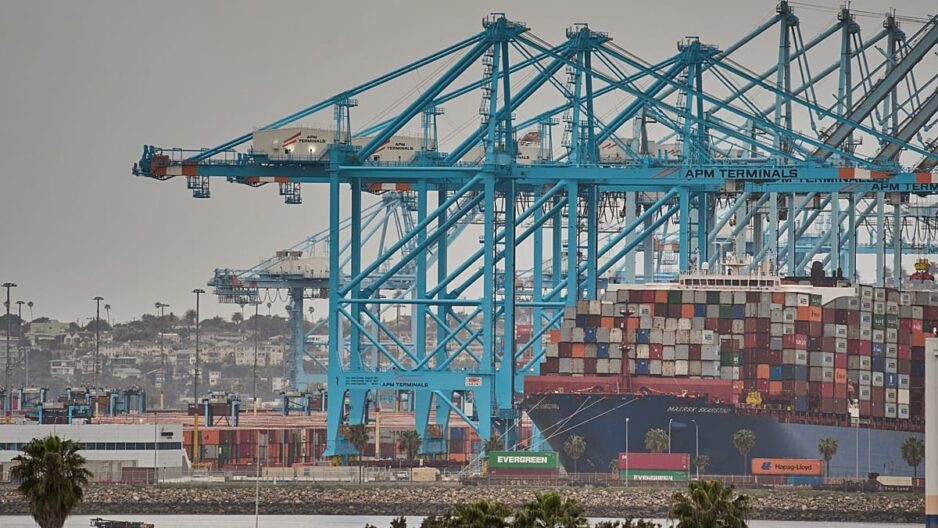
Maersk’'s profit plummets sharply as firm Hormuz maintains forecasts despite uncertainty

Shipping giant Maersk reported that despite strong demand for container transport, its earnings fell significantly in the first three months of the year.

Net profit from January to March fell to $100 million (€85 million), nearly 12 times lower than a year ago, when extraordinarily strong demand for maritime transport increased earnings.

It comes in %It fell 2.6 percent to just under $13 billion (11 billion euros), while earnings per share fell from $74 in the same quarter last year to $4.

The Copenhagen-based company notes that weak freight rates in the Ocean division are the main barrier to gains, but not in volumes across the enterprise. %He said the 9.3’ increase helped offset some of that decline.

Maersk said the conflict in the Middle East’ has only a limited direct impact on first-quarter results, but warned that this adds new uncertainty to the global outlook.

The conflict that began in “ on February 28, 2026, created an additional layer of uncertainty, ’ said in a statement.

He added that traffic in the Strait of Hormuz, ’, remained almost at a standstill, while weak sentiment puts pressure on consumer confidence.

Despite this, global demand for container transport is in the quarter %From 3 to %Five is up.

Chief executive Vincent Clerc said demand remained resilient in most regions.

“We saw strong demand in most regions this quarter, which supports strong volume growth across our three business segments, ” said.

But he warned that volatility in ocean transport continues to be high, and excessive transport capacity continues to put pressure on rates.

Maersk did not change its forecast for the whole year and said that global container demand will increase in 2026, in line with the overall market in ’. %From 2 to %He said he expected it to go up by four.

However, he warned that the sector continues to face surplus supplies from new ship deliveries, and that uncertainty persists as to when major shipping routes through the Red Sea and Strait of Hormuz will be fully reopened.

Maersk’in stock price Denmark’'s Nasdaq Copenhagen stock exchange at 10:30’ (CET) %It lost 4 percent of its value.

Industry under pressure

The wider maritime sector is also struggling with disruptions.

Hundreds of ships have been stranded in the Persian Gulf ’ for more than two months due to the Iranian conflict, which increases costs and disrupts the flow of trade. Delayed cargoes in the region include crude oil, refined products and fertilizer, while thousands of sailors remain on ships without being able to move freely.

According to U.S. military estimates, there are more than 1,550’ ships in the Persian Gulf, carrying around 22,500 sailors.

Insurance premiums for ships operating in the region also increased sharply due to the threat of attack, increasing pressure on operators already facing rising fuel costs.

German maritime group Hapag-Lloyd said the disruption around Hormuz cost it about $60 million (51 million euros) a week, largely due to rising fuel and insurance bills.

Analysts warn that even if the Bosphorus ’ reopens soon, markets are unlikely to return to normal quickly.

Kaho Yu, head of energy and resources at Verisk Maplecroft’, said refineries, shippers and commodity traders will remain cautious until there is clear evidence that a new threat of disruption has passed.

“Energy markets are unlikely to quickly return to pre-crisis assumptions, ” said.

Samsung employees protest and threaten strike by demanding share of profits amid artificial intelligence explosion

Thousands of Samsung Electronics employees protested at the chip complex in ’, South Korea on Thursday, demanding higher bonuses and threatening to strike as the company made record profits as artificial intelligence increased its demand for memory chips.

Workers with banners in their hands and waving banners gathered under heavy police presence at a factory compound in Pyeongtaek’ and shouted, "“, make compensation transparent and remove maximum limits on bonuses!"

Union representatives said the turnout was about 40,000, while police did not specify an official number.

The protest came on the day Samsung’'s main competitor, SK Hynix’, announced its best quarterly results so far: Record revenue and operating profit for the first three months of the year is owed to the company's growing global investment in data centers and AI infrastructure to drive demand for memory chips, he said.

Samsung Electronics labor union members chanted slogans during a rally demanding higher bonuses at the computer chip complex in Pyeongtaek, South Korea.

Samsung, which together with SK Hynix produces about two-thirds of global memory chips, estimated its first-quarter operating profit earlier this month to reach a record 57.2 trillion won (€33 billion).

The Samsung syndicate, which represents about 74,000 workers, says the company has failed to provide adequate compensation despite its strong performance. He rejected the administration's proposal for bonuses for limited stocks and called for the lifting of ceilings on bonuses.

If negotiations with management failed, the union threatened an 18-day strike from May 21, ’, estimating that it would cost the company more than 1 trillion won (578 million euros) per day.

Union leader Choi Seung-ho said via a loudspeaker at the top of a crane-mounted structure, “We will not stop this struggle until our fair demands are met.

South Korea’'s semiconductor manufacturers benefited from the artificial intelligence explosion, but the war in the Middle East’ overshadowed the outlook for the future by disrupting the supply of essential materials such as helium, which is vital for chip making, and raising energy costs.

But in a conference call on Thursday, Woo Hyun Kim, chief financial officer at SK Hynix’, said the company was closely monitoring the dispute but did not expect any meaningful impact on production.

Demand drops will bring oil prices down

Brent oil, which was last recorded as $80.4 on Thursday last week, has not reached the same level for the last six sessions in line with weak economic data from the world's largest oil importer China and the largest oil consumer USA.

According to data released last week in China, new home prices continued their 14-month decline series, while in July the year-on-year decline was 4.9 percent.

In addition, the country's industrial production increased by 5.1 percent year-on-year, falling below projected levels, while the unemployment rate remained above expectations at 5.2 percent.

In addition, weak labor data from the U.S. reinforced forecasts of low demand from China, supporting concerns about economic growth.

The U.S. Department of Labor revised non-agricultural employment data for the 12-month period up to March 2024. According to the revision, employment in the U.S. increased by 818,000 less than previously announced during the period in question.

The number of people who applied for unemployment benefits for the first time in the country increased to 232 thousand in the week ending August 17, while the number of ongoing unemployment benefits applications increased by 4 thousand people in the week ending August 10 to 1 million 863 thousand.

DATA FEEDS REQUEST WORRIED

The data supported concerns about countries' economic growth and suppressed prices, fueling market players' demand concerns.

On the other hand, the possibility of a ceasefire in the Middle East, where most of the global oil reserves are located, eased the supply concerns in the markets.

In line with all these developments, Brent oil, which rose to $81.92 last week, could not hold at these levels and closed the week at $79.1.

The price of Brent oil, which fell to $75.7 on Wednesday, lost 1.3 percent on the same day.

After Fed Chairman Powell said in his speech at the Jackson Hole Economic Policy Symposium that it was time to adjust monetary policy, prices rose 2.1 percent to $78.3 a week, although they tended to recover below $80.

China's lower-than-expected oil demand is an important focus for the market
Julien Mathonniere, Petroleum Markets Economist at U.S.-based energy information company Energy Intelligence Group, told the AA correspondent that there was more than one reason for the fall in oil prices.

Mathonniere stated that the weak demand forecast from Çin ⁇ is the most important factor among these reasons, adding that ⁇ China ⁇ 's below-expected oil demand is an important focus for the market, especially considering that the Organization of Petroleum Exporting Countries (OPEC) has revised down the 2024 global demand growth forecast in line with the weak demand forecasts in the country. ⁇ said.

On the other hand, Mathonniere pointed out that the reduction of gasoline and diesel production by refineries operating in China in July compared to the same period last year also had an impact on prices.

⁇ The fact that this decrease in production took place in China, the world's largest oil importer, in July, which is expected to increase the demand for these products worldwide, caused the prices to fluctuate by reinforcing the expectations that the demand for transportation fuels in the country will increase from now on. ⁇

NO INCREASE OF REQUEST EXPECTED IN CHINA

Contrary to forecasts, there was no significant increase in demand in China this year, Mathonniere said, adding that the country's oil demand fell by 284,000 barrels per day year-on-year in the second quarter, reflecting weak industrial activity in China and the unstable private sector. While Brent oil is currently trading in October barrels, the likelihood that the country will meet expectations is becoming increasingly questionable.

Mathonniere pointed out that another reason for the decline was concerns about the difference between the calculated amount and the actual amount in oil storage facilities, transportation or sales transactions, ⁇ Missing barrels returned this year. Market players suggest that supply is under-measured or demand is overcounted. This disturbs the market players and the market reacts to this disturbance at low prices.

Mathonniere stressed that the impact of the resurgent ceasefire negotiations in the Middle East on oil prices was limited, adding that prospects for reconciliation in the region were insufficient to reduce the risk premium on prices.

Emphasizing that the risk premium on prices has long since melted, Mathonniere said that while the Middle East will continue to affect prices in the background, it is no longer the main focus for market players.

PRICES MUST RISE WITHOUT INCREASE OF REQUEST IN CHINA

Mathonniere pointed out that unless there is an increase in China's oil demand in the future, it is unlikely that prices will rise.

It is difficult to predict how much further prices will fall, but there is an interesting theory that the market may try to force OPEC to take action by bringing prices down. This could cause the group to stop reversing cuts in the fourth quarter. While it's a bit far-fetched to assume that the market can make such a concerted effort to bring prices down, the fall in prices will certainly cause the group to reconsider reversing cuts as the year draws to a close.

The market focused on the decision to come out of the US Central Bank to find direction
Independent oil market analyst Gaurav Sharma also stated that oil prices could rise if the US Central Bank cut interest rates in September, and I think the market is focused on the decisions of the US Central Bank to find direction. If a rate cut is announced in September, it may be possible for prices to show a positive reaction in crude oil futures, but the weakness in the market is likely to continue until this date.

Stating that uncertainties regarding oil demand in China put pressure on crude oil prices, Sharma said, "In recent days, we have observed that industrial production in China has slowed, unemployment has increased and housing prices have fallen. In particular, many market forecasters, such as the International Energy Agency (IEA) and OPEC, predict that Chinese demand will be lower in 2024 and 2025.

Sharma pointed out that the impact of geopolitical developments in the Middle East on the oil market is limited, while geopolitical developments in the Middle East are important, but the impact of geopolitical factors on crude oil prices is limited when oil demand remains weak. This is currently the case, especially due to the increased supply of non-OPEC crude oil.

​​​​​​​

From the source: AA

Call for earnings: Hapag-Lloyd sails to H1 2024 with strong financials

Hapag-Lloyd, one of the leading global shipping companies, reported strong financial performance with EBITDA of approximately $0.9 billion despite the setbacks it faced in the first half of 2024. Faced with strong demand in May and June, the company took several measures to meet customer needs, including speeding up ships, adjusting its network, and ordering additional containers.

Hapag-Lloyd is preparing for the new Gemini network, which is expected to begin bookings in December. CEO Rolf Habben Jansen, addressing the effects of the explosion at Ningbo Port, stated that this will not greatly affect the operations. The company has a strong balance sheet with $20 billion in equity and $7 billion in liquidity reserves, and expects moderate transport volume growth, slightly lower freight rates, and higher EBITDA than previously expected.

Significant inferences

  • Hapag-Lloyd generated approximately $0.9 billion in EBITDA in the first half of 2024.
  • Unexpected strong demand was met by accelerated ship operations and network adjustments.
  • The company is moving forward with the Gemini network, which will start selling and bookings later in the year.
  • The balance sheet maintains its robustness with significant equity and liquidity reserves.
  • The CEO predicts moderate growth in shipping volumes and a higher EBITDA.
  • Concerns about potential port disruptions on the East Coast of the U.S. and the effects of the Ningbo explosion were addressed.

Appearance of Company

  • Hapag-Lloyd reiterated the appearance of moderate transport volume growth.
  • Freight rates are expected to be slightly lower.
  • EBITDA is expected to be higher than previously predicted.
  • The company continues to focus on network reliability and implementing its 2030 strategy.
  • Switching to the Gemini network is an important focus for the rest of the year.

Highlights from the Bear's Point of View

  • The market faces uncertainties, including possible disruptions to US East Coast ports.
  • There is a possibility of softening demand in the fourth quarter.
  • Although an explosion at Ningbo Port has raised concerns, its impact on operations is expected to be minimal.

Highlights on Ascension

  • In May and June, a strong demand was observed with the effect of stock smelting, preloading and consumption.
  • The global order book is declining but is expected to increase due to aging fleets and new environmental regulations.
  • The company's terminal business is growing and investments in fleet and new service offerings continue.

The shortcomings are

  • No specific financial issues were addressed during the interview.

Highlights in Questions and Answers

  • The CEO mentioned the increase in rental liabilities due to the need for more capacity and higher rental prices.
  • A significant portion of the order book is likely to be renewed to comply with environmental regulations and scrap old ships.
  • The CEO acknowledged growing concerns about potential strikes at US East Coast ports and proactive measures taken by customers.

In summary, Hapag-Lloyd (ticker not provided) spent the first half of 2024 with strong financial results and a proactive approach to market demands and disruptions. The company continues to focus on its strategic goals and is preparing for the upcoming launch of the Gemini network. Despite facing potential challenges such as port disruptions and market uncertainties, Hapag-Lloyd ⁇ 's leadership expresses confidence in the direction of the company and its financial health.

This article was created, translated and reviewed by an editor with the support of artificial intelligence. See our Terms and Conditions for more information.