Turkish Exporters Assembly (TIM) According to the data, Turkey's exports In the month of September22 billion 7 million dollars As it happened. While this figure reveals Turkey's export potential, it also reflects the effects of global economic conditions.
Success of the Chemical Sector
The chemical industry, In the month of September$2.2 billion exporting and exporting the most the Second Sector He retained his position. This success proves once again the strong position of the sector in the international market.
Evaluation of İKMİB President ⁇
Istanbul Chemicals and Chemical Products Exporters' Association (İKMİB) Chairman of the Board of Directors the Fair Pelister, in his evaluation, he stated that many factors such as the decline in global demand, wars in the near geography, inflation, exchange rate balance and increase in input costs were reflected in the export figures in September. Pelister, ⁇As the second most exporting sector of Turkey, we continue to make the most contribution to the country's economy.He used his expressions.
The First Nine Months of the Year and the Future of the Industry
In the data for the January-September period, the chemical sector's exports compared to the same period last year 4.2 percent of It was seen growing. Pelister, ⁇ Our exports for January-September period $23.1 billion It has arrived. Our exporters need more support in terms of access to finance during this challenging period. We expect the support and incentives of our economic management in this direction. Despite all the difficult conditions, we will continue to work to increase our exports. ⁇ said.
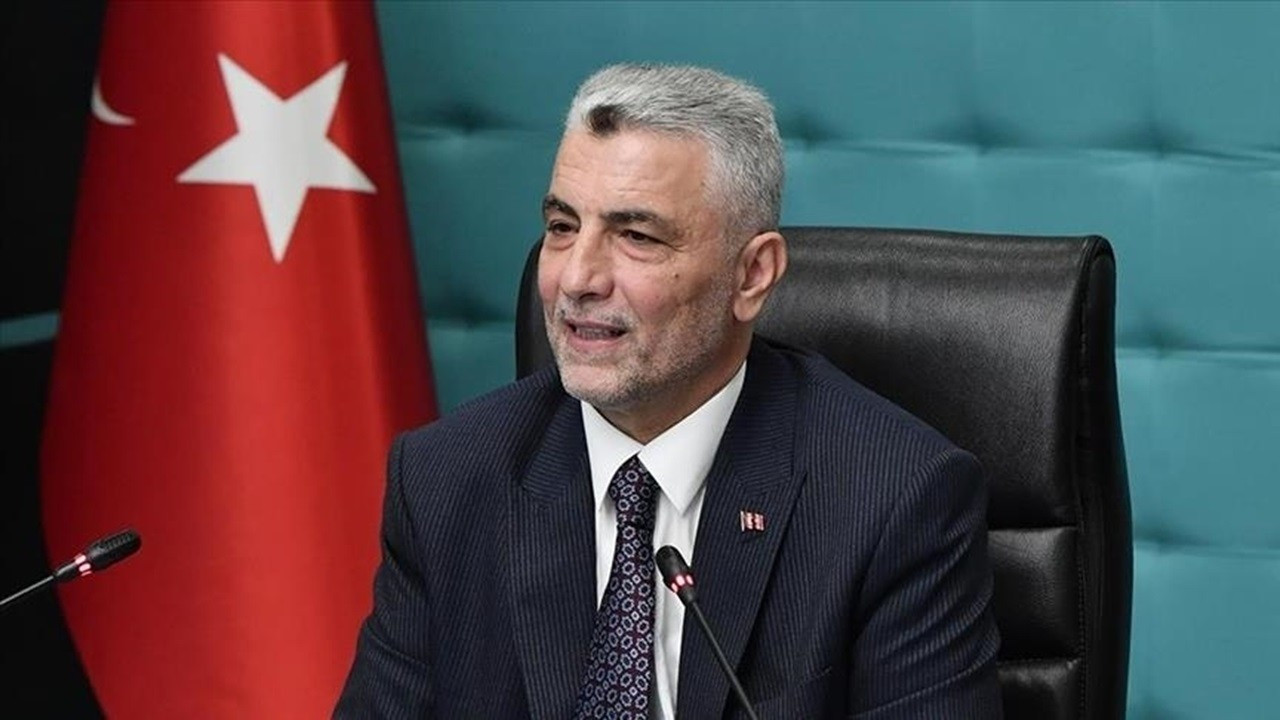
Minister of Trade Ömer Bolat, He visited Laleli Industrialist Business People Association (LASİAD) and met with representatives of the textile sector. During the meeting, he made important statements about the export figures in the textile sector, the access of the sector to finance and access to foreign markets.
Value Added Production and Employment Minister Bolat, drawing attention to the importance of the textile sector for the Turkish economy, ⁇ Despite the contraction in global markets last year, our textile exports reached 33 billion dollars. The textile sector makes a great contribution to the economy with the employment and value-added production it creates in the sub-sectors. This broad sector will always continue to be very valuable to us, ⁇ said.
Access to Financing and Supports
Financial Supports and Measures Minister Bolat stated that they have taken various measures to overcome the challenges faced by the sector. ⁇ We provided serious support to our sector and prevented the decline in exports. We will take the necessary steps to make the textile and apparel sector better. We also continue to support access to financing. ⁇ He used his expressions.
International and Domestic Fair Participations As the Ministry, they continue to provide support especially in foreign fair participations, promotion at fairs held in Turkey, e-export and branding.
Compliance with the Rules and Measures in Imports
It will not be tolerated Minister Bolat stated that they will take measures within the framework of international rules regarding increasing imports, ⁇We do not have the slightest tolerance against those who try to seize the Turkish market with illegal import methods. We stand by our textile exporters. We will also apply international rules against the problems experienced in imports. Turkey will rise to higher ranks in textiles and apparel. Our country is a quarterback in the sector. Our next goal is to carry our successes even higher, ⁇ said.
The Global Survey carried out by Allianz Trade ⁇ every year was renewed and published with up-to-date data as a result of the evaluation of the surveys by expert economists.
In the assessment in the report; In the global survey in 2023, it was stated that 70 percent of companies expect an increase in their turnover through exports, but 2023 ended with a recession in trade due to slowing demand more than expected.
Deja vu of optimism: Are companies underestimating the risks on the horizon again?
In the current survey, it is stated that the companies are drawing an extremely optimistic picture again with the expectation that the recession will end in 2024. In the latest update of the survey, 82% of companies, especially from consumer-related sectors such as retail, home appliances and computer & telecom, said they expect an increase in their turnover through exports in 2024. In fact, about 40 percent of companies expect this increase to be as serious as 5 percent in 2024.
Françoise Huang, Senior Economist at Allianz Trade APAC and Global Trade, said that after more than a year of stagnation, exporters expect a recovery in the second half of 2024, but they have more conservative forecasts. ⁇ Globally, 8 out of 10 companies expect export prices to increase in 2024 and this will support their export turnover. Our predictions are more conservative: After the contraction of 2.9 percent in global trade in 2023, we expect a nominal increase of 2.8 percent in 2024. This rate, which is significantly below the long-term average of 5 percent increase, is a reflection of the disruptions in global maritime transport such as the Red Sea crisis, as well as the increased protectionism risks. ⁇
The risk of not receiving payment is still the most important issue for exporters
While exporters are optimistic, they are also aware of the risks posed by developing their business internationally. Globally, companies are most concerned about; focus on geopolitical risks, input/labor shortages and financing. However, the risk of not getting paid remains at the top of the list.
Aylin Somersan Coqui, CEO of Allianz Trade, said: "We found that around 70 percent of companies globally are paid between 30 and 70 days, slightly more than other countries in the UK, France and the United States. Due to low growth, trade disruptions and geopolitical uncertainties, 42% of companies expect longer export payment terms in the next six to twelve months. Longer payment terms mean more pressure on cash flow, and it could get worse. In addition, 40 percent of respondents expect an increased risk of not receiving payments by 2024. These expectations also coincide with our forecast that global commercial insolvencies will increase by 10 percent this year.
In Turkey, although export data are not at pre-pandemic levels, they are relatively promising compared to the global level.
Allianz Trade Credit Intelligence Deputy General Manager and Executive Board Member Altuğ Karagöz said that despite all the difficult conditions in Turkey continued to grow in exports. ⁇ 2024 ⁇ te Turkey ⁇ te achieved a 3.9 percent increase in exports despite global risks, geopolitical developments and contraction of demand in the export market. When we look at Allianz Trade, this increase stands out as a positive development despite the political risks. The increase in the ratio of exports excluding gold and energy to meet imports shows the positive effect of Turkey's return to orthodox policies on the foreign trade balance.
According to the August results of the Turkish Exporters Assembly (TIM) Export Market Monitor (IPC), the Export Demand Index was 99.9 points and the Market Endurance Index was 99.5 points.
In the statement made by TİM ⁇ , the August results of the Export Market Monitor, where the conditions that create demand in important markets and the demands and risks in the global economy are monitored, were shared.
Accordingly, in August there was an increase in the Export Demand Index compared to the previous month and the same period last year, and a decrease in the Market Endurance Index compared to the previous month and the same period last year.
The Export Demand Index, which follows the demand conditions for exported products through the export markets, using basic macroeconomic indicators and leading macroeconomic indicators, increased by 0.4 percent on a monthly basis in August and became 99.9 percent compared to the same month of last year. Under the He watched it.
Despite the decline in industrial production in August, improvements in job and consumer confidence, the limited increase in unemployment rates, brought the demand index closer to the long-term average.
Uncertainties in global economic conditions and high interest rates continue to weigh on the improvement in the index, while negatively impacting consumer spending and investment appetite.
Market Endurance Index was 99.5
The Market Resilience Index, which measures the resilience of export markets against risks by taking advantage of long and short-term social, economic and political indicators, decreased by 0.3 percent on a monthly basis in August and became 99.5 percent compared to the same month of last year.
Despite the partial improvement in the export demand index, the decline in the global geopolitical risk index negatively affected the resilience across the export markets and pushed the index away from the long-term average.
Within the framework of our export-based economic policies, the Ministry of Trade resolutely continues our efforts to continue the export increase to all over the world.
EXPORT DEVELOPMENTS ACCORDING TO GEOGRAPHIC COUNTRY GROUPS
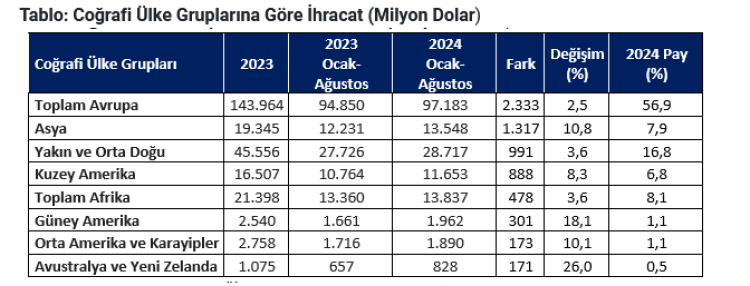
In geographical country groups, in the January-August period of 2024, compared to the same period of the previous year; Our exports to European countries increased by 2.5 percent ($2.3 billion increase) to $97.2 billion, our exports to Asian countries increased by 10.8 percent ($1.3 billion increase) to $13.5 billion, our exports to Near and Middle Eastern countries increased by 3.6 percent ($991 million increase) to $27.7 billion, our exports to North American countries increased by 8.3 percent ($888 million increase) to $11.7 billion, and our exports to South American countries increased by 18.1 percent ($301 million increase) to $2.0 billion.
In the same period, our exports to Central America and the Caribbean increased by 10.1 percent (increase of 173 million dollars) to $1.9 billion, our exports to African countries increased by 3.6 percent (increase of 478 million dollars) to $13.8 billion, and our exports to Australia and New Zealand increased by 26.0 percent (increase of 171 million dollars) to $0.8 billion.
The Ministry of Trade underlined that they will continue to implement practices for the needs of exporters in order to increase the awareness of the Turkish brand, to reach new markets with market diversification and to strengthen our position in existing markets.
In the written statement made by the Ministry, ⁇ We will continue to work intensively to benefit from bilateral and multilateral dialogue and consultation mechanisms in order to increase our exports to different markets, including neighboring and neighboring countries and distant countries, especially to friendly and close countries within the scope of our Medium Term Program targets ⁇
Ministry of Commerce, exports the Increasing Tendency Indicating that it continues Groups of countries According to the export figures and the previous year He explained the comparisons.
In the January-August period of 2024, exports increased compared to the same period of the previous year as follows:
the European Union Export to their countries
2.5% increase
of 97.2 billion reached the dollar
History of Asia Export to their countries
10.8 percent increase
13.5 billion dollars reached the dollar
Near and Middle East Export to their countries
Increased by 3.6%
$27.7 billion reached the dollar
North America (USA) Export to their countries
Increased by 8.3%
$11.7 billion reached the dollar
South America (United States) to their countries
Increased by 18.1%
and 2.0 billion reached the dollar
Central America and the Caribbean
Increased by 10.1%
$1.9 billion reached the dollar
History of Africa to their countries
Increased by 3.6%
$13.8 billion reached the dollar
Australia and New Zealand
26.0% increase
0.8 billion dollars reached the dollar
Ministry of Commerce's statement on exports ⁇ Turkey (disambiguation) the Brand 's to increase awareness of exporters, to reach new markets with market diversification, to strengthen our position in existing markets. to your needs We will continue to implement applications ⁇ It was called.
The Central Bank of the Republic of Turkey (CBRT) announced the data on its current account in July. According to the data released in July, the current account account gave more than 566 million US dollars.
Trade Minister Ömer Bolat said the following in his evaluation on X:
In July 2024, the 12-month current account deficit fell below $20 billion for the first time since April 2022.
The increase in exports and the decrease in imports also support a balanced growth structure.
The major improvement in the current account continues to provide a positive picture of the future of our economy, consolidating macroeconomic stability.
⁇ In July 2024, a surplus of 566 million dollars was given in the current account. Thus, an improvement of $5.9 billion was recorded from the current account compared to the same month of the previous year. Thus, it has been given more than 2 months in a row and will continue to be given more strongly in August.
⁇ Current account deficit in the January-July period of 2024 compared to the same period of the previous year %It was recorded as $16.0 billion, down 61.8 percent.
⁇ Thus, the peak annualized current account deficit, which was $57.0 billion in May 2023, decreased by $37.9 billion in the following months to $19.1 billion as of July 2024. Thus, the annualized current account deficit fell below the $20 billion level for the first time since April 2022.
In the same period, the annualized foreign trade deficit decreased by 39.8 billion dollars. Thus, the annualized current account deficit compared to May 2023, with the effect of the policies implemented in foreign trade, %It dropped to 66.5.
⁇ Our annualized exports in July 2024, on an annual basis %With an increase of 3.4 ⁇ , it increased to 261.5 billion dollars. Annualized imports in the same month %With a decrease of 8.0 ⁇ , it decreased to 343.9 billion dollars. Annualized foreign trade deficit creased by 32.0 percent and became 82.4 billion, while the import satisfaction rate of exports increased by 8.4 percentage points %It was 76.0.
⁇ The decline in the foreign trade deficit is accompanied by an increase in our service exports. Service revenues renewed their record in July at $106.8 billion on an annualized basis. Travel revenues under the services increased to $52.4 billion. Supports to increase exports of goods and services and the implementation results of measures to reduce imports have recorded a significant decline in the current account deficit.
· Exports according to the temporary foreign trade statistics announced by our Ministry in August %2.4% increase, while imports creased by 10.8 percent. Thus, in the foreign trade deficit %There was a strong decline of 43.4 percent. In this context, the annualized current account deficit in August is expected to fall below $16 billion.
⁇ Positive developments in the foreign trade balance make economic growth more balanced, while the improvement in the current account strengthens macroeconomic stability. As a matter of fact, in the second quarter of 2024, current account deficit %While a decrease of 52 percent was observed, %Half of the economic growth of 2.5 percent was due to net exports of goods and services. It is expected that the trend of increase in exports and decrease in imports will continue throughout 2024, and foreign trade is expected to make positive contributions to the current account balance and economic growth. As the Ministry of Trade, we will continue to work resolutely in close cooperation with our producers and exporters with the aim of increasing our share in global exports of goods and services. ⁇
The Dutch government has expanded restrictions on the export of equipment used in chip production.
The government said in a statement that national export control measures for advanced semiconductor production equipment, which have been in force since September 1, 2023, have been expanded.
According to the statement, additional restrictions published in today's official newspaper will come into force from tomorrow and from that date, exports of more types of chip production equipment will be allowed.
According to this, companies that will send chip machines outside the European Union (EU) should obtain an export license from the government in advance.
NATIONAL SECURITY SIGNATURE
In the statement, it was emphasized that chip production machines play an important role in the production of advanced military technologies, and the uncontrolled export of these equipment affects the security interests of the Netherlands.
Reinette Klever, Minister of Foreign Trade and Development Cooperation, pointed out that the new chip machines are used in the production of advanced military vehicles, and because of our national security, these machines can only be exported by license. This is how the Council of Ministers controls who gets their hands on these machines. Even old machines can now produce sophisticated chips. That's why the government is expanding the list. From now on, export licenses will be required for old chip machines. ⁇
The ASML is: NO SERIOUS CHANGES
Dutch-based ASML, one of the world's leading companies in chip production equipment manufacturing, said in a statement on the government's restriction policy that this will not cause a serious change in the company's financial situation and long-term policies.
CHINA AND RUSSIA WILL AFFECT EXPORTS TO BE MADE
In the news of public broadcaster NOS ⁇ un, it was stated that Europe and the USA were afraid of establishing economic and military superiority as the advanced chips of manufacturers such as ASML fell into the hands of Çin ⁇ .
The report emphasized that Chinese companies importing chip machines from the Netherlands are both ahead of their European competitors and gaining superiority with supercomputers and artificial intelligence-powered weapons.
According to the research of the Trouw newspaper, it was stated that Russia produced the microchips used in the production of weapons with the old machines of the Dutch chip machine manufacturer ASML ⁇ .
According to the report, Russian arms companies provide the necessary spare parts for these machines mostly through intermediaries in China.
In the Dutch press, it was claimed that microchip machines sent from companies in the country went to Russia collectively through the penetration of sanctions.
Istanbul Chamber of Industry (ICI) Turkish Manufacturing Export Climate Index was realized above the threshold value of 50.0 in August. The index, which was 50.8 in July, was 51.3 in August. In August, economic activity increased in the majority of the main export markets of Turkish manufacturers. While U.S. production continued to increase markedly, Germany remained in the contraction zone.
The U.S. remains one of the main sources of improvement in demand. Production in France and Italy, which constitute a total of 9 percent of the Turkish manufacturing industry export market, has started to grow again. While the weak outlook in Central and Eastern Europe continued as of the middle of the third quarter, generally supportive demand conditions continued for a significant part of the Middle East. In August, the strongest production increase in all countries and regions followed by the PMI survey was recorded in India.
Production in the USA increased strongly in August
In August, economic activity increased in the majority of the main export markets of Turkish manufacturers. In Germany, which is the largest market, there was a contraction for the third month in a row, contrary to the general trend. This contraction was significant and at the highest rate since March. The U.S. remains one of the main sources of improvement in demand. While production increased strongly in August, it also gained momentum compared to July. In the UK, the pace of economic activity growth has strengthened to its highest level in four months. Production in France and Italy, which constitute a total of 9 percent of the Turkish manufacturing industry export market, has started to grow again. Especially in France, production increased for the first time in the last 15 months and this increase was realized at the highest speed since March 2023. In Spain, another major economy in the Eurozone, economic activity maintained a strong upward trend.
Strongest production growth recorded in India
In Central and Eastern Europe, the weak outlook continued as of the middle of the third quarter. Manufacturing industrial production contracted in Romania, Poland, the Czech Republic and Austria. In the same period, Russia recorded a moderate increase in economic activity for the second month in a row. For a significant part of the Middle East, conditions for generally supportive claims continued. Non-oil economic activity in the United Arab Emirates and Saudi Arabia also increased rapidly in August. While Qatar continues to grow, Egypt has recovered for the first time in three years. In Lebanon, on the other hand, production continued to contract. In August, India recorded the strongest production increase in all countries and regions followed by the PMI survey. At the other end was Myanmar, which recorded the fastest decline in production in the last 20 months.
Commenting on the Istanbul Chamber of Industry Turkey Export Climate Index, Andrew Harker, Economy Director of S&A P Global Market Intelligence, said: ⁇ August was generally positive for the important export markets of Turkish manufacturers. As the most important exception to this trend, Germany's continuation in the contraction zone also played a role in the weakness in Central and Eastern Europe. Exporters will expect a strong growth trend in major export markets such as the U.S. and the U.K., as well as a positive resumption in France and Italy.
China's exports increased by 8.7 percent year-on-year in August, according to data from China's Customs Administration. Economists expected an increase of 6.6 percent.
In imports, your expectations are very high. Under the increased by 0.5 percent. Expectations were for imports to be 2.5 percent.
Looking at the first 8 months of the year, exports increased by 4.6 percent, while imports increased by 2.5 percent.
China's main trading partners; Exports to the United States, the European Union and the Association of Southeast Asian Countries increased in August compared to a year ago. Exports to AB ⁇ increased by 13 percent and became the highest growing exports. The data showed that China's imports from ABD ⁇ increased by 12 percent in August compared to a year ago, while imports from AB ⁇ den decreased.
Finally, the data showed that China's imports from Russia decreased by 1 percent, while its exports increased by 10 percent.