Brent oil, which was last recorded as $80.4 on Thursday last week, has not reached the same level for the last six sessions in line with weak economic data from the world's largest oil importer China and the largest oil consumer USA.
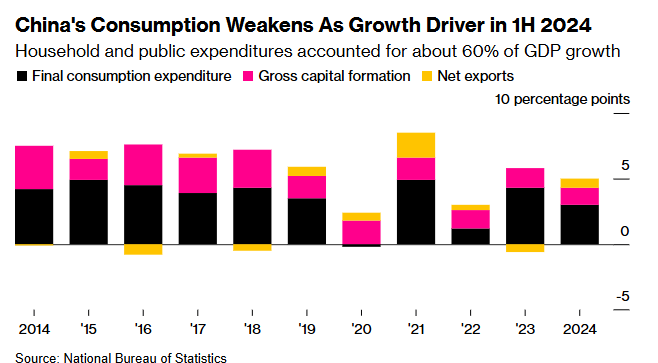
According to data released last week in China, new home prices continued their 14-month decline series, while in July the year-on-year decline was 4.9 percent.
In addition, the country's industrial production increased by 5.1 percent year-on-year, falling below projected levels, while the unemployment rate remained above expectations at 5.2 percent.
In addition, weak labor data from the U.S. reinforced forecasts of low demand from China, supporting concerns about economic growth.
The U.S. Department of Labor revised non-agricultural employment data for the 12-month period up to March 2024. According to the revision, employment in the U.S. increased by 818,000 less than previously announced during the period in question.
The number of people who applied for unemployment benefits for the first time in the country increased to 232 thousand in the week ending August 17, while the number of ongoing unemployment benefits applications increased by 4 thousand people in the week ending August 10 to 1 million 863 thousand.
DATA FEEDS REQUEST WORRIED
The data supported concerns about countries' economic growth and suppressed prices, fueling market players' demand concerns.
On the other hand, the possibility of a ceasefire in the Middle East, where most of the global oil reserves are located, eased the supply concerns in the markets.
In line with all these developments, Brent oil, which rose to $81.92 last week, could not hold at these levels and closed the week at $79.1.
The price of Brent oil, which fell to $75.7 on Wednesday, lost 1.3 percent on the same day.
After Fed Chairman Powell said in his speech at the Jackson Hole Economic Policy Symposium that it was time to adjust monetary policy, prices rose 2.1 percent to $78.3 a week, although they tended to recover below $80.
China's lower-than-expected oil demand is an important focus for the market
Julien Mathonniere, Petroleum Markets Economist at U.S.-based energy information company Energy Intelligence Group, told the AA correspondent that there was more than one reason for the fall in oil prices.
Mathonniere stated that the weak demand forecast from Çin ⁇ is the most important factor among these reasons, adding that ⁇ China ⁇ 's below-expected oil demand is an important focus for the market, especially considering that the Organization of Petroleum Exporting Countries (OPEC) has revised down the 2024 global demand growth forecast in line with the weak demand forecasts in the country. ⁇ said.
On the other hand, Mathonniere pointed out that the reduction of gasoline and diesel production by refineries operating in China in July compared to the same period last year also had an impact on prices.
⁇ The fact that this decrease in production took place in China, the world's largest oil importer, in July, which is expected to increase the demand for these products worldwide, caused the prices to fluctuate by reinforcing the expectations that the demand for transportation fuels in the country will increase from now on. ⁇
NO INCREASE OF REQUEST EXPECTED IN CHINA
Contrary to forecasts, there was no significant increase in demand in China this year, Mathonniere said, adding that the country's oil demand fell by 284,000 barrels per day year-on-year in the second quarter, reflecting weak industrial activity in China and the unstable private sector. While Brent oil is currently trading in October barrels, the likelihood that the country will meet expectations is becoming increasingly questionable.
Mathonniere pointed out that another reason for the decline was concerns about the difference between the calculated amount and the actual amount in oil storage facilities, transportation or sales transactions, ⁇ Missing barrels returned this year. Market players suggest that supply is under-measured or demand is overcounted. This disturbs the market players and the market reacts to this disturbance at low prices.
Mathonniere stressed that the impact of the resurgent ceasefire negotiations in the Middle East on oil prices was limited, adding that prospects for reconciliation in the region were insufficient to reduce the risk premium on prices.
Emphasizing that the risk premium on prices has long since melted, Mathonniere said that while the Middle East will continue to affect prices in the background, it is no longer the main focus for market players.
PRICES MUST RISE WITHOUT INCREASE OF REQUEST IN CHINA
Mathonniere pointed out that unless there is an increase in China's oil demand in the future, it is unlikely that prices will rise.
It is difficult to predict how much further prices will fall, but there is an interesting theory that the market may try to force OPEC to take action by bringing prices down. This could cause the group to stop reversing cuts in the fourth quarter. While it's a bit far-fetched to assume that the market can make such a concerted effort to bring prices down, the fall in prices will certainly cause the group to reconsider reversing cuts as the year draws to a close.
The market focused on the decision to come out of the US Central Bank to find direction
Independent oil market analyst Gaurav Sharma also stated that oil prices could rise if the US Central Bank cut interest rates in September, and I think the market is focused on the decisions of the US Central Bank to find direction. If a rate cut is announced in September, it may be possible for prices to show a positive reaction in crude oil futures, but the weakness in the market is likely to continue until this date.
Stating that uncertainties regarding oil demand in China put pressure on crude oil prices, Sharma said, "In recent days, we have observed that industrial production in China has slowed, unemployment has increased and housing prices have fallen. In particular, many market forecasters, such as the International Energy Agency (IEA) and OPEC, predict that Chinese demand will be lower in 2024 and 2025.
Sharma pointed out that the impact of geopolitical developments in the Middle East on the oil market is limited, while geopolitical developments in the Middle East are important, but the impact of geopolitical factors on crude oil prices is limited when oil demand remains weak. This is currently the case, especially due to the increased supply of non-OPEC crude oil.
From the source: AA