Following the collapse of the European ’'s Future Combat Air System (FCAS) program, a new German-led fighter jet initiative is taking shape.
A consortium of eight Airbus-led companies, dubbed ’Team Gen 6‘, will be operational in Berlin’ on Thursday, aviation giant AFP’ye said.
The alliance aims to develop a new generation of fighter jets, and more details are expected to be revealed at the signing ceremony to be held during the ILA air show in the German capital of ’.
The initiative comes after months of tension between Airbus and French manufacturer Dassault, with Berlin and Paris’ abandoning the FCAS project on Monday.
Airbus said the companies had submitted a position document summarizing the visions of German Defence Minister Boris Pistorius’a sixth-generation fighter jets.
The consortium is urging the German government to ensure that contracts are made in “tam and on time by the second half of 2026, the news agency reported, citing access to the newspaper.
A source involved in the project said the agreement could be signed privately by participating companies as early as Wednesday.
Germany will largely lead the “Team Gen 6” project.
In addition to Airbus’, the alliance includes European missile manufacturer MBDA and six German companies: Hensoldt, Diehl Defence, MTU Aero Engines, Liebherr, Autoflug and Rohde & Schwarz.
German Defence Minister Boris Pistorius told reporters on Tuesday that the project was “ak-prone and a possibility”, but Berlin’in said it was considering alternatives, including buying additional US-made F-35 fighter jets or participating in other aircraft development programs.
Pistorius said “ talks with various ” stakeholders on the issue had been going on for months.
Problems within FCAS culminated in the summer of 2025 when Dassault’ pushed for more control of the program, angering politicians and Airbus executives at Berlin’.
Launched in 2017 and joined by Spain’ in 2019, FCAS was seen as the flagship project of European defence cooperation. Its collapse is seen as a failure to strengthen European ’'s military capabilities in the face of growing security threats from Russia’.
“Artificial intelligence will be our government's managing partner to support decisions, improve services, improve the efficiency of operations, and even evaluate results and deliver real-time improvements.”
These were the words of His Highness Sheikh Mohammed bin Rashid Al Maktoum’, Vice President and Prime Minister of the UAE and Ruler of Dubai, announcing one of the most ambitious AI transformation programs of any government in the world. While most countries are still discussing how artificial intelligence should be used in public life, the UAE is already transforming systems.
In April, the Gulf nation announced that within two years, public sectors, services and operations would be ’sini has announced a framework that will transform the agent through artificial intelligence. Days later, His Highness Sheikh Hamdan bin Mohammed bin Rashid Al Maktoum, Crown Prince, Deputy Prime Minister and Minister of Defence of the UAE, went even further and led the Dubai Chamber of Commerce to launch an equally comprehensive transformation centered on technology in the private sector.
The goal is not to use AI’ as a tool for people to ask questions, like a chatbot. Building a country where artificial intelligence works with each person as part of the daily routine, both in businesses and in public services.
Agentic AI refers to systems that go beyond just creating text and images or answering queries like ChatGPT, Claude, or Gemini. These are AI models that can independently plan, make decisions, and proactively complete tasks. Consider renewing your passport before it expires, processing and paying contracts without asking or interfering in advance with customer complaints, and resolving customer complaints before they arise. And it's all without a human in the loop. The difference between a chatbot and a mediated artificial intelligence is roughly the difference between a calculator and an accountant.
Dubai’'s private sector initiative includes specific training pathways for Business Groups and Councils operating within the Dubai Chamber of Commerce to be implemented over the next two years. The chamber will also set up special incubation centers for agent AI companies, create opportunities for young people to enter the space, and raise funds to support the transition. The goal, in the words of Sheikh Hamdan’, is for Dubai’ to become “, the world's leading city in adopting these technologies economically and commercially.
There are two reasons to consider for founders and business owners outside the UAE. The first is competitive. According to Precedence Research’, the global market for agency AI is expected to grow from $5.25 billion at 2024’te to $199 billion by 2034’. McKinsey’in 2025The State of Artificial Intelligence study, published in late ’, found that 23 percent of respondents were already scaling intermediary AI systems, while 39 percent were conducting experiments; That means almost two-thirds of them are somewhere on this journey. Companies that take the earliest action tend to gain leads that are hard to catch. Dubai is trying to move the entire city's private sector at once.
The second reason has to do with where it happened. BAE’'s move, almost by design, creates a market where the agency will seek investment from outside its artificial intelligence products, partnerships and borders. Businesses that can offer solutions in the field of logistics automation, finance, healthcare or retail will find a market that actively welcomes them. Incubation centers, special support funds and direct access to corporate decision-makers are already being put together. This is an unusual combination that can be found in one place.
Mr. Eng. - Mm-hmm. Sultan bin Saeed Al Mansoori, President of Dubai Chambers and Chairman of the recently created Executive Committee on Agentic Artificial Intelligence, said the initiative reflects Dubai’'s determination to prepare the business world for the next wave of technological change.
Agentic AI’ya said the move was designed to strengthen the private sector's competitiveness, increase productivity and help companies leverage advanced technologies across their operations.
HE Al Mansoori, “DubaiWe are committed to strengthening ’'s global leadership, increasing the competitiveness of the private sector and ensuring that businesses are ready for rapid technological change, ” added.
The public sector is moving along a similar timeline. BAE’'s national framework is based on the speed and effectiveness of adoption, which forms part of how ministers, general managers and government agencies are assessed, as well as how government sectors, services and operations ’sinin aims to be transformed into Agentic Artificial Intelligence’ within two years. The result is a parallel public and private sector exchange, each aimed at supporting and strengthening the other.
The practical question for businesses already operating in Dubai’ is how quickly they can be integrated. While the room's training paths are designed to accelerate companies regardless of their size or starting points, the planned incubation network will provide structural support to those who build artificial intelligence products from scratch.
One of the most pressing questions for those watching from Singapore’ to Sao Paulo’ is whether a city that is so conscious and moving so fast with a technology that most businesses are still in the trial stage is a market they should enter right now without the ground slipping beneath them.
It is becoming increasingly difficult to buy a house in ’, Spain. In the year 2025 A worker had to dedicate 8.4 years of his gross salary to this jobAccording to research conducted by Fotocasa and InfoJobs, buying a second-hand house of 80 square meters.
The shape represents a sharp deterioration in the affordability of housingcompared to the previous year. In just 12 months, the effort required to buy a house increased from 7.1 years at 2024’te to 8.4 years at 2025’te with a 16-month salary increase.
Behind these deteriorating lies Increasing gap between wages and house prices. The announced wages increased by 1 percent in 2025’te, while second-hand housing prices increased by 20.5 percent, reaching an average of 2,879 euros per square meter.
“Spain is going through a process” Worst housing affordability crisis in history. María Matos, Head of Fotocasa Research and spokesperson for “, said: "Citizens have never had to pay for so many years to buy a house before."
Madrid and the Balearic Islands are the least accessible markets
Regional differences are still quite pronounced. The Balearic Islands are the most difficult autonomous region to access housing. Here, a resident must devote 15.1 years of his gross salary to buying an average home, which equates to 181 months' salary.
Madrid is just behindwhere the necessary effort has been achieved 15 years salary. In 2025 ’te, this was the area where the situation worsened the most: The time required to buy a house has increased by 34 months compared to the previous year.
Regions such as the Canary Islands and the Basque Country also exceed the ten-year salary, while Catalonia approaches this threshold in 9.4 years. On the other end of the scale Castile-La Mancha and ExtremaduraWhere buying a house requires a gross wage of about four years.
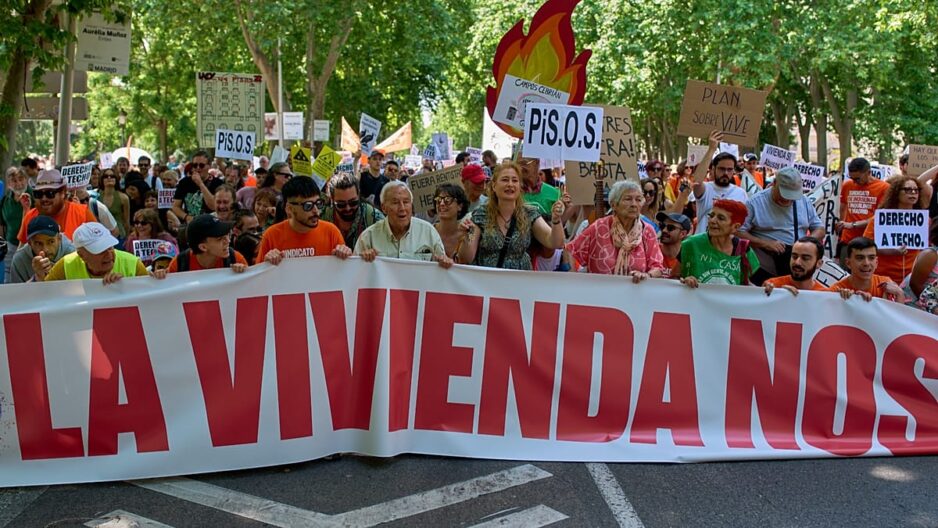
On May 24, 2026, during a protest in Madrid, ’, Spain, several people carry a banner that reads "Houses for residents of ’".
Only 17 provinces are allowed to buy a house with a salary under 5 years
At the state level, with the 15.1-year salary required to buy a house, the Balearic Islands are again at the top of the ranking. They are followed by Madrid (15 years). Malaga (12.9 years), Guipuzcoa (11.7 years), Santa Cruz de Tenerife (11.3 years) and Barcelona (10.2 years).
In return for this, Jaén is the most affordable province in the country. Residents need a three-year gross salary to buy an 80-square-foot home. Ciudad Real, Teruel, Toledo, Zamora and Ávila also stand out, and efforts fall under four years.
According to the study, only 17 provinces in ’ allow the purchase of houses with devotion. Gross salary of less than five full years.
The gap between wages and housing is widening
The report's authors warn that rising fees are not enough to offset the fluctuation in the real estate market. “2025’te recorded %1’ increase The rise in house prices is far behind.Mónica Pérez, Director of Communications and Research at InfoJobs, “Diyor. In his view, this gap is forcing people to work and accumulate for more years to buy a house of their own.
Study concludes housing is slowly becoming inaccessible Purchasing power of householdsespecially in overheated markets where the effort required to buy a home has nearly doubled the national average.
Germany’'s economic recovery looks weaker than expected in the spring. This is the conclusion reached by experts at the German Institute for Economic Research (DIW). They lowered their growth forecasts for this year by 0.5’e.
DIW chief economist Geraldine Dany-Knedlik says the ‘Energy price shock is clearly slowing the recovery. However, he stresses that the situation is not a repeat of 2022/23’. This was the year when Russia launched the ’'s large-scale invasion of Ukraine. Dany-Knedlik explains: ‘Shock is smaller, energy resources are still safe, and Germany is now less dependent on fossil fuel imports than it was after the start of the war in Ukraine.’
The chief economist, ‘, says public spending is the only reason the economy is growing this year. Household demand is weakening, and companies have become more cautious recently. Higher defense spending and increased government spending through private funding, for example, support economic growth.
The government had already revised its growth forecast downwards in its spring forecasts. Initially, growth of 1.0 percent was assumed, but only 0.5 percent was expected by the end of April. This is in line with the prediction of the Kiel Institute for World Economics (IfW). But the federal government makes it clear that private consumption continues to be the pillar of the economy. Public investments, on the other hand, give a significant impetus to growth.
Stability through defense spending
In a recent press release, the DIW suggests that funds from the special budget for infrastructure and climate neutrality, combined with increased defense spending and a delay, support the German economy and ensure moderate growth in both forecast years.
Dany-Knedlik, ‘However, these fiscal policy impulses do not completely compensate for the cyclical setback, ’ adds. What is important is that resources from private funds are distributed quickly and in a real way in addition to existing budgets, rather than just financing investments that are already planned.‘
The DIW describes other problems facing the German economy as ‘structural’. The industry is no longer as competitive as it used to be, especially the automotive sector is under pressure. High production costs and demographic change also put pressure on competitiveness. These factors limit growth potential, regardless of the current geopolitical situation, and make a rapid cyclical recovery even more difficult, according to the institute.
As an energy producer, the U.S. is the winner, while the eurozone is the loser.
Internationally, DIW estimates that as a major energy producer, ABD’ will continue to record relatively robust growth rates of just over 2%’, while the outlook for the Eurozone will be significantly weaker.
Meanwhile, the U.S. has become one of the world's largest exporters of liquefied natural gas (LNG) and is forced to import European energy while partially taking advantage of high gas prices. RussiaWhen ’'s natural gas supply was cut off, its first port of call for new deliveries was overseas.
Europe is dependent on imports because it cannot produce enough energy on its own. Any related price shock is a burden on the economy and erodes purchasing power. DIW does not expect a supply shock, arguing that oil and gas supply security is not at risk, especially thanks to a diversified structuring.
But energy-intensive sectors such as chemistry, steel and paper are suffering from rising electricity and gas prices. According to DIW assumptions, this means that Germany’ is more affected than other European countries.
Expanding fiscal policy buffers inflation but fails to fully absorb it
While the shock slows growth and also pushes prices up, Dany-Knedlik describes it as ‘, a disturbing situation. So far, expansionary fiscal policy has been able to buffer particularly high inflation. However, it cannot achieve the desired growth.
Consumers are also feeling the impact of rising energy costs for heating, electricity and transportation in their daily lives. As the Ifo Institute noted in ’'s Joint Economic Forecast for the spring of 2026, this leaves less money for private consumption. The European Central Bank remains unclear whether ’ will respond to the rate hike on Thursday.
This is a problem, as the government currently sees consumption as one of the main drivers of growth in the German economy. DIW has a more critical view, arguing that growth stems only from the public sector.
Structural changes in the labor market also play a role. Employment in manufacturing and retail is declining, while employment in the public sector is steadily increasing. The structural change towards services is evident, but the overall number of people working is decreasing.
Employers, trade unions and leaders of the ruling coalition are gathering in the bloodlines today to discuss reforms. Social partners were asked, among other things, to prepare their views in advance on the key factors behind the German ’'s persistent structural growth weakness.
The new Eurostat figures reveal sharp differences in working hours across Europe.
According to the latest data on actual working hours from the bloc's statistics office, people at AB’ work an average of 35.9 hours per week. The figure covers full-time and part-time employees between the ages of 20 and 64 in their main jobs.
The data also reveal significant differences between countries, raising questions about why some Europeans work longer hours than others.
Balkan countries record longest working hours
Actual weekly working hours within the EU range from 31.9 hours in Netherlands’ to 39.6 hours in Greece’. When EU’ candidate countries and EFTA members are included, this figure increases to 42.4 hours in Turkey’. It is followed closely by two other candidate countries: Bosnia and Herzegovina (40.9 hours) and Serbia (40.6 hours).
These are the only countries where average working hours exceed 40 hours per week; This is equivalent to more than eight hours a day in a five-day work week.
This is followed by Greece (39.6 hours), North Macedonia (39.5 hours) and Bulgaria (38.7 hours). The Balkan countries lead the list of longest working weeks, while Greece and Turkey are generally considered part of the wider Balkan region.
Professor David Spencer of the University of Leeds, ’, told Euronews Business’a: “In no country do workers choose the hours they will work ‘: Instead of ‘normal’ they work in an hour interval (the latter is under the influence of employers). Low productivity may explain the lack of labor power in addition to longer working hours in the above countries.”
Jorge Cabrita, senior research manager at Eurofound’, said differences in working time-setting regimes could help explain why some countries record longer working hours than others.
The Netherlands has the shortest working hours
The Netherlands stands out as the country with the shortest average working week in Europe ’, with people working only 31.9 hours per week.
Cabrita, Netherlands, where part-time employees have an approximate total employment in ’ %He said it made up 43’, which is much higher than other EU member states. The country also has one of the shortest average working weeks agreed collectively in the bloc.
Spencer told Euronews Business’a: “Dutch turned to more part-time work, which helped reduce the average work week; But the working week of full-time workers is still close to 40 hours.”
This is followed by Germany, Norway and Denmark with 33.9 hours; This means that workers in ’ in the Netherlands work about two hours less per week than workers in the nearest countries.
Average working hours are also below 35 hours per week in Austria (34.0), Belgium (34.3) and Finland’ (34.7). The average working day in these seven countries is less than seven hours in a five-day work week.
Germany, France, Italy and Spain work fewer hours than ’
With 33.9 hours, Germany records the shortest working week among AB’'s four largest economies. Workers in ’, Germany, France, work 1.7 hours less per week than those in ’ (35.6 hours).
Spain (36.3 hours) recorded the longest working week among the four major EU economies, while Italy (36.1 hours) was above the EU average of 35.9 hours. The difference between Germany and both countries exceeds two hours per week.
“, for example GermanyThe shortening of working hours at ’ partly reflects the strength of the unions and the positive impact of collective bargaining, ” said.
In other places, the average weekly working hours are Poland’da 38.7, Romania’da 38.2, Czechia’da 37.5, Hungary’da 37.4, Switzerland’da 35.9, Sweden’te 35.4 and Ireland’da 35.1’.
Why are working hours so variable?
In general, Northern and Western European countries tend to have shorter working weeks than Eastern and Central European countries.
Cabrita pointed out working time determination regimes, employment structures and wider economic structures as the main factors of the differences between countries.
The role of trade unions and collective bargaining
Cabrita said that countries where unions and collective bargaining play a larger role in determining working time limits tend to have shorter actual working hours.
He added that stronger collective bargaining is also associated with less overtime and greater compliance with labor regulations.
The impact of part-time and freelance work
Employment structure also plays an important role, including how workers are distributed according to occupations, sectors, employment status, and contract types.
The greater the share of part-time employment, the shorter the average working hours tend to be, Cabrita said.
Self-employed people, who often have more autonomy over their schedules, tend to work longer hours than employees, especially if they employ others.
Economic structure is also important. The relative weight of different sectors in an economy can affect average working hours because some industries often need longer work schedules than others.
Working hours vary significantly by industry
Skilled agricultural, forestry and fisheries workers Record the longest working weekAt AB’, 42 hours are followed by executive occupations (40.6 hours) and occupations in the armed forces (39.4 hours).
At the other end of the scale, workers in basic occupations recorded the shortest average work week at 31.8 hours, followed by office support workers (33.0 hours) and service and sales workers (34.5 hours).
SpainThe evidence of ’'s housing crisis is clear for all to see. In the rental market, 2022Cumulative increase since ’ %Around 30 of themAccording to CIS’, construction of housing– PwC data showed that – was at its lowest level since 2010, with an average of 83,000 homes per year, compared to an average of 315,000 homes between 1970 and 2010. And in addition, mass housing stockThe Bank of Spain is clearly insufficient, according to ’: The EU average %A total of 9.3 %With a 1.5 %It is between 3.3 and ’u.
Warning sounds even from inside the real estate sector, which is subject to heavy criticism from platforms such as the Tenants Association because it does not take harsh measures against vulture funds or the evacuation of vulnerable people. Fotocasa, the real estate portal that acts as a sales and rental agent, shows that the average salary of Spaniards who rent their homes in 2025 %He estimates that he spent 50’sini on rent.
Calculated using the average salaries advertised in job offers published on the InfoJobs platform, these figures are much higher than those found in –-like studies of a very unrealistic snapshot. Funcas think tank (source in Spanish)He believes that young people, one of the most affected groups, are spending About their budgets %The 35th ’i:still two percentage points above the maximum amount that economists recommend for such costs, i.e. no more than one-third of the income.
Fotocasa, SpainTaking into account the inequalities between the regions of ’, the average salary share for rent in 2019’da ’den 2025’te %He calculates that he has risen to 50’: Estimated for residents of Extremadura’This rate is for residents of Madrid’ ’e coming out. This is similar to the rest of the autonomous community ranking; The usual suspects are those living in the Basque Country, the Canary and Balearic Islands, Catalonia and Valencia, who pay the most.
In return for this, Provinces where residents allocate the smallest share of their gross salariesAmong those hired is Jaén (), Teruel (), from Cáceres (), Ciudad Real (), Albacete (), Ourense (), from Badajoz (), from Córdoba (), from Palencia () and Castellón () is located.
SpainThe evidence of the housing crisis facing ’ is clear for all to see. In the rental market, rents 2022approximately since ’ %Increased by 30According to CIS’, new housing construction– PwC data compared to an average of 315,000 homes between 1970 and 2010, – has been at record lows since 2010, with an average of 83,000 homes per year. mass housing stockThe Bank of Spain is clearly insufficient, according to ’: The EU average %A total of 9.3 %With a 1.5 %It is between 3.3 and ’u.
The warnings now even come from within the real estate sector and have long been criticized by platforms such as the Tenants Association for failing to take sound action against vulture funds or the evacuation of vulnerable people. Fotocasa, the real estate portal that mediates sales and rentals, reports that the average salary of Spaniards renting their homes in 2025 %He estimates that he spent 50’sini on rent.
These figures (based on average salaries in job postings published on the InfoJobs platform; this is a very unrealistic snapshot) is higher than other similar works. Funcas think tank (source in Spanish)He believes that young people, one of the most affected groups, are committed Approximately 35% of the budgetTo rent it: It is usually two points above the maximum amount that economists recommend for such expenses, i.e. no more than one-third of the income.
Fotocasa reports that the average salary share spent on rent in 2019’da ’den 2025’te %While calculating that it has risen to 50’, Spain also takes into account the inequalities between ’'s autonomous communities: For residents of Extremadura’This is for those in the Madrid area. ’e coming out. The numbers are similar to the rest of the regional ranking; The usual suspects that residents of the region pay the most (Basque Country, Canary and Balearic Islands, Catalonia and Valencia Community).
On the other hand, the provinces where the residents allocate the smallest share of their gross salaries for rent are Jaén (), Teruel (), from Cáceres (), Ciudad Real (), Albacete (), Ourense (), from Badajoz (), from Córdoba (), from Palencia () and Castellón ().
A consortium led by Airbus has proposed to develop a next-generation fighter following the collapse of its high-profile Franco-German fighter program, one of the companies involved told AFP news agency on Tuesday.
The move comes a day after German Chancellor Friedrich Merz and French President Emmanuel Macron’. After years of disagreements, he ended the original project.between industrial partners.
Munich-based defence electronics company Hensoldt said it has joined forces with Airbus Defence and Space, Autoflug, Diehl Defence, Rohde & Schwarz, Liebherr, MBDA and MTU Aero Engines to prepare an alternative plan.
A company spokesperson said the proposal was submitted to German Defence Minister Boris Pistorius’. The Financial Times, which first reported the initiative, said the initiative was also sent to Merz’in's office.
The companies are preparing a joint position document on the “ Future Combat Air System (FCAS) and the relevant Next Generation Weapon System (NGWS), ” said.
More details are expected during the announcement to be made at the Berlin ILA Air Show’ on Thursday.
EuropeA setback for ’'s defence integration
The German defence ministry confirmed the existence of the proposal. Pistorius, Berlin’in “, said ” was evaluating which direction we were going.
“We have also been discussing this issue with various stakeholders for months, ” added.
Pistorius said “ suffered from the collapse of the original Franco-German project.
I know how important French-German cooperation is in the European “, but ultimately you have to draw a line between the mind and the heart, ’ said.
The FCAS programme was seen as a flagship European defence project aimed at strengthening military co-operation at a time when the European ’ was facing increasingly tense relations with a more assertive Russia and the United States.
However, the initiative was hampered by long-standing disagreements between French Dassault Aviation and Airbus, Germany’'s leading industrial partner and a key partner in Spain’'s FCAS programme.
German partners opposed Dassault’'s efforts to gain greater control over the construction of the aircraft.
Merz also argued that Germany ’, unlike France ’, does not need warplanes capable of carrying nuclear weapons or working with aircraft carriers.
While the EU is trying to protect its market from the rise in low-cost Chinese imports, alarm is mounting in the face of a new phenomenon in the European Union: Chinese companies are introducing ways to overcome the bloc's tariff barriers.
France, Italy, Spain, the Netherlands and Lithuania are increasingly fuzzy and complex actions to avoid EU customs duties, the European Commission jointly warned “ on ”.
In an informal proposal last month, which did not name any Chinese company, the quartet called for ’ improvements to AB“'s anti-skipping tool, which would allow ’AB” to guarantee the legal effect and effectiveness of existing trade defense measures.
Euronews found that online Chinese companies offer ways to explicitly avoid EU trade defense measures, including anti-dumping duties imposed on imports sold at AB’ at prices below their normal values in Brussels’in China’.
Skipping practices include setting up production facilities or making small changes to products in countries where EU extra tariffs are not targeted. Not all of this is illegal unless businesses at AB’ provide solid evidence that they are harming their industry, but many are thought to be at least controversial, prompting the European Anti-Fraud Office (OLAF) to launch an investigation into the true origin of certain products.
As the EU faces a wave of China's ’ overcapacity, exceeding tariffs has become an even more pressing concern. European manufacturers have filed a growing number of complaints against Commission’a, alleging unfair trade practices in various sectors and the strain on the resources of EU officials.
Transfer through third countries
One of the ways Chinese companies are already pursuing is to establish production facilities in so-called “gate countries, such as Morocco, Tunisia, Turkey or various southeast Asian countries, which benefit from favorable trade agreements or are not subject to EU anti-dumping taxes.
Other methods include minor product changes designed to change the customs classification and minor changes designed to transfer goods through ’gate “ countries to create the impression that the goods were actually manufactured there, even though they were entirely made in China”.
Euronews’in research has revealed that some Chinese companies do not hide their activities and openly offer online services to overcome trade barriers.
Xin Rui Da Logistics, a logistics supplier from Shenzhen’, specializes in “anti-dumping research and providing transit trade solutions for third countries. the Website.
The company says it has solved the problems of many Chinese businesses and foreign importers with restricted products in “, such as anti-dumping, compensatory, quota restrictions and trade barriers such as CIQ (Customs, Inspection and Quarantine), ” says, and “ explains that it has re-exported from Malaysia, Sri Lanka, Taiwan, India, Thailand, Singapore, Indonesia, Bangladesh, Hong Kong”.
Xin Rui Da Logistics is currently working on a variety of products, from e-bikes to steel, aluminum and plywood product categories; All of these have been hit by AB’'s anti-dumping taxes in recent years.
The company did not respond to the interview request.
Sale of converted chemicals
The chemical sector, where competition between the EU and China is particularly intense, is particularly exposed to the risk of exceeding customs tariffs. European manufacturers are already under pressure due to the surplus of China’in production capacity, which is flooding the EU market with imports and increasing competitive pressure.
On the complaint of EU producers, the European Commission imposed an anti-dumping tax on a specific chemical imported from China’: titanium dioxide (TiO2), a strategic chemical used in green technologies and aerospace. The missions were temporarily brought to ’ on July 2024 and finalized on January 9, 2025.
But some Chinese producers are looking for ways to adapt to the new tariffs to export the chemical to AB’.
ChinaZontai Titanium Dioxide ’in manager Nina Zhu, a company based in Guangdong province, south of ’, He wrote itA few months before AB’ introduced its customs duties on LinkedIn’de: “AB’'s anti-dumping taxes will be introduced at the end of the year. It is advisable to prepare inventory in advance to provide you with a variety of titanium dioxide solutions.”
Euronews’in contacted Zhu, who confirmed that the company can supply products with TiO2 content below 80 percent’ to avoid EU tariffs.
Linkedin (linked
Later, 2025’te NanJing Titanium Industry International described in theThe recently commercialized new type of mixed TiO2’ “, with excellent performance, qualifies as the highest quality”, adding: “Furthermore, its unique features allow you to bypass certain regional anti-dumping taxes, saving you significant costs. It's a game-changer for your business!”
The company did not respond to Euronews’'s requests for comment.
Linkedin (linked
In some cases, as soon as the EU launches an anti-dumping investigation that could result in additional taxes, Chinese companies begin offering such services.
This is what led to the introduction of new tariffs in January 2025, following the Commission's decision to launch an anti-dumping investigation against Chinese TiO2 producers in ’ on 13 November 2023.
In a LinkedIn post on January 23, 2024, an executive of Titan Industry’, a Shandong-based company, offered EU customers certificates of origin for shipments via “ Vietnam or Thailand to deal with anti-dumping taxes imposed by ”AB. Such certificates may have obscured the true origin of the product produced in China’.
Since then, the company has removed the post from social media, saying it has stopped offering such transfer solutions because Euronews’e is not allowed to.
Instead, “ said it would build a new TiO2 factory in ’, Vietnam.
‘Shoot the mole’
Like many other Southeast Asian countries, Vietnam is often seen as ’, a country where Chinese companies invest in exporting to AB“. However, in some cases, companies cannot maintain a real production presence in the country.
The situation is hitting a ’ mole, according to Deborah Elms’e, a trading expert from the Hinrich Foundation ’ in Singapore“ problem.
Euronews’e said: “If you go after a particular company for illegal transfer, you'll discover that this is the mailbox address of a company that changed its name and moved to another location very quickly.”
“If the tariffs are high enough, there is always an incentive for companies to try to circumvent this illegally.”
Linlin Liang, spokesman for the Chinese Chamber of Commerce ’'s European Union (CCCEU), told Euronews’e that CCCEU’ is not aware of Chinese companies offering online solutions to overcome EU tariffs.
Liang, “Generally, the risks of circumvention are not specific to any country” said, adding that AB’ has a rooted anti-survival system“, and the important thing is that these ”tools are implemented in a transparent, evidence-based and proportionate manner“.
“Unfortunately, EU trade defence measures have so far largely targeted imports from China’, ” said.
Beijing has repeatedly threatened to retaliate if AB’ tightens its trade defence measures. But with AB’'s trade deficit with China reaching a record high of 359.9 billion euros in 2025’te, the European Commission announced last week that the current state of the “ trade and investment relationship is not sustainable.
AB’'s executive branch is expected to propose strengthening AB’'s trade defence system to EU leaders, who will meet for a summit in mid-June. The draft results shared by diplomats do not include the name Çin’in, but China’in is expected to be at the center of the discussions when the leaders meet.
OLAF is investigating
In its 2025 annual report, it said the issue of exceeding tariffs had become important enough for OLAF’ to take over investigations into such cases.
In particular, the report pointed to a case involving e-bikes, which would likely be imported from Indonesia’ to AB’, if the bloc's anti-fraud authority had not intervened.
It turns out that most of the components are actually of Chinese origin and are processed only in Indonesia’; This means that the goods must be labeled as of Chinese origin. OLAF assessed that if the products are exported to AB’, this plan could lead to €7.2 million avoiding EU import taxes. In the end, they weren't.
Thomas Grjebine, an economist at the French Centre for Research and Expertise in World Economy ’, Euronews’e “ChinaThe greater ’'s competition, the more difficult it will be, ” said.
In an important report for the French government's advisory body recently, it warned of the impact of Chinese competition on EU industry.
Grjebine, “We will not launch investigations into thousands of products, this is a complicated situation, ” said. Moreover, the investigations are carried out at the European level and customs checks are mostly carried out at the national level.“
Beyond commercial defense measures targeting specific products, industries such as the EU's automotive, metals and chemicals are facing an increase in cheap Chinese imports, while questions about the protection of all industrial sectors are also being raised.
But Morocco, Tunisia and Turkey, China, which has invested billions of dollars in building factories in ’, already knows how to overcome industry-wide tariffs, leaving AB’ with even more challenges.
Official data released on Tuesday showed that industrial production in ’, Germany, rose in April for the first time since the start of the war in the Middle East’; But analysts have warned that single-month earnings mask a much worse picture of Europe's largest economy.
GermanyAccording to ’'s federal statistical office Destatis’, production was mainly affected by construction in April compared to the previous month. %It's up 0.4.
Readings put an end to a series of defeats dating back to last November ’, but few consider it a turning point.
According to ING Global Macro President Carsten Brzeski’, in a research note published on Tuesday, the April figure was “too few”, production effectively stagnated during the first four months of 2026’, and pre-pandemic levels were still about %It looks like it's under 12.
Number of headlines, compared to the previous month %2.4 received support from the encouraging jump in growing construction activities.
Exports also created an upward surprise; the March %Compared to the month before 0.5 level %It increased by 0.9, but the trade surplus did not change much due to the even faster increase in imports.
Just months ago, what seemed to be the foundation of a promising year with increased confidence, rising orders and a major financial contribution to defense and infrastructure under Chancellor Friedrich Merz's rule once again cast doubt.
Iran war, shrinking energy prices and bleak outlook
The background of the April data is quite clear.
According to the ING analysis, Germany remains one of ’'s largest net energy importers, accounting for about 6% of its oil imports from Middle Eastern countries, while energy-intensive industries employing close to one million people account for about 17% of its industrial gross added value.
Conflict has caused energy prices to spiral; Germany’'s inflation rate in April on an annual basis %It's up to 2.9’a. This rate, compared to the previous year %With the impact of rising energy products prices above 10’, January 2024 reached the highest level since ’.
In April, the German government cut its 2026 growth forecast in half, and at the moment, GDP growth is only %He predicts 0.5.
Tuesday's production data followed an extremely discouraging ordering report released the day before. According to the provisional Destatis figures, new manufacturing orders are made monthly in April. %It's down 3.8.
Automotive industry, orders %While it was among the worst affected by the fall of more than 5’, electrical equipment and machinery also recorded sharp declines. Category: Foreign orders %4Lowered over ’ and domestic orders approx %3 is down.
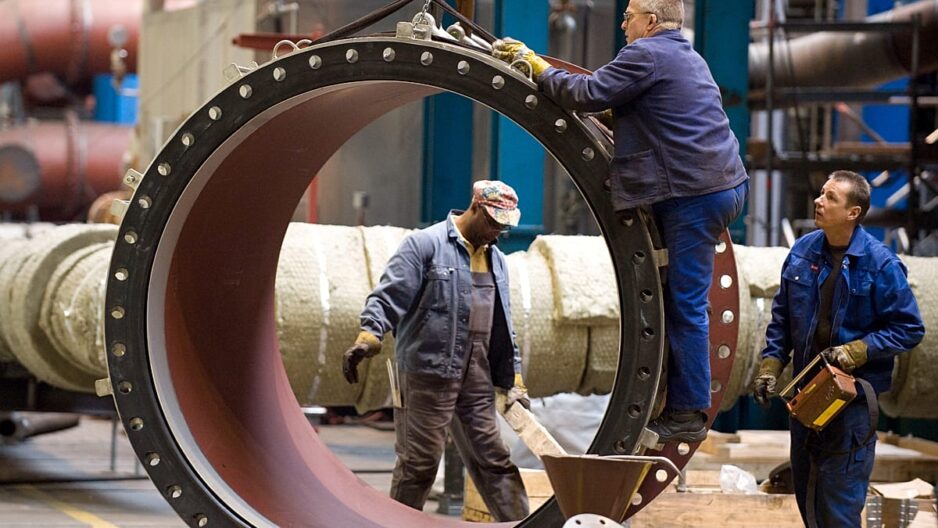
Struggling steelmaker ThyssenKrupp’un Duisburg, GermanySteel in roll cars before shipping at its main factory in ’, February 2025
According to ING’den Brzeski’, industrial orders are monthly for four consecutive months after last summer. %The boom, with an increase of over 4’, was sharply reversed in 2026’, with orders averaging every month until April. %He fell more than 2’.
The momentum from domestic defense stockpiling and supply chain pre-orders has evaporated for now.
According to the German Federal Ministry of Economic Affairs, ’, any normalization is expected to take quite some time, given the extent of the damage to production capacity in the region and the accumulated workload caused by bottlenecks in energy and commodity supply.
Brzeski concluded that the expected industrial recovery in 2026’ did not occur, and in a note he described the mood as “, a theme he expected to continue in the coming weeks, with great hopes and broken dreams.