

Those traveling on Deutsche Bahn ⁇ 's trains from mid-July in Germany will need plenty of patience and time over the next few years. On July 15, the day after the end of the European Football Championship, the state-owned railway company is preparing to launch a major infrastructure renewal program.
Under the program, 40 main lines will be renewed by 2030 and flights on some routes will be completely stopped due to construction work. The first of these will be the approximately 70-kilometer line between Frankfurt am Main and Mannheim, known as ⁇ Riedbahn ⁇ .
In Germany, a train is considered punctual if it is delayed by less than six minutes. But Deutsche Bahn ⁇ 's punctuality problem has steadily increased in recent years. From time to time, trains do not even arrive at the last stop due to large delays. In 2023, two-thirds of long-distance trains failed to reach their destinations on schedule. This is a delay record for Germany. In addition, interrupted trains are not included in the punctuality statistics.
Compensation and financial difficulties
If a train is delayed by more than 60 minutes, passengers can request a refund of part of the ticket fare. Deutsche Bahn was forced to issue a total delay refund of 133 million euros in 2023. This represents a 43% increase over the previous year. Now, this amount has caused a serious breach in the investment budget.
The railroad's financial situation isn't bright enough. Since the huge drop in the number of passengers during the coronavirus pandemic, Deutsche Bahn has been unable to straighten its back. The 2023 balance sheet closed with a loss of approximately 2.4 billion euros. The total amount of debt is 34 billion euros.
Investment in infrastructure is necessary but expensive
Maintenance and repairs are becoming increasingly costly. The railway made a record investment of approximately 7.6 billion euros from its own funds in 2023. However, most of the infrastructure is so old that it can no longer be repaired.
The Deutsche Bahn Group, a state-owned company, is dependent on subsidies from the federal government. However, the government has significantly reduced its investment budget in recent years. However, 40 main lines, which are essential for the operation of a high-performance railway network, need to be completely renewed. This means the acquisition of a railway network of approximately 4,200 kilometers by 2030.
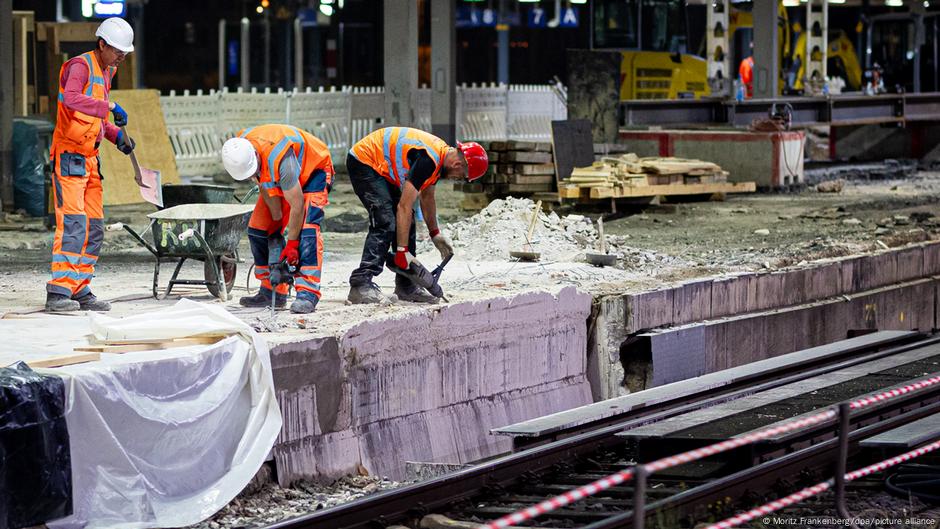
Renovation works carried out at Hannover StationPhoto: Moritz Frankenberg/dpa/picture alliance
Transportation to Frankfurt Airport will be disrupted
Important information for passengers on board:
During the construction period, it will no longer be possible to reach Frankfurt ⁇ a, the largest airport in Germany, by direct train services. In addition, between mid-July and mid-August, the high-speed train line from the northwest between Cologne and Frankfurt will be closed.
Finance and the future of Deutsche Bahn ⁇
The federal government, which is the main financier of the railroad, and the states that are financially responsible for the railroad, have to save because they are over-indebted. Billions of euros were also missing for investments in railways after the Federal Constitutional Court declared parts of the federal budget unconstitutional in the autumn of 2023.
Currently, the 45 billion euros needed for the restructuring plans of the railway network cannot be properly financed. The federal government has committed only 30 billion euros. According to the plans of the railway, after Riedbahn ⁇ , the approximately 280-kilometer line from Hamburg ⁇ to Berlin ⁇ will be closed and renewed in 2025.
Will the problems end after the renovation?
With up to 30,000 passengers a day, Riedbahn is Germany's most frequently used direct city connection for long-distance transport. Every day, about 230 commuter, long-distance and freight trains run on rails between Germany's two major metropolises.
However, it is not enough just to renew existing lines so that the railway becomes not only more reliable, but also more efficient. The current network is being used at full capacity. Additional trains will only be able to operate on the newly planned lines. Given the public savings plans, whether these ambitious goals can be achieved is a complete mystery.


