GreeceGreeceGreen light on early payment of ’a 6.95 billion-euro bailout loan

The European Stability Mechanism (ESM) has approved ’'s request for early repayment of €6.95 billion in loans under the first bailout programme through the Greek Credit Facility (GLF). The loans were part of international bailout packages agreed upon during ’'s 2010 debt crisis in Greece. Paying debt ahead of schedule can help reduce future borrowing costs and signal financial strength to investors.

As part of the agreement, European bailout funds agreed not to demand that Greece repay ’'s debts to them early. Normally, Greece would have to repay some of its bailout loans, while the European Stability Mechanism and the European Financial Stability Facility would have to make parallel repayments to ’ne. The decision allows Athens’ to continue repaying 6.95 billion euros without triggering these additional obligations.

The ESM board also approved the use of funds from a special cash buffer account created to help finance the transaction after Greece's exit from the ’ bailout program.

Under the terms of ’'s agreements with the ESM and the European Financial Stability Fund (EFSF), early repayment of certain creditors, including GLF lenders, will require early repayment, which normally corresponds to both European bailout mechanisms. The waivers approved on Thursday eliminate this requirement.

Pierre Gramegna, Managing Director of the ESM and Chief Executive Officer of the EFSF, said that Greece’ continues to make steady economic progress. He said the recent repayment to GLF lenders (the second-largest repayment to date) would strengthen market confidence, reduce risk from fluctuations in interest rates, and help improve the structure of public debt. A stronger debt position could make it easier and cheaper for governments to raise money for public spending and investments.

The decisions came at the official request of the Greek government. The plan includes early repayment of GLF loans, due in 2029’ and expected to expire between 2033 and 2035, with a total value of €6.95 billion. Once completed, the cash buffer account will be completely depleted.

Greece Credit Facility, adopted in ’ in May 2010, was an important part of ’'s first international bailout program. This loan consisted of a total of €52.9 billion in bilateral loans from 14 eurozone countries; Of this, 26.3 billion Euro’s remain unpaid.

Greece completed the repayment of its loans to the International Monetary Fund (IMF) in 2022’, two years ahead of schedule. The previous early repayment of GLF loans occurred in 2025.

At the mercy of the air: How many people can't afford air conditioning in AB’?

EuropeSummer came early this year as ’ was overwhelmed by record-breaking temperatures.

In May, mercury peaked at 37°C for the first time in ’, France, while in London, England, it broke the monthly record with temperatures reaching 34.8°C’. The same goes for Ireland with an unprecedented temperature. It's 30.5°C.

However, according to the European Environment Agency ’'s report titled “Overheated and Underprepared, the majority of EU citizens, that is, 68%, have no air conditioning (air conditioning) or ventilator system in their homes.

Which countries struggle the most to afford air conditioning?

Although some countries do not need it (Europe is not equally hot everywhere) more than one in three people () says they can't afford to buy air conditioning.

In some of the hottest regions of the continent, the numbers are particularly high: France in ’ , Greece’da , Portugal’de and Spain’da (), Italy’da () and Romania’da () more than a third.

It is a worrying picture given that more than one in four EU citizens are over 65 years old and some of the oldest populations are concentrated in countries such as Italy, Portugal or Greece.

It is also Malta (%8.5) and Luxembourg () and Ireland () emerged as the countries with the least problems with air conditioning or fan systems.

Of course, there are other ways to keep homes cool, such as shutters, awnings, or exterior shading.

Spain (although, from Portugal () from Italy () or Cyprus’ta () The majority of people say that their homes do not even have these characteristics.

Warm weather is more worrying than other climate issues

That doesn't mean people aren't worried about high temperatures.

Heat, for EU citizens () is the number one concern about climate; The Flood (), fires (.5) or water shortage (.5) is more.

Concerns are particularly high in the Mediterranean’: the Cyprus ’ , Greece’da and Malta’da %From extremely high temperatures of 70, “much ” or “much ” says they are concerned.

In addition, about half of AB’'s respondents are already at home (%Fifty, that's it.) and %More than 60’ in their own neighborhood () It feels very hot.

There is no air conditioning: Italians and Germans face post office queue hell in summer

Local communities report mixed heat responses from local authorities, and it seems quite rare to come across any public building equipped with “ or air conditioning to ” refrigeration centers in general.

Italians in particular seem doomed to melt; only for the ’i reports using air conditioning in public buildings; In Germany, this figure is even lower in ’, %7. Greece, Malta and RomaniaIn ’, this rate is much higher; About the citizens ’i benefit from refrigerated public spaces.

26 May 2026’ in RomePeople trying to protect themselves from the scorching sun in ’

Greeks love air conditioning but stay away from trees when arranging Cyprus work schedules

Planting trees seems to be a cheaper, more coherent and environmentally friendly option, and the EU residents ’si says they have seen this applied in their circles.

However, the proportions of tree plantings reported in ’ in Hungary ’dan Greece’da only %Since it varies up to 22’ye (third lowest rate across the EU), purchase rates vary widely.

Another reaction on the hottest days may be to adjust work or school schedules.

However, only EU citizens ’i complied with these measures; Replies Cyprus’ta ’ to Portugal’ only %It varies up to 8’e.

the Participants ' %Local authorities seem more active when it comes to heatwave alerts, such as phone calls, text messages or communication through the media reported by 57’si.

At the same time, this type of communication seems to be related to emergency response rather than prevention; There are fewer citizens (.5) reported exposure to awareness campaigns about extreme weather health risks and recommended actions.

As rising costs push Greeks away from Turkey’, Turkish tourists flock to Greece’

Economic relations between Greeks and Turks have changed significantly in recent years.

The two neighbors have long witnessed political leaders tossing and turning between the conflict and what diplomats call “sakin waters” (a phrase used to describe the current spell).

Overall trade and tourism volumes have doubled in five years, but gains have fallen unevenly on both sides compared to what was previously observed.

Maria Dimou, who lives in ’, Istanbul, “Up until about 10 years ago, people came to ’ from Greece, especially Istanbul, Edirne and Keşan. But now we see a lot more visitors coming to ’ from Turkey’ to Greece, because everything they want to buy is cheaper there, ” said.

Dimou continued: “TurkeyThe basic needs one needs to live and make a living in ’ are cheap.”

But when they want to buy something more expensive “prices go up, so they go to ’ in Greece and visit Thrace’, especially Alexandroupolis’, but some also go as far as Kavala’ for vacation or shopping, and especially here [in Turkey’] they go for food, drink and cold meat, which is very expensive” added.

GreeceThe number of Turks visiting ’ has tripled in four years

While the number of Greeks visiting ’ each year has remained stable at just over 500,000’, the number of Turks arriving in ’ in Greece has tripled over the past four years on a similar basis; According to estimates obtained by the relevant authorities from various sources, it exceeded 1.5 million last year, but the official ELSTAT figures are slightly lower.

Doruk Euronews’e, a computer engineer who lives permanently in Ankara’ but whom we met at a popular shopping mall in Istanbul’, said: “I went on holiday to ’a in Greece last month. I drove all the way to Kavala and Thessaloniki ’ and honestly I really liked Greece ’. The food was delicious, the portions were generous, and everything was cheap.”

TurkeyPeople in ’ Greecereact to the more affordable prices in ’ and say they want to return as soon as possible.

Symeon Soltaridis, who lives in Istanbul’ and is the President of the Balino Greek Community, said that “Many Turks either make day trips to the Edirne region and go to Orestiada’ from there, or gradually switch to Greece’ as a tourist, because the cost of tourism in Greece’ is much lower than in Turkey’, and as a result, thousands of people go to the Greek islands, especially in the summer months, passing through Ayvalık and other regions” said.

Greek Consulate in ’ is issuing 1,300 visas per day

Greece has become a very attractive destination for Turkish citizens. According to diplomatic sources, only the Greek consulate in Istanbul’ issues about 1,300 visas per day; Most of them are very introverted. These visas are primarily provided by Turks who plan repeated visits for the holiday, but shopping trips are also available.

This figure does not include approximately 25,000 Turks who have obtained or are in the process of obtaining a residence permit through golden visa programs or by working in ’, Greece.

In addition, within the scope of a quick on-site visa arrangement, a large number of people living in large parts of Izmir and Anadolu’, who made short visits to 12 islands in the Northeast Aegean ’ and Twelve Islands ’ for up to seven days, were not taken into account.

Eastern Aegean’de ‘Visa Express’

The plan, known as the “ Visa Express, and announced as part of the broader ” interpersonal diplomacy, was approved by the European Commission and launched after the Kyriakos Mitsotakis government met with Turkish President Recep Tayyip Erdogan at the Greece-Turkey High-Level Cooperation Council session.

The program includes 12 candidates: Kalymnos, Kastellorizo, Kos, Lesbos, Leros, Limni, Rhodes, Samos, Symi, Chios, Patmos and Samothrace. Visas are issued at port entry points, are valid for seven days and link the holder to the island where the visa is issued; Passage from the island to the island is not allowed. As a result, there was a strong tourism increase in the islands.

Kos topped the list of destinations last year largely because of its proximity to Bodrum’, followed by Rhodes and Chios, which attracted predominantly high-income visitors.

Lesbos and Samos were in the top five. August was the busiest month in 2025’ with about 281,000 arrivals; This was followed by July with 233,000 arrivals and September with about 188,000 arrivals.

‘Greeks can no longer cope with prices in Istanbul’

However, there are complaints that Greeks who come to ’ in Turkey are no longer shopping as before.

Kantar Pehlivanoğlu, owner of a street stall that sells jewelry and fashion accessories in Istanbul’, told euronews’e: “I had more Greek customers in the past, but now it is even harder for them to come to ’, let alone shop, Turkey, and this is because of their financial situation compared to the past.”

Soltaridis of Istanbul also underlined that prices have become too high for Greek visitors.

“, once upon a time, they would come and take all sorts of things. Now they come, they look, they experience the city, they see us, the Greek Cypriots, but they can't buy anymore because things have become expensive, ” said.

According to official figures, every Greek who visited Turkey’ last year spent an average of 340 euros per trip; This figure has increased by about 50 euros a year over the past three years.

However, this increase in practice leads to fewer purchases than before. TurkeyThe sharp increase in ’'s cost of living means that Greek visitors receive less in return for their money.

Turkish visitors to ’, meanwhile, spent an average of just over 300 Euro’ per trip, or precisely over 303 Euro’, according to the latest data from the Bank of Greek’.

Dimou, “GreeceIt is much cheaper to go to ’, eat there in a tavern, drink ouzo or other drinks, spend the night here and return, than to go to a similar tavern in Istanbul’, ” explained.

“GreeceThe quality of food in ’ has increased significantly, and while prices are considered affordable for Turks, here in Turkey’ has increased rapidly.”

Great change in the Greek-Turkish trade balance

At the same time, according to the Greek Statistical Institute’ (ELSTAT), there has been a significant shift in the trade balance between the two countries over the past few years.

For example, imports from Turkey ’ to Greece ’ reached 1.34 billion Euro’ in 2020’, exceeded 2 billion Euro’ the following year and 3 billion Euro’ in 2024’te, and are currently estimated at 3.34 billion Euros for last year.

In contrast, it is estimated that for 2025, exports from ’ to Turkey ’ will be only 1.37 billion euros; This figure has fallen in the last three years, reaching 3 billion Euro’ in 2022’, the last year in which Greece’ exports more to Turkey than it imports to ’.

What is the impact of ’'s RRF fund on the Greek economy?

Managing the climate crisis is one of the most important issues European rescue planIt's for Greece.

An extended spell drought and heat wavesIn 2023, it fueled one of the worst wildfire seasons the country has ever experienced; In the Alexandroupolis and Meriç fires of August 19, ’, only more than 81,000 hectares of land were burned, a total of 170,000 hectares of land was burned across Greece.

The Megara Forest, about 60 kilometers northwest of Athens’, was also severely hit.

Jasmine Georgiou euronews’e, a forester specialising in Waste Management, said: “In the last five years, large fires have occurred in the Megara Forest, ’, destroying woodlands, forests, homes, businesses and animals.”

The Greek AntiNero Program‘mega was created to combat fires by clearing and maintaining forests, planting slow-burning trees, and creating different fire prevention zones.

Georgiou explained that highly flammable bushes and forest debris need to be cleaned to prevent fires from spiraling out of control, especially in the summer.

Creating fire breaks helps control the spread of forest fires

But public initiatives like this require a significant amount of investment to cover the costs of contractors, staff, and basic equipment.

Project manager Giouli Vourna, “The budget of the project is over 400 million Euro’; This is the largest intervention to combat this problem in our country, thanks to the resources provided by the Recovery and Resilience Fund, ” said. Wealth Development Fund of the Republic of Greece.

The measures financed by the RRF are determined according to the priorities of each country. Greece’ has access to 35.9 billion Euro’ distributed in grants and loans, including the modernization of public infrastructure, including health centres.

The Road to Better Health Care

the Metaxa Cancer HospitalAthens’da Balkans’ has the largest oncology hospital. Director Sarandos Efstathopoulos toured the Euronews’e complex, which has not been renovated since its construction in the 1960s.

Efstathopoulos, “We have renovated all patient rooms, all facilities and toilets, adding a very important call accessory for consoles and nurses for oxygen supply. It will also be followed by the complete reconstruction of the sixth floor and the E.R. ” said.

Director Sarandos Efstathopoulos Metaxa Cancer HospitalIntroduces new facilities in ’

Evangelos Manolis, another project manager at the Development Wealth Fund of the Republic of Greece, ’This project cost about 1 million Euro“. The RRF has certainly helped a lot by quickly completing these studies carried out in more than 80 ’ hospitals under the program, ensuring that Greek people have access to quality medical services, ” said.

GreeceAccording to ’'s recovery plan, 38 percent of the funds will be allocated to ’i climate targets, 22 percent to ’i digitalization and 18 percent to ’i social projects.

by Professor Phoebe Koundouri Athens University of Economics and Businessand the chair UN SDSN Global Climate Center, Euronews’e said that in order for Greece RRF’ to achieve its goals, the creation of a suitable financial space, more time and significant reforms are needed.

“We managed to get almost 50 percent ’ of the prepayments and ensured that a third of the money was spent on the investment. This is an unprecedented rate of absorption for Greece. But of course, we definitely need more time for this financial space to transfer itself to truly viable projects. So you really need the public sector to be productive, ” warned.

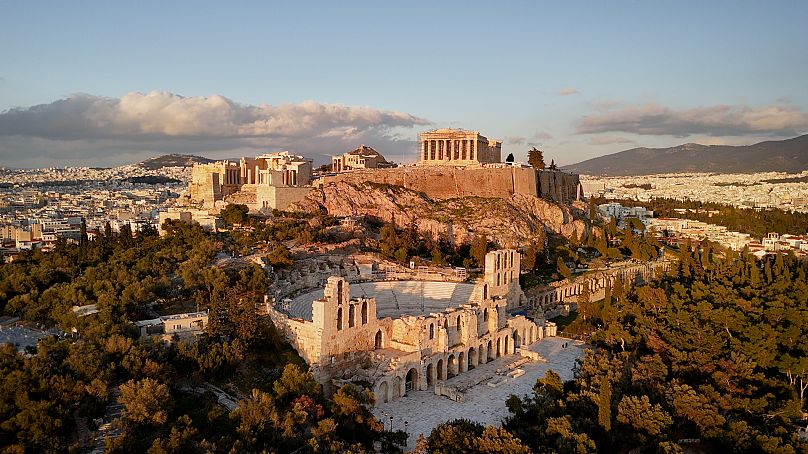
Aerial view of Athens’

Bright appearance for the coming years

After a hard decade, Papathana of NikosThe Deputy Minister at the Greek Ministry of Economy and Finance predicts that the Greek economy will grow by 2.9 percent in 2024’te; This is slightly above the European Commission's estimate of 2.3% ’ for 2024 and 2025.

According to Papathanasis’, which is also responsible for Greece’'s RRF funds, the average growth rate in Europe’ in 2024 will be 0.8 percent.

Together with other European funds, we expect “ to contribute more than 60 percent of the growth we expect for 2024. ’ reforms make our economy more interesting for investments and, of course, investments help create new jobs. And in the last four years, we've reduced unemployment from 17.5 percent ’ to less than 10 percent ’.

Papathanasis stressed that going forward, improving health facilities will remain a top priority and controls are in place to ensure the money is well spent.

Euronews correspondent Fanny Gauret and Deputy Minister of Economy and Finance of Greece Nikos Papathanasis

“There is a national and European audit, we are constantly being audited. That's how we make sure the money goes to the right place. - ”

Finally, Papathanasis added: “RRF is based on performance; It's not about how much money you spend, it's about achieving reforms and reaching those milestones. So it's hard, but it's more effective. And I think reforms, along with investments, are more beneficial to society than projects alone, ”.

For Greece, strategic investments and smart governance are opportunities to move forward on a positive path and turn a decade of challenges into prosperity.