
BP strikes another blow to troubled energy giant, dismissing its president Manifold’

BP dismissed its president, Albert Manifold’, with immediate effect, citing unacceptable management and behavioral problems in the recent coup against a company that has struggled for years to stabilize its leadership.

The board said “ was surprised and disappointed to learn of the problems, and ”, without going into details, carried out the decisive action“.

His sudden departure prolongs a period of serious leadership turmoil, which coincides with a period in which BP’ must recover after years of poor performance.

Shares listed in London’ fell as much as 9% before reducing their losses on the news, and were last traded at a loss of about 6%.

Manifold was in office for less than eight months, assuming the presidency of ’te in October 2025. He first joined the board of directors in September 2025’te as the next president.

BP’ played a central role in accelerating its strategic return to fossil fuels, cutting spending on transition energy assets to revive the company's struggling share price.

He was also instrumental in the dismissal of former CEO Murray Auchincloss’ and the replacement of Meg O’Neill’.

Another change at the top.

As the search for a permanent successor continued, board member Ian Tyler was appointed interim president with immediate effect.

In a statement, Tyler said the board has a ’derin belief in BP“'s strategic direction, and praised his leadership since taking office as O”Neill’'s chief executive officer, describing his decision to move to a clearly defined up/down direction as bold and necessary.

The layoff is the last chapter of the turbulent period at BP’; Former general manager Bernard Looney resigned in September 2023’te because he did not disclose his past sexual relations with colleagues when he took office.

Since then, the company has been cutting debt, pursuing shareholder returns and trying to simplify its structure under constant pressure from investors.

BP did not specify what concerns were about governance and behavior.
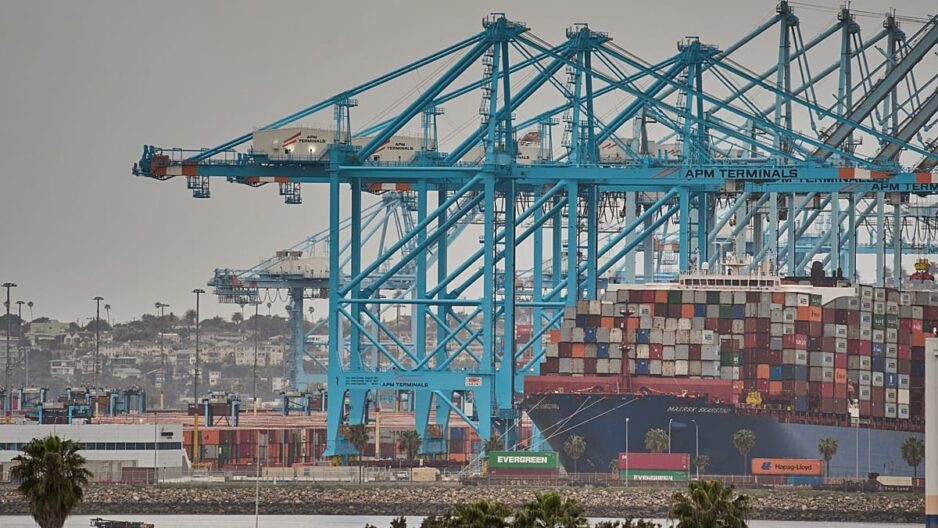
Maersk’'s profit plummets sharply as firm Hormuz maintains forecasts despite uncertainty

Shipping giant Maersk reported that despite strong demand for container transport, its earnings fell significantly in the first three months of the year.

Net profit from January to March fell to $100 million (€85 million), nearly 12 times lower than a year ago, when extraordinarily strong demand for maritime transport increased earnings.

It comes in %It fell 2.6 percent to just under $13 billion (11 billion euros), while earnings per share fell from $74 in the same quarter last year to $4.

The Copenhagen-based company notes that weak freight rates in the Ocean division are the main barrier to gains, but not in volumes across the enterprise. %He said the 9.3’ increase helped offset some of that decline.

Maersk said the conflict in the Middle East’ has only a limited direct impact on first-quarter results, but warned that this adds new uncertainty to the global outlook.

The conflict that began in “ on February 28, 2026, created an additional layer of uncertainty, ’ said in a statement.

He added that traffic in the Strait of Hormuz, ’, remained almost at a standstill, while weak sentiment puts pressure on consumer confidence.

Despite this, global demand for container transport is in the quarter %From 3 to %Five is up.

Chief executive Vincent Clerc said demand remained resilient in most regions.

“We saw strong demand in most regions this quarter, which supports strong volume growth across our three business segments, ” said.

But he warned that volatility in ocean transport continues to be high, and excessive transport capacity continues to put pressure on rates.

Maersk did not change its forecast for the whole year and said that global container demand will increase in 2026, in line with the overall market in ’. %From 2 to %He said he expected it to go up by four.

However, he warned that the sector continues to face surplus supplies from new ship deliveries, and that uncertainty persists as to when major shipping routes through the Red Sea and Strait of Hormuz will be fully reopened.

Maersk’in stock price Denmark’'s Nasdaq Copenhagen stock exchange at 10:30’ (CET) %It lost 4 percent of its value.

Industry under pressure

The wider maritime sector is also struggling with disruptions.

Hundreds of ships have been stranded in the Persian Gulf ’ for more than two months due to the Iranian conflict, which increases costs and disrupts the flow of trade. Delayed cargoes in the region include crude oil, refined products and fertilizer, while thousands of sailors remain on ships without being able to move freely.

According to U.S. military estimates, there are more than 1,550’ ships in the Persian Gulf, carrying around 22,500 sailors.

Insurance premiums for ships operating in the region also increased sharply due to the threat of attack, increasing pressure on operators already facing rising fuel costs.

German maritime group Hapag-Lloyd said the disruption around Hormuz cost it about $60 million (51 million euros) a week, largely due to rising fuel and insurance bills.

Analysts warn that even if the Bosphorus ’ reopens soon, markets are unlikely to return to normal quickly.

Kaho Yu, head of energy and resources at Verisk Maplecroft’, said refineries, shippers and commodity traders will remain cautious until there is clear evidence that a new threat of disruption has passed.

“Energy markets are unlikely to quickly return to pre-crisis assumptions, ” said.

Intel shares, with earnings better than expected and a stronger-than-expected outlook is elevated

Investors held Intel shares in after-hours trading Thursday after the company released a quarterly report signaling a successful return to AI-powered hardware. %Increased by 20.

According to the financial statement, Intel exceeded analyst estimates in terms of both revenue and earnings.

Income by year .3 billion with an increase of 7.2 $13.58 billion against an estimate of ’ (€10.5 billion) $ (€11.6 billion), while adjusted earnings per share are 0.01, which many analysts expect $0.29 compared to the ’ estimate $ As it happened.

The firm also provided evidence that its strategy of integrating advanced AI capabilities into its product range yielded results and strengthened the outlook.

The core of Intel’'s financial recovery was found in the Data Center and Artificial Intelligence (DCAI) section, which delivered results far beyond Wall Street estimates.

The DCAI segment generated revenue of $5.05 billion (EUR 4.2 billion) in the quarter; compared to the same period last year. %It represents an increase of 22.4’. This figure was considerably higher than the $4.41 billion (€3.77 billion) forecast by analysts.

The figures confirmed that Xeon 6 processors and Gaudi 3 AI accelerators have received significant interest among enterprise customers and cloud service providers.

Intel CEO ’ Lip-Bu Tan, who took office just a year ago, “ stated that the next wave of artificial intelligence will move from basic models to inferences and agency models, bringing intelligence closer to the end user.

“This change significantly increases the need for Intel’'s CPU’s, sheet and advanced packaging offerings.”

Looking ahead, Intel released a strong forecast for the second quarter, predicting revenue to be between $13.8 billion (€11.8 billion) and $14.8 billion (€12.6 billion). This estimate is well above the $13 billion (euro 11.1 billion) that investors expect.

2025Recovering from U.S. government intervention in ’

These positive figures reassured shareholders who witnessed the most turbulent year in Intel’'s recent history. In 2025, the company faced a serious existential crisis that reported billions of dollars in losses and struggled with inefficient production nodes.

In order to prevent an alleged collapse that could threaten national security, the Trump administration announced that the August 2025 ’te operation would %He took a direct stake of 9.9’.

U.S. Government 20.47 $ (€18.01) at a share price of 8.9 billion $ (€7.8 billion) invested; The investment is 5.7 billion. $The ’ (€5 billion) was funded by grants granted to Intel’ but not yet paid.

As part of the broader agreement, Intel canceled high-profile factory projects in ’, Germany and Poland to consolidate its operations and focus on U.S. domestic production.

At the time of writing this article and after-hours transactions %Intel shares after 20’ increase nearly since Trump administration buys shares .3 representing an increase of 300’ $ It is at the 71.5 level.

U.S. President Donald Trump smiled after speaking at an AI summit in ’, Washington in July 2025, holding a signed presidential order.

In this troubled time, Intel is also implementing a major downsizing strategy to bring its global workforce %It reduced 25, that is, about 25,000 employees.

According to management, this move was designed to stop the flow of capital and simplify the “ factory footprint, which was unnecessarily fragmented.

The current earnings performance shows that while these tough measures were difficult at the time, they successfully stabilized the balance sheet and allowed the company to reinvest in the high-margin AI market, which had previously lagged behind its competitors.