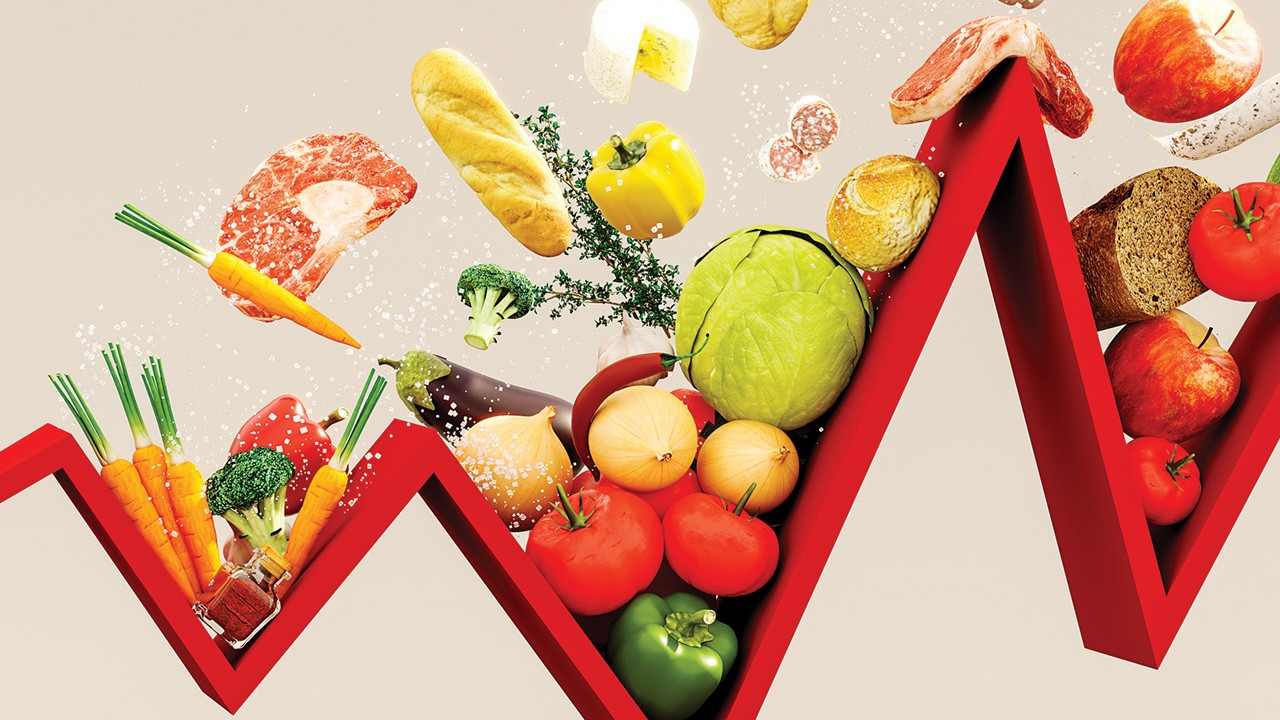
the United Nations Food and Agriculture Organization (FAOFAO) announced the September results of the Global Nutrient Price Index, which tracks the monthly change in the prices of food products between countries.
Accordingly, the FAO Food Price Index rose 3 percent on a monthly basis and 2.1 percent on a yearly basis in September to an average of 124.4 points. Thus, global food prices have seen the fastest increase in the last 18 months, led by sugar prices. In September, the Sugar Price Index recorded the largest monthly increase of 10.4%.
Weakening revenue expectations in Brazil and concerns that India's decision to lift restrictions on the use of sugarcane for ethanol production could affect the country's exports have been instrumental in this increase.
The increase in all works attracted attention
The Grain Price Index rose 3% on a monthly basis in September. This increase was due to the rise in wheat and corn export prices.
Vegetable Oil Price Index up 4.6% month-on-month, Prices of palm, soybean, sunflower and canola oil increased. The increase in international palm oil was due to the lower-than-expected production of the main producing countries in Southeast Asia.
The Milk Price Index increased by 3.8 percent on a monthly basis in September, while the Meat Price Index increased by 0.4 percent.
The increase in meat prices was due to the rise in chicken meat prices due to the strong demand for Brazil's works.
FAO revised its global grain production forecast for this year to 2,853 million tons, while forecasting that wheat production will increase by 0.5 percent this year compared to last year.
The scale of the food crisis in the world due to climate change is increasing day by day. Negatively affected food crops and plant-based animal feed threaten nutrient access globally.
Mersin Chamber of Commerce and Industry (MTSO) Chairman Hakan Sefa Çakır, Mersin Commodity Exchange Chairman Ö. Abdullah Özdemir and Yusuf Değirmenci, Chairman of the Board of Directors of the Chamber of Food Engineers, made evaluations to the DÜNYA Newspaper.
Hakan Sefa Çakır, Chairman of Mersin Chamber of Commerce and Industry (MTSO), emphasized that there is no food crisis that will put countries and the world in great distress nationally and globally, and that there is a problem caused by wars and production and transportation problems on the basis of certain products. Çakır, ⁇ For example, wheat supply originating from the Russia-Ukraine war.
There are food prices rising with inflation brought on by the long-standing global economic contraction. If these political problems, wars and economic contraction continue, the balance of supply and demand will be disturbed in a short time and a crisis will occur. The deterioration of the supply demand balance, the increase in prices due to increasing costs, the deterioration of product quality, the decrease in shelf life and, of course, the negative conditions created by global climate change, which is the most important problem of the coming years, indicate that the food crisis is at the door and we should take this issue seriously.
We must harness the power of technology.
Çakır, who says that a planned agricultural production is necessary in order to ensure sustainability in food, is also dependent on data in his plan and cannot be made in his plan if there is no correct data, ⁇ You should definitely work with the sector, agricultural dynamics, farmers, and listen to the voice of the base. Of course, the main element of sustainability is to protect nature, soil and water.
How will we talk about sustainability if we cannot leave a healthy soil, clean air, clean water source to future generations? To be sustainable means to protect these resources today, to use them efficiently and not to waste them. Here, too, we must use technology and take advantage of the power of technology. We have to integrate digitalization into agriculture and food. The other side of the job is human resources. It's a city-building world. It's the same in our country. Rural life is disappearing. People are now leaving the agricultural sector. New generations are not interested in agriculture. We have to ensure the return of young people to agriculture.
⁇ Food planning should be done ⁇
Emphasizing that uncontrolled and unconscious production creates supply from time to time and this situation causes waste, Çakır said that we should integrate agriculture more into the food industry and ensure long-term storage conditions. It's all about planning. We need to know how much to produce. Unplanned means wasted. The other thing, of course, is that there is no traceability. All processes from the field to the end consumer of agricultural products, all processes such as production, storage, packaging, transportation should be monitored, that is, recorded.
Traceability is a food safety issue. In whichever of the processes there is a problem, measures are taken according to it and waste is prevented. But if there's no traceability, you don't know where the waste is. Çakır stated that in a country that adopts a free market policy, the state should assume the duty of control rather than production, and should carry out sanctions with incentives and supports. With the right information from the base, it should make macro planning in cooperation. Food crises are a national security issue for countries.
States have to feed their people, they have to provide healthy food. It has to protect society against excessive food price increases. Emphasizing that there was an unprecedented food price increase in the world, Çakır said that there were never-before-seen droughts. Çakır, ⁇ All this means that the bells of the food crisis are ringing. Price increases, irregular nutrition, increased diseases, unhealthy new generation, depleted soil and water resources. All of this creates a dark picture. He said that we will come out of this dark picture with cooperation between countries.
⁇ The importance of agriculture and food sector is increasing ⁇
Mersin Commodity Exchange Chairman of the Board Ö. Abdullah Özdemir said that with the pandemic process that started in the last months of 2019, the importance of the agriculture and food sector has increased further, countries have started to exhibit more protective attitudes in agriculture, and various practices such as customs tax changes, prohibition of exports, restriction or quotas have started to be implemented. In this period, concepts such as food nationalism, self-sufficiency, food reliability, sustainable food and food waste started to come up much more.
The food crisis is one of those concepts, he said. The United Nations (UN) has set a goal of ending world hunger by 2030. The State of Food Safety and Nutrition in the World report released by the UN Food and Agriculture Organization (FAO) emphasizes that this goal is far from being achieved.
⁇ Turkey in Food Sustainability Index ⁇ 28 ⁇ inci ⁇
Özdemir emphasized that according to the data of the Ministry of Agriculture and Forestry, 93 kilograms per person and a total of 7.7 million tons of food are thrown away every year in Turkey, and according to the statement of the Turkish Food Industry Employers' Union (TÜGİS), 14 million pieces of bread are thrown away in our country, while Turkey is the 15 ⁇ th country with the highest food waste among 214 countries. Özdemir stated that the world's population is expected to be based on 10 billion people and the population of Turkey is expected to be based on 100 million people in 2050, so we do not have a single bite of luxury to waste.
Moreover, in the last 20 years, agricultural areas in our country have decreased by about 10 percent, while our population has increased by 17 percent. In the future, we may have to feed more populations with less agricultural land. We should know the value of each of our foods produced with all this effort, and we should already spread this awareness, especially among our younger generations. Yusuf Değirmenci, Chairman of the Board of Directors of the Chamber of Food Engineers, who said that the food crisis in the world also affected Turkey, noted that basic foodstuffs such as wheat decreased in the world with the effect of the Ukraine and Russia war and logistics could not be provided.
⁇ Awareness about sustainability should be made ⁇
Değirmenci said, "When the soil and water are protected, and you protect the person who will cultivate that soil, we ensure sustainability." This phenomenon, which has become an indispensable fact for the Agriculture and Food sector in today's world, will become even more important in the future. For this reason, as consumers, we will draw attention to all these issues first. Then, people in the position of producers will research the conditions of ensuring sustainability and develop a production model in this way. Miller also emphasized that in line with state incentives, citizens and farmers should be aware of sustainability in food.
⁇ The right agricultural areas should be selected ⁇
⁇ 900 million people suffer from malnutrition problems ⁇ Yusuf Değirmenci, Chairman of the Board of Directors of the Chamber of Food Engineers, who also touched on the importance of choosing the right agricultural areas, ⁇ It is necessary to ensure food sustainability by considering many conditions such as not opening agricultural areas to construction, not planting products where irrigation is very necessary in drought areas, and choosing seeds and seedlings. It is necessary to choose the right seedlings and seeds. It's important to put the right product in the right place. Breading a product that requires a lot of water in a place where there is no water reduces productivity, he said.
We cannot resist the food crisis by wasting water
Hakan Sefa Çakır, Chairman of the Board of Directors of Mersin Chamber of Commerce and Industry (MTSO), stating that it cannot be resisted against the food crisis by destroying the soil with traditional agricultural methods, chemical fertilizers and drugs, and wasting water with wild irrigation, we have to focus on the use of high technology in agriculture and food R&D.
The issue is not only about production, but also about the ecological, social and health damages along with monetary values such as energy, logistics, promotion and labor in terms of cost. All these seemingly indirect issues should be evaluated in a short time. Global warming is not a conspiracy theory, the food crisis is not a far-fetched phenomenon. Everyone from the citizen sitting at home to the producer, from the representatives of the sector to the public has a responsibility, there are things to do. "The food issue is a matter of survival, it is a matter of national security," he said.