

Things are going badly for the European auto industry. Fewer cars are sold than expected, and most of the new electric models remain available. Volkswagen (VW) is not the only one facing forced factory closures; Renault and Fiat are also producing more cars than they can sell.
According to a study by Bloomberg Intelligence, one in three plants in Europe - BMW, Mercedes, Fiat, Renault and Volkswagen - is operating below capacity due to low demand. At present, some factories cannot produce even half of the cars that can leave the production lines.
The situation is particularly dire at the Mirafiori plant in Turin, where Stellantis Group ⁇ 's fully electric Fiat 500e ⁇ is produced. Production here fell by more than 60 percent in the first half of 2024. In Belgium, the Audi factory, where the expensive Q8 e-tron is produced, is also on the verge of collapse.
Europe's rival China
Sales problems are also depressing at the Renault plant in Douai ⁇ in northern France and the VW plant in Dresden ⁇ . Electric cars produced here can hardly find buyers, and manufacturers are hurting.
In a statement to ING chief economist Carsten Brzseski DW ⁇ ye, ⁇ We are in the midst of a structural change. This applies not only to VW, but to the entire automotive industry. We can see that this international trend towards increased electromobility leads to more competition.
The pressure on Europe's car manufacturers, especially from China, is increasing. Despite the penal duties imposed by AB ⁇ on electric cars made in China, manufacturers from the People's Republic ⁇ are determined to have a permanent place in the EU market.
In addition to the Geely brand, Lynk & Co., Chery, Great Wall Motor and BYD want to produce e-cars in their own factories in Europe in the future.
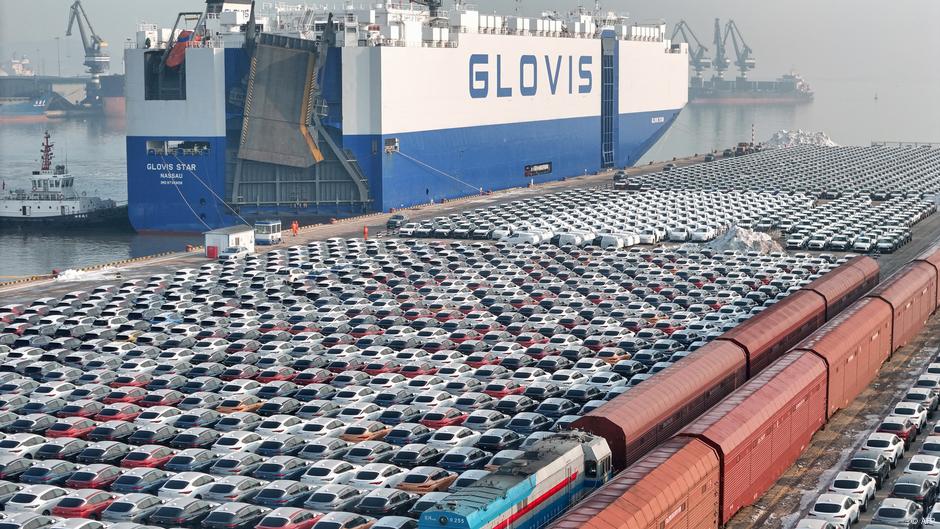
Cars waiting to be loaded on board in the Yantai Port of ChinaPhoto: AFP
Have the Car Managers Failed?
Why are European car manufacturers having such a hard time switching to electromobility? Did the managers miss the train, unlike their counterparts in China?
Carsten Brzeski says the industry is struggling with many problems at the same time. Many problems come together in the automotive sector, such as stronger international competition and lower competitiveness among Europeans.
Hans-Werner Sinn, who has been president of the Ifo Institute in Munich for many years, does not see this as a management failure in an interview with DW: For example, we cannot say that Volkswagen or others have missed the trend in the market. Rather, European politicians failed to realize that China was acting swiftly and decisively in this area. This may be a deficiency. ⁇
Stating that the agreement called ⁇ Green Agreement ⁇ , prohibition of internal combustion engines in AB ⁇ from 2035 ⁇ and increasingly strict emission standards have radically invalidated market laws in a short time and put the sector on a politically-driven transformation route, Sinn argues that if a route correction is not made, Europe will be the loser.
According to Sinn ⁇ e, the increase in e-car production in China and France was seen as an opportunity to break the technological dominance of German automotive manufacturers in internal combustion engines. However, countries such as France and Italy have begun to question the issue again. Because they realized that the Chinese benefited the most from the radical change towards electromobility.
The zigzags drawn by politicians also have an impact on these uncertainties, Carsten Brzeski writes: What will happen to the internal combustion engine now? Will he stay or not? When will it be phased out? Will it be extended again or not? In addition to these uncertainties, the German government's decision to remove the e-car incentive premium by the end of 2023 also sowed salt and pepper in the wound. In this case, it should not be surprising that e-vehicles remain in the hands of manufacturers. ⁇
Prosperity will be in jeopardy
According to ING chief economist Brzeski ⁇ , there is no doubt that a possible decline in the automotive industry in Germany and Europe will jeopardize the current prosperity. In Germany alone, the automobile industry, together with suppliers, sub-industry and all other companies that indirectly do business with car manufacturers, account for seven to eight percent of the economic output.
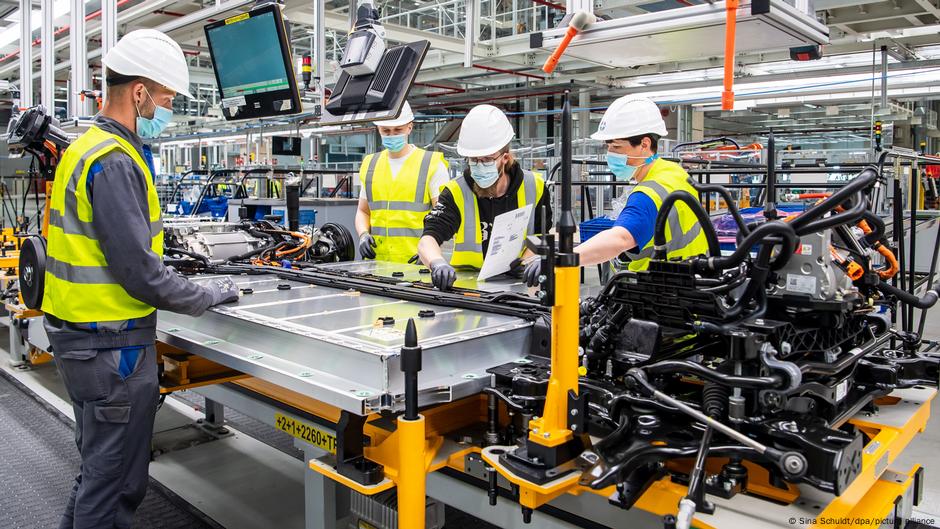
Production of the ID.4 model car at the Volkswagen factory in Emden, GermanyPhoto: Sina Schuldt/dpa/picture alliance
International climate club call
Munich economist Sinn ⁇ in has in mind a ⁇ climate club ⁇ of the largest CO2 emitter, as proposed by German Chancellor Olaf Scholz. All major players, such as China, India, Brazil, the US and the EU, will have to limit fossil fuel production and use. Sinn believes that this idea, put forward by Nobel Prize-winning US economist William Nordhaus, could actually help the climate. Everything else would be a dark central planning policy that doesn't really belong to the market economy.
EU plans such as the ⁇ Green Agreement ⁇ or ⁇ taxonomi ⁇ , which make the entire economy subject to climate and environmental protection, seem fundamentally well-intentioned. But these plans run the risk of undermining prosperity as they would override market laws. As an economist, Sinn sees this as a catastrophic scenario: You can end up ruining the economy this way. I recommend an urgent U-turn from this error. ⁇
Pressure on politicians and unions?
Frank Schwope of the School of Applied Sciences (FHM) for SMEs in Hannover ⁇ is relatively comfortable: The fact is that Volkswagen makes high net profits. For example, in 2023, it reached a record profit of 22.6 billion euros. Analysts expect a profit of 20 billion euros this year. In other words, the crisis has not reached here yet, but it will definitely make itself felt in the future. ⁇
According to Sinne ⁇ e, the VW administration is trying to put pressure on politicians and unionists by creating a ⁇ threat scenario ⁇ to bring down current salary demands and introduce new electric car incentive premiums.
The decline in sales continues
One of the brands that hit the brakes was Italian automotive giant Fiat. Production of the Fiat 500e at the Mirafiori plant in Turin was halted for a month due to a decline in sales.
Hans-Werner Sinn summarizes the current picture in the automobile industry as follows: Volkswagen is just an early victim. New ones will be added to this soon.


