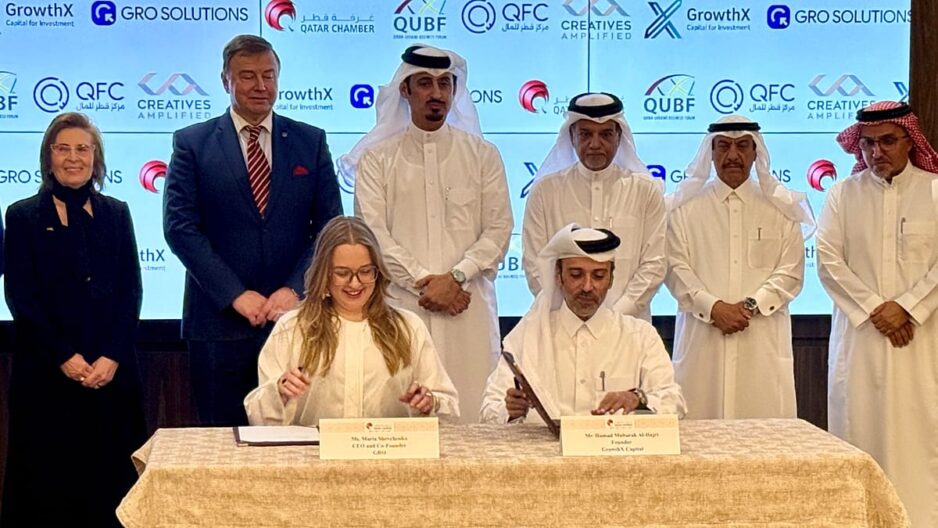
GRO’'s journey to Qatar began at Web Summit Katar’, where the company first connected with local investors.
The initiative, founded by Mariia Shevchenko and a team of Ukrainian and German co-founders, later decided to establish its headquarters in Doha’.
Shevchenko Euronews’e said the company plans to move to Katar’a full-time as it enters the next phase of growth.
“We came here, met investors, and started building relationships, ” said.
This move will support the company's expansion in the Middle East’.
The investment in GRO’ was announced on Thursday with the launch of GrowthX Capital’, a new venture fund aimed at attracting international founders Qatar’a.
The fund's founder, Snoonu CEO, Hamad Al-Hajri, said he plans to invest QAR500 million (€119 million) in startups over the next five years.
The launch event was held at the Qatar Chamber’ and was attended by Qatar Financial Center (QFC) CEO ’ Mansoor Rashid Al-Khater and Dr. Olga Rivina, co-founder and president of the Ukrainian Business Forum’ in Qatar.
Artificial intelligence financial assistant
GRO is developing an AI-powered financial assistant that helps users manage spending, make financial decisions, and improve financial literacy while keeping personal financial data private.
The platform is aimed at both adults and families, and parental control features are also under development.
Privacy remains one of the company's priorities.
Shevchenko said “Must be special for your financial situation”. “We are working intensively on an architecture that will turn it into a closed system.”
He said members of the company's German team brought expertise in privacy and parental control systems.
Ukrainian Ambassador to Qatar Andrii Kuzmenko welcomed the investment, describing it as a sign of growing trade ties between the two countries.
Al-Hajri said he believes GRO’ has the potential to become a “tek unicorn” (a venture worth more than $1 billion (€866 million)) in the future.
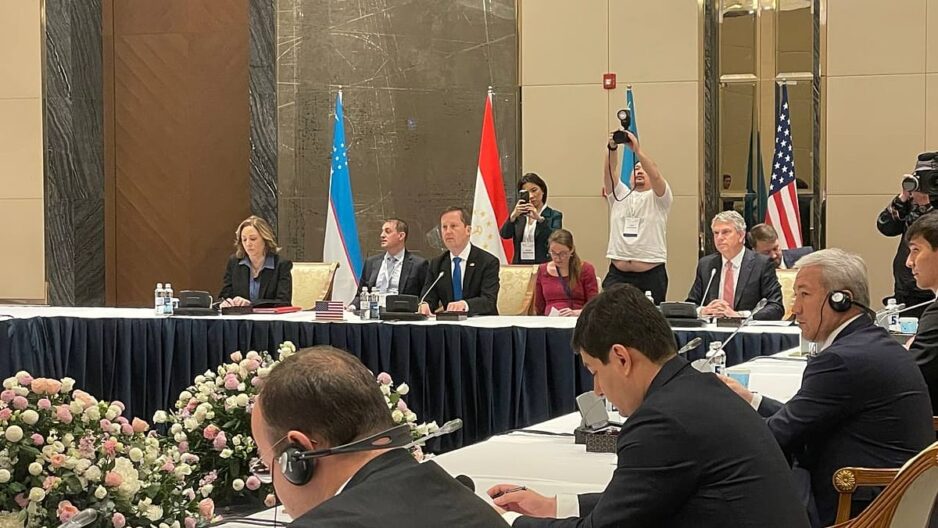
U.S. ’ Special Representative for South and Central Asia Sergio Gor met with officials from Kazakhstan, Uzbekistan, Kyrgyzstan, Tajikistan and Turkmenistan for the first face-to-face meeting of the critical minerals dialogue under the C5+1 format, which brought together five Central Asian countries and the U.S. ’.
The meeting followed talks between US President Donald Trump and Central Asian leaders at last year's C5+1 summit in ’, Washington, where the parties agreed to deepen cooperation on critical mines and related investments.
Gor, “When President Trump hosted the C5’ at Washington’ last fall, Central Asia was clear that the ’ did not receive the attention it deserved from the USA’, and he was adamant that this situation would change.
In a separate meeting with Kazakh President Kassym-Jomart Tokayev, Gor said that the Kazakh leader is “, a friend of ’ in the White House”.
Central Asia’'s mineral wealth is attracting growing interest from Western governments looking for alternative sources for critical raw materials. Kazakhstan has the largest and most diverse mineral base in the region, with more than 9,500 ’ defined deposits containing more than 100’ rare earths and other strategic minerals.
Euronews Office in Astana
A challenge continues to be transportation. As landlocked states, Central Asian countries must rely on land and sea corridors to reach global markets.
One of the important routes is the Central Corridor, which connects the Central Asian ’ to the European ’ through the Caspian Sea, the South Caucasus and further transport links.
Azamat Panbayev, Chairman of the Industrial Committee of the Ministry of Industry and Construction of Kazakhstan, said that “Central Asian countries and the American side are working together to develop joint solutions for the exploration, extraction and delivery of these mines to Western markets.
“A route runs over the Caspian Sea via the rapidly developing Central Corridor, which is currently experiencing dynamic growth in cargo traffic.”
Beyond transportation, governments are looking for investment across the entire value chain, including geological exploration, mining, and mineral processing.
Many beds in the area were first explored during the Soviet period, and additional research is needed.
1990Kazakhstan, which attracted a large US investment in the oil and gas sector in the ’s, is now looking for ways to replicate this experience in mining and minerals.
Said Sultanov, founder of a geological research and mining services company based in Astana, “, said that from a geopolitical point of view, the arrival of American companies contributes to a greater balance.
“There is China, there is Europe, there is Russia, and now American companies are entering the market. This increases competition and creates a healthier market environment.”
Kazakhstan has proposed expanding cooperation with the United States through joint critical mining projects, processing facilities, technology transfer, research partnerships and workforce training.
Minister of Industry and Construction Yersayin Nagaspayev, “Kazakhstan is interested not only in the export of raw materials, but also in the development of joint production facilities, technology transfer, labor training and scientific cooperation.
Kazakh officials said the country signed agreements worth $17 billion at meetings in Washington ’ last year, including a memorandum of understanding on cooperation on uranium, tungsten and rare earth elements.
Authorities expect the agreements to support domestic processing capacity and facilitate technology transfers. Kazakhstan has reached agreements with Cove Capital on the development of Severniy Katpar and Verhniy Kairakty tungsten bearings.
The government has also introduced investment conditions that allow foreign investors to hold majority stakes in some projects. Authorities, US-backed Kaz Resources Inc.’in shares, Kazakhstan’'s %He's talking about a recent tungsten deal where he'll own 30 shares.
KazakhstanInvestment in geological research in ’ has more than tripled since 2018’, exceeding $1 billion. Companies such as Rio Tinto, Barrick Gold, First Quantum Minerals, Ivanhoe Mines and Fortescue entered the Kazakh market.
Agreements and agreements between the two countries amounted to more than $20 billion last year.
Critical mines cooperation is expected to be high on Washington’'s agenda and further negotiations between the C5+1 countries and the United States are expected by the end of this year.
A consortium led by Airbus has proposed to develop a next-generation fighter following the collapse of its high-profile Franco-German fighter program, one of the companies involved told AFP news agency on Tuesday.
The move comes a day after German Chancellor Friedrich Merz and French President Emmanuel Macron’. After years of disagreements, he ended the original project.between industrial partners.
Munich-based defence electronics company Hensoldt said it has joined forces with Airbus Defence and Space, Autoflug, Diehl Defence, Rohde & Schwarz, Liebherr, MBDA and MTU Aero Engines to prepare an alternative plan.
A company spokesperson said the proposal was submitted to German Defence Minister Boris Pistorius’. The Financial Times, which first reported the initiative, said the initiative was also sent to Merz’in's office.
The companies are preparing a joint position document on the “ Future Combat Air System (FCAS) and the relevant Next Generation Weapon System (NGWS), ” said.
More details are expected during the announcement to be made at the Berlin ILA Air Show’ on Thursday.
EuropeA setback for ’'s defence integration
The German defence ministry confirmed the existence of the proposal. Pistorius, Berlin’in “, said ” was evaluating which direction we were going.
“We have also been discussing this issue with various stakeholders for months, ” added.
Pistorius said “ suffered from the collapse of the original Franco-German project.
I know how important French-German cooperation is in the European “, but ultimately you have to draw a line between the mind and the heart, ’ said.
The FCAS programme was seen as a flagship European defence project aimed at strengthening military co-operation at a time when the European ’ was facing increasingly tense relations with a more assertive Russia and the United States.
However, the initiative was hampered by long-standing disagreements between French Dassault Aviation and Airbus, Germany’'s leading industrial partner and a key partner in Spain’'s FCAS programme.
German partners opposed Dassault’'s efforts to gain greater control over the construction of the aircraft.
Merz also argued that Germany ’, unlike France ’, does not need warplanes capable of carrying nuclear weapons or working with aircraft carriers.
Belgian prosecutors are in the advanced stages of an investigation into money transfer company Wise over suspicions that criminal groups are using their accounts for money laundering, officials said on Monday.
The Brussels prosecutor's office said it launched the investigation last year after the British firm's name repeatedly appeared in hundreds of requests for assistance from investigative authorities in other countries.
Prosecution spokesman AFP’ye said in a statement, first confirming the information reported by the European Investigative Collaborations (EIC) network, the “Investigation is currently at an advanced stage and approaching the conclusion.” said.
“The findings are primarily related to the use of Wise accounts for criminal purposes, in particular with indications that anti-money laundering legislation has not been complied with due to the inability to identify customers and their activities.”
Investigators are examining whether criminal groups are using Wise services to launder proceeds from illegal activities, including fraud, corruption and drug trafficking.
The investigation focuses on Wise Europe’, the Belgian-based European subsidiary of the firm, which says it is cooperating with prosecutors and responding to requests for information about its business.
The company said in a statement that such requests for information are a normal part of “operations and are not indicative of any misconduct or non-compliance with anti-money laundering requirements on their own.
The company, “, has not shared any specific findings with us to date, ” added.
Wise, which has more than 19 million active customers worldwide, says it handles about 4.7 million transactions per day.
The company said it processed more than $243 billion (€213 billion) in cross-border transactions during fiscal year 2026.
London Stock Exchange at noonWise shares in ’ approx. %He's down 15.
British low-cost airline easyJet said in a statement published on Monday that US-based private investment firm Castlelake’ had registered interest in the possible takeover. After the news, the airline's shares are in early transactions %Increased by more than 12’.
Castlelake confirmed the rumors on Friday, saying that “ is in the early stages of evaluating a possible proposal, stressing that no approach has yet been taken to the easyJet board of directors. “There can be no certainty as to whether any offer will be made or the terms of any offer.”
The British low-cost airline, “, said in a statement that it was clear about the Board's task of targeting maximizing shareholder value and would consider any proposals if they were made. However, “ added that the Board would be particularly careful about its valuation and deliverability in any assessment.
Dan Coatsworth, market manager at AJ Bell, said “EasyJet’'s largest shareholders are unlikely to accept a takeover offer unless there is a knockout price.
Coatsworth said the airline is facing its toughest period since the Covid-19 pandemic, largely due to rising jet fuel prices linked to the closure of the Strait of Hormuz ’ following the conflict involving Iran’.
The airline's statement also stated: “Kurul points out the extremely opportunistic timing when easyJet’'s share price temporarily falls due to the current situation in the Middle East’ and its impact on customer confidence and jet fuel prices.”
easyJet shares in London’ on Monday morning %In 12 increments, 445.80p was traded from ’. Due to increased fuel costs and travel cuts caused by conflicts in the Middle East’, there has been a 23 percent drop in the last 12 months.
EasyJet added that “ remains in a strong position, backed by strong customer satisfaction and high employee engagement, as well as a net cash position, an investable balance sheet, and is highly confident in the company's strategy and ” ability to deliver attractive long-term value to “ shareholders.
“Board highlights significant regulatory, financial and other implementation challenges related to the potential takeover of easyJet’.”
Coatsworth, “Given its history of investment linked to the aviation industry, there is a logic to Castlelake’'s interest in this business, ” said. The biggest unknown is whether easyJet will want to run “ in its current form or simply reverse it when market conditions improve.’
Under UK takeover rules, Castlelake’ has until 26 June’ to either make an official offer for easyJet or announce that it has no intention of continuing.
Ryanair reported record post-tax profits of €2.26 billion for the year up to March 2026’; in relation to the previous fiscal year. %It represents an increase of 40’, warning that fluctuations in oil prices and geopolitical risks remain key concerns for the airline industry.
Despite ongoing delays in Boeing aircraft deliveries that have restricted capacity growth, the number of passengers in the 2025-26 period %4 increased to 208.4 million.
It happens to the passenger %Due to the high wages at the rate of 10 %7 increase, while operating costs are only %6 increase in unit cost %1’de held it. The Total Income increased to 15.54 billion Euro’.
CEO Michael O’Leary said Ryanair’'s fuel risk hedging strategy has mitigated the direct impact of the recent rise in oil prices caused by the Iran war and concerns over shipping routes in the Gulf ’.
Ryanair estimates fuel needs for the current fiscal year ’ini said it protected it from about $67 per barrel until April 2027’.
Middle East tensions overshadow airline's appearance
The carrier warned that instability in the Middle East’ continues to create uncertainty for airlines and energy markets globally.
Ryanair said in its earnings statement that the sector would continue to suffer potential disruption if tensions around the Strait of Hormuz, a key global oil transit route, escalated further.
But the company believes it is uniquely positioned to take advantage of the potential collapse of other European airlines.
In an interview with CNBC on Monday, CFO Neil Sorahan said that “I think prices will stay high longer, which puts Ryanair’i in a particularly strong position given our strong fuel protection.
In an interview with CNBC in April, the CEO of Ryanair’in confidently stated that the company could profit from the disruption of other airlines.
O’Leary said at the time: “, I think there will be failures. If it continues at $150 per barrel in July, August and September, then you will see that European airlines have failed, and this will probably be good for Ryanair’'s business in the medium term.”
It's a FILE. Ryanair CEO Michael O’Leary speaks at a press conference at ’ in Brussels’ in September 2022
The airline refused to publish detailed profit guidance for fiscal year 2026-27, citing limited visibility into future fees, consumer demand and fuel costs.
Ryanair said summer bookings remain generally strong, although customers continue to book flights close to departure dates due to wider economic uncertainty.
Boeing delivery delays remain a constraint
Ryanair said delays affecting Boeing aircraft deliveries continue to restrict European ’'s opportunities for expansion in the short-haul aviation market.
The airline expects traffic to increase to around 216 million passengers this year, with the gradual introduction of additional Boeing 737 MAX aircraft.
O’Leary also warned that aircraft shortages and supply chain constraints affecting the wider aviation sector will likely continue for several more years, limiting industrial capacity growth across Europe.
Ryanair argued that tighter market capacity should continue to support fees, especially for low-cost carriers with a scale advantage and strong balance sheets.
The company also confirmed that negotiations are ongoing on the extension of its contract, which will allow O’Leary’ to serve as CEO until 2032.
Could Mercedes-Benz move towards the defence sector as well as car and Formula 1 racing in the future? According to CEO Ola Källenius’, at least the idea is not off the table.
In an interview with The Wall Street Journal’a, the Mercedes-Benz chief said the company would be open to supporting Europe’'s growing defense efforts.
Källenius, “The world has become more unpredictable, and I think it's pretty clear that Europe needs to strengthen ’'s defensive capabilities, ” said. "If we can play a positive role in this, we will be ready to do it." - “
Källenius did not outline any concrete plans. But he stressed that any potential defence-related business would remain a small complementary activity compared to Mercedes-Benz’'s core automotive operations.
The company has not yet released an official statement on possible projects.
Guns instead of cars?
Mercedes-Benz is not the first car manufacturer to consider a potential future role in the defence industry.
Volkswagen is also exploring possible opportunities linked to defence production. CEO Oliver Blume said the company plans to decide later this year whether military transport vehicles can be manufactured at the Volkswagen’in factory in Osnabrück’. Blume also emphasized that the Volkswagen’ will not produce weapons or tanks.
Meanwhile, defense companies are increasingly turning to the struggling automotive sector. Rheinmetall, Neuss and Berlin said they were investigating whether some of the existing automotive supplier facilities in ’ could be converted into defense production.
The company is also reportedly considering taking over entire factories from automakers facing economic pressure. Among the facilities under discussion is the Volkswagen’in Osnabrück plant, whose long-term future remains uncertain.
But Armin Papperger, CEO of Rheinmetall, has been cautious so far, stating that existing automotive plants are only partially suitable for defense production and conversions will be expensive. Still, he said, such options should be considered before completely new facilities are built.
Other defense firms are also benefiting from the decline in Germany's ’'s automotive industry. Aerospace and defense company Hensoldt is actively recruiting skilled employees from suppliers such as Continental AG and Bosch.
Rising defense industry
Germany’'s automotive industry is under increasing pressure. High production costs, weak demand across Europe, increased competition from China’, and U.S. tariff threats from ’ place a heavy burden on manufacturers.
In February, Mercedes-Benz reported a profit of around €5.3 billion from €10.4 billion in 2025’te %He reported that he had fallen by 49 percent, while his income had fallen by about nine percent.
All major German automakers, except BMW, have announced layoffs at their domestic factories in recent months.
While the automotive industry is struggling, the defense industry is growing. According to Stockholm-based peace research institute SIPRI’, the world's 100 largest arms manufacturers reached record revenues in 2024’.
Analysts, however, question whether the defense sector can realistically offset the decline in the automotive industry. The scale of the two sectors remains quite different: Germany’'s automotive sector generated revenues of more than 540 billion Euro’ in 2024 alone.
By comparison, the country's five largest defense companies, 2023’te, generated total revenues of just under 30 billion Euro’.
German telecommunications company Deutsche Telekom and defense firm Rheinmetall said they have developed something they call the “ defense shield against unmanned aerial vehicles and acts of sabotage.
In a joint press release Monday, the companies announced plans to protect cities and critical infrastructure across Germany. This comes at a time when countries across Europe have seen an increase in attacks by unidentified drones in recent years.
Due to the current geopolitical situation, there has been a steady increase in threats from “sabotage and drone activities, Rheinmetall said.
The system will use sensors to detect drone’s and be able to disable them using signal jamming technology or preventive drone’s.
Companies say laser technology could also be used to stop drones near industrial sites, power plants and other sensitive infrastructure.
The number of drone incidents is increasing.
Germany's Federal Criminal Police Office said more than 1,000 suspected drone flights were reported last year.
BKA President Holger Münch told German media that military installations, airports and ports are among the places most affected by the outbreak.
Germany has also passed a law allowing the armed forces to shoot down unmanned aerial vehicles in some high-risk situations.
Armin Papperger, CEO of Rheinmetall, said drone defense requires a combination of ’ sensors, countermeasures and secure communications systems.
Deutsche Telekom said it would contribute expertise in cloud computing, connectivity and data analytics.
A YouGov survey conducted last year found that respondents ’ was concerned about recent drone sightings.
How does technology work?
During the 2024 European Football Championship in ’, Germany, Deutsche Telekom was tasked by police to detect and localize unauthorized drone flights on the pitches.
The company said this is possible thanks to a network of sensors it has been developing since 2017.
Telecom said its systems used a combination of video, audio, radio frequency and radar sensors to detect drones.
One of the methods uses passive radio frequency sensing, which itself does not emit signals. Telecom, technology low-altitude drone’s %He said he was able to identify more than 90’.
Mobile network controlled droneDetection of ’s
Companies say detection systems need to be adapted as more drones are now controlled via mobile phone networks rather than traditional radio controllers.
Deutsche Telekom, together with Helmut Schmidt University/Hamburg Federal Armed Forces University, is exploring ways to detect such unmanned aerial vehicles.
Researchers are investigating whether mobile networks can help identify drone activity by detecting unusual patterns of data traffic.
The research is based on an independent Ericsson 5G network installed on the university campus.
Rheinmetall expands drone defense work at Hamburg’
Rheinmetall is also expanding its civilian drone defense operations.
December 2025’te Rheinmetall, Hamburg police and Hamburg Port Authority enter into a strategic partnership to help protect the port, where heavy infrastructure and heavy radio traffic can complicate drone detection.
Rheinmetall, whose defense systems are already in use in Ukraine and the Middle East, said it would develop customized solutions for critical infrastructures.
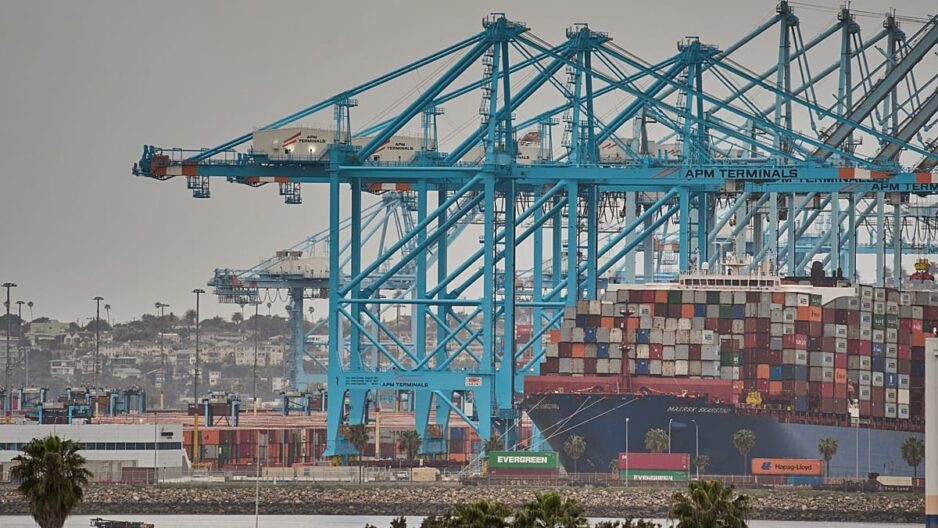
Shipping giant Maersk reported that despite strong demand for container transport, its earnings fell significantly in the first three months of the year.
Net profit from January to March fell to $100 million (€85 million), nearly 12 times lower than a year ago, when extraordinarily strong demand for maritime transport increased earnings.
It comes in %It fell 2.6 percent to just under $13 billion (11 billion euros), while earnings per share fell from $74 in the same quarter last year to $4.
The Copenhagen-based company notes that weak freight rates in the Ocean division are the main barrier to gains, but not in volumes across the enterprise. %He said the 9.3’ increase helped offset some of that decline.
Maersk said the conflict in the Middle East’ has only a limited direct impact on first-quarter results, but warned that this adds new uncertainty to the global outlook.
The conflict that began in “ on February 28, 2026, created an additional layer of uncertainty, ’ said in a statement.
He added that traffic in the Strait of Hormuz, ’, remained almost at a standstill, while weak sentiment puts pressure on consumer confidence.
Despite this, global demand for container transport is in the quarter %From 3 to %Five is up.
Chief executive Vincent Clerc said demand remained resilient in most regions.
“We saw strong demand in most regions this quarter, which supports strong volume growth across our three business segments, ” said.
But he warned that volatility in ocean transport continues to be high, and excessive transport capacity continues to put pressure on rates.
Maersk did not change its forecast for the whole year and said that global container demand will increase in 2026, in line with the overall market in ’. %From 2 to %He said he expected it to go up by four.
However, he warned that the sector continues to face surplus supplies from new ship deliveries, and that uncertainty persists as to when major shipping routes through the Red Sea and Strait of Hormuz will be fully reopened.
Maersk’in stock price Denmark’'s Nasdaq Copenhagen stock exchange at 10:30’ (CET) %It lost 4 percent of its value.
Industry under pressure
The wider maritime sector is also struggling with disruptions.
Hundreds of ships have been stranded in the Persian Gulf ’ for more than two months due to the Iranian conflict, which increases costs and disrupts the flow of trade. Delayed cargoes in the region include crude oil, refined products and fertilizer, while thousands of sailors remain on ships without being able to move freely.
According to U.S. military estimates, there are more than 1,550’ ships in the Persian Gulf, carrying around 22,500 sailors.
Insurance premiums for ships operating in the region also increased sharply due to the threat of attack, increasing pressure on operators already facing rising fuel costs.
German maritime group Hapag-Lloyd said the disruption around Hormuz cost it about $60 million (51 million euros) a week, largely due to rising fuel and insurance bills.
Analysts warn that even if the Bosphorus ’ reopens soon, markets are unlikely to return to normal quickly.
Kaho Yu, head of energy and resources at Verisk Maplecroft’, said refineries, shippers and commodity traders will remain cautious until there is clear evidence that a new threat of disruption has passed.
“Energy markets are unlikely to quickly return to pre-crisis assumptions, ” said.
German lawmaker Bernd Lange (S&D), head of the European Parliament's trade committee, told Europe Today’e on Monday that Trump’ is not interested in EU vehicles. %He said the decision to impose 25 tariffs was politically motivated and targeted directly at German automakers.
Lange, “These tariffs have no legal or economic reason. This is really politically contrary to Germany's ’, he said. “ is specifically targeted at German automakers.”
Lange’nin's remarks came a few days after German Chancellor Friedrich Merz’in US Trump’ announced the tariffs after ’'s criticism of his war in Iran’.
The US president has accused many European countries of refusing to contribute to Washington ’'s military operations against Iran ’. On Friday, Germany announced it would withdraw 5,000 U.S. troops from ’.
Measures if enacted this week, July 2025, between ’te Trump and European Commission President Ursula von der Leyen Turnberry, Scotland, agreed under the trade agreement reached in ’ %He's going to violate his 15th ceiling.
Lange expressed doubts about the Turnberry deal, which was reached after weeks of trade tensions between Europe and the United States following Trump’'s rise to power and the launch of a nationalist trade agenda.
Lange said “ about the deal, which I'm not sure we can really continue.
Divisions over the guarantees of Parliament
The Turnberry agreement was subsequently suspended several times by members of the European Parliament; Especially after Trump’ threatened tariffs on EU countries that didn't allow him to buy Greenland’.
The mood in “ changed especially after Greenland’, Lange said, adding that all retaliatory options are now on the table after Trump’'s recent threats.
Referring to AB’'s anti-pressure tools designed to respond to economic pressures from third countries, we have the “Toolbox, and of course all the tools are also available, ” said. “We will also look at other elements, such as countermeasures, such as counter tariffs or export restrictions.”
The agreement is currently being discussed between EU governments and lawmakers with the aim of reducing EU tariffs on U.S. industrial goods to zero, as outlined in the agreement.
Members of the European Parliament nevertheless added security measures to the joint statement, including a ’ sunrise “ clause, which stipulates that the new EU tariff cuts must meet US”'s obligations, and a ’ sunset “ clause, which will terminate the agreement in March 2028”.
However, EU member states are divided on these provisions; France's European Parliament supports ’'s tougher stance, while Germany resists.
Lange said “, Germany was unfortunately more in the second camp. “Now I think there's a change here too.”