
The OECD warned: Global steel crisis deepens as supply surplus reaches alarming levels

Global steel production capacity continues to increase despite weak demand, which threatens to cause prices to fall and competition to deteriorate.

Steel is a critical material for a wide range of industries, from construction and manufacturing to electric vehicles and data centers.

The OECD says government subsidies are a major driver of global surplus capacity, with most of the increase in steel production capacity over the past two decades occurring outside OECD countries, often with government support.

According to OECD’, in 2024, the average Chinese steel firm received subsidies equivalent to 15 times the subsidies received by producers elsewhere based on total assets.

At the same time, Chinese steel producers exported a record 131 million tons of steel in 2025’te; This is according to 2020’ %With an increase of 153, the European Union was more than ’'s total steel production that year.

The warning comes at a time when OECD’ expects global steel surplus capacity to increase from 640 million tons in 2025’ to 745 million tons in 2028’, as steel production capacity continues to increase much faster than demand.

Global steel demand is expected to increase by only 34 million tons between 2026 and 2028, while producers plan to add up to 139 million tons of new capacity in the same period.

China’in is expected to play an important role in this expansion, with plans to increase its steel production capacity to 38.6 million tons by 2028; This is the largest increase planned by any country.

If these projects continue, the OECD says the global overcapacity will exceed the current annual steel production of all OECD countries by almost 320 million tons, underlining the extent of the imbalance the sector faces.

Policymakers fear that permanent surplus capacity could undermine the profitability and long-term viability of local steel industries, increasing dependence on imports of a material deemed strategically important for construction, defense, energy infrastructure and manufacturing.

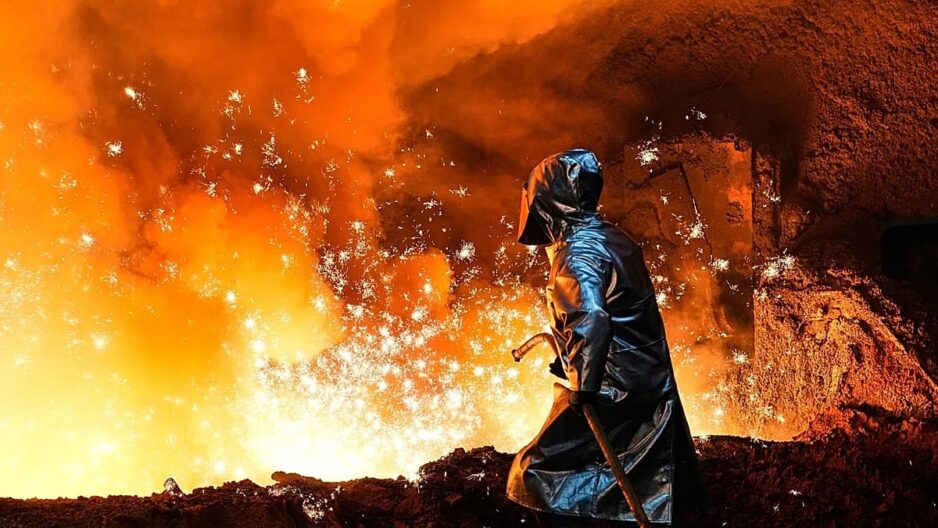
5 November 2025’te DuisburgSteel production at the ThyssenKrupp steel mill in ’

Speaking at the OECD Council of Ministers Meeting, OECD Secretary General Mathias Cormann said: “We need to address the root causes, including harmful subsidies and other non-market applications. This means stronger international cooperation and an equal playing field for steel producers everywhere.”

The OECD also found evidence that some exporters have overcome trade barriers by sending semi-finished steel to Southeast Asia ’ for processing before re-exporting it to OECD markets. China’in exports semi-finished products to the region %The 300’ increase points to a possible route to avoid customs duties and anti-dumping measures.

Energy costs and trade tensions increase pressures

At the same time, the sector is grappling with rising energy costs in connection with the Iran war. Energy, steel production costs %It can make up 40’, making the industry especially vulnerable to high prices.

The report also highlights the increasing pressure on the supply of raw materials. No country producing steel is completely self-sufficient in the inputs required for steel production; Export restrictions on basic materials are increasing worldwide. Forty-two countries are now restricting the export of steel scrap, an important raw material for the production of electric arc furnaces.

Europe is particularly vulnerable to these pressures. The region's steel producers often face higher labor and energy costs, as well as stricter environmental standards, compared to many international competitors.

As a result, European ​​ producers are generally less able to withstand long-term low prices compared to their competitors, who enjoy lower costs or stronger government support.

If current trends continue, the long-term viability of the sector and the economic security of many countries will weaken.

Turkey lifts restrictions on direct trade with Armenia’ to improve relations

Turkey lifted the restriction on direct trade with Armenia on Wednesday as a symbolic gesture to improve ties between its longtime rivals.

Turkey's Ministry of Foreign Affairs Spokesperson Öncü Keçeli said that under the new regulation, shipments of goods from Turkey or Armenia ’ through a third country can now be directly shown as the final destination or point of origin, Turkey or Armenia, and the pre-restriction on such definitions has been lifted.

Using the government's preferred writing for Turkey, in light of the historic opportunity seized to strengthen lasting peace and prosperity in “ South Caucasus, Turkey will continue to contribute to the development of economic relations in the region and the further advancement of cooperation for the benefit of all countries and peoples in the region.’

Armenia welcomed the move.

We would like to emphasize that this is an important step towards the establishment of full and normalized relations between the two countries, which can logically continue through the opening of the Armenia-Turkey border and the establishment of diplomatic relations, ’ said.

Turkish President Recep Tayyip Erdogan and Armenian Prime Minister Nikol Pashinyan at Prague Castle’nde, October 6, 2022

Turkey and Armenia ’ have no official relations and their common borders have been closed since the 1990s.

Relations between neighbours are strained by historical disagreements and Turkey's close alliance with Azerbaijan ’.

However, Ankara and Yerevan agreed to work towards improving relations in late 2021’ and appointed special envoys to discuss ways to reconcile and open the border.

Efforts have resulted in the resumption of direct flights between the two countries and the easing of some visa restrictions.

He said technical and bureaucratic efforts to open the common border are also ongoing.

AzerbaijanTurkey, a close ally of ’, closed its border with Armenia in 1993 in solidarity with Baku, which is in conflict with ’ over Karabakh, internationally known as Nagorno-Karabakh.

AzerbaijanThe national flag of ’ flies over destroyed houses in a residential area in Ganja’ where Armenian forces were hit by rocket fire overnight, October 22, 2020

In 2020, Turkey strongly supported Azerbaijan ’ in its six-week conflict with Armenian-backed ethnic Armenian forces over Karabakh; This caused Azerbaijan ’ to regain control of a significant part of the region and most of the ethnic Armenian population to leave the region.

Azerbaijan used Turkish military equipment, including warplanes, in the conflict.

Turkey and Armenia ’ also have a long and bitter relationship due to the deaths of approximately 1.5 million Armenian ’ in the massacres, deportations and forced marches that began in 1915’ in the Ottoman Turkey ’.

Historians commonly see the event as genocide. Turkey strongly denies this accusation and opposes the numbers; The Ottoman Empire says that among the hundreds of thousands of people who died in the chaos of the First World War ’ during the dissolution of ’, there were also Armenians.

Saudi Arabian oil giant Aramco hit by fall in oil prices

Saudi Arabia’'s state-owned oil giant Aramco compared to the previous year in the first quarter on Sunday as falling global oil prices undermined the kingdom's multi-trillion dollar development plans. %It posted a profit of $26 billion (€23.4 billion), down 4.6 percent.

Aramco’, officially known as Saudi Arabian Oil Co., reported in a file on Riyad’'s Tadawul exchange that the company generated revenues of $108.1 billion (97.4 billion euros) in the quarter. The company generated revenues of $107.2 billion (96.5 billion euros) and profits of $27.2 billion (24.5 billion euros) in the same quarter last year.

Saudi Arabia has pledged to invest $600 billion (540.2 billion euros) in the U.S. ’ during President Donald Trump’'s tenure.

Trump, who will make his first official overseas trip to Riyad’ on Tuesday since taking back the Oval Office, said in January that he wants that figure to be even higher, about $1 trillion (0.9 trillion euros).

Meanwhile, Saudi de facto ruler Crown Prince Mohammed bin Salman has set his sights on a $500 billion (€450.1 billion) project to build Neom’, a vast, futuristic city in the desert off the Red Sea coast. The kingdom will need new stadiums and infrastructure that will cost tens of billions of dollars by 2034, when Saudi Arabia will host ’'s World Cup.

OPEC+ increases oil production

The announcement of Aramco’'s first quarter results came as the OPEC+ alliance increased oil production. The oil cartel agreed to increase production by 411,000 barrels per day next month as uncertainty caused by U.S. tariffs spreads to Middle Eastern markets. This means that Saudi Arabia's ’ will likely have to borrow money or spend reserve funds to finance the crown prince's expensive goals.

Aramco’'s shares traded above $6 per share (5.4 euros) on Sunday; from last year's high of around $8 (7.2 euros). Last year, with oil prices falling, and in recent months.

"Global trade dynamics have affected energy markets in the first quarter of 2025’, while economic uncertainty has affected oil prices," Aramco President and CEO Amin H. Nasser said in a statement.

Benchmark Brent crude oil traded above $63 per barrel (56.7 euros) on Friday; There has been a decline since their peak above $80 (72 euros) last year.

Aramco’ has a market capitalization of over $1.6 trillion (€1.4 trillion), making it the sixth richest company behind Alphabet’, which owns Microsoft, Apple, NVIDIA, Amazon and Google’. Analysts see the company as a trend leader in global oil markets.

Part of Aramco’ is traded on Tadawul’, and the lion's share of the company is owned by the Saudi Arabian government, helping cover expenses and contributing to the wealth of the country's Al Saud royal family.