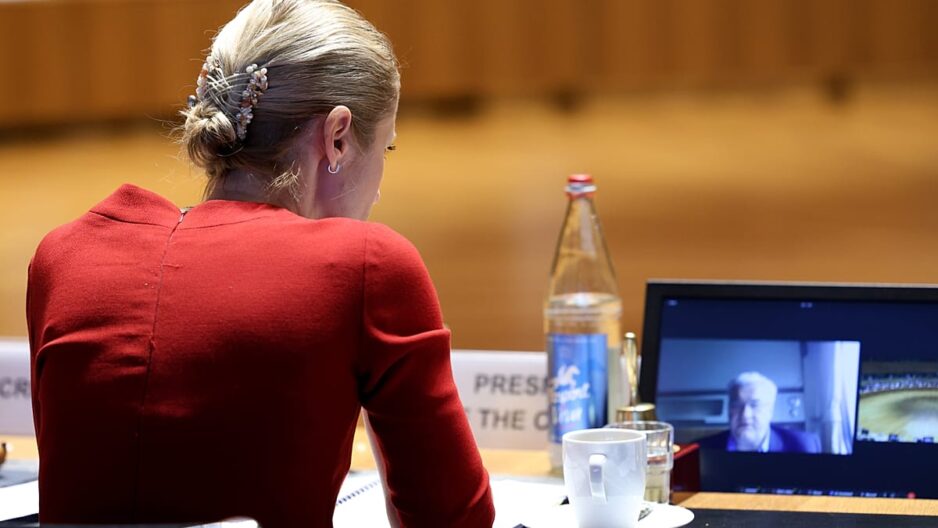
Speaking to Euronews’e, five diplomats from the European Commission are expected to present options on how to restrict imports of goods from Israeli settlements in the occupied Palestinian territories ahead of the EU Foreign Ministers' meeting in July.
After months of stalemate, the EU administration is under constant pressure from the majority of European governments to put forward a concrete proposal to restrict trade with settlements deemed illegal under international law.
At a meeting of foreign ministers in ’, Luxembourg on Monday, EU Commissioner for the Mediterranean ’ Dubravka Šuica said that given strong pressure from member states, the Commission will prepare some options ahead of ’'s next ministerial meeting on 13 July, Euronews’e quoted five diplomatic sources as saying.
However, it is not yet clear what types of options will be offered. The Commission has been reluctant to put forward proposals to restrict trade so far, bearing in mind that Council ’ could not find a qualified majority to suspend the EU-Israel Association Agreement; This is already a much more important measure and is already on the table.
Last week, a report by advocacy group Global Echo Litigation Center suggested that agricultural products produced in Palestinian-occupied areas entered the EU market mislabeled as legitimate Israeli goods.
In this context, the Commission may submit corrective measures if the evidence in the report is verified.
EU foreign policy chief Kaja Kallas told reporters after the meeting that “Many member states have called for proposals from the Commission on trade with illegal settlements. I will submit this request and ask the Commission ’ to draw up a list of options for possible trade measures, including measures aimed at preventing imports of goods from illegal settlements, ahead of the next Foreign Affairs Council.”
Israel has recently implemented measures aimed at strengthening its control over the West Bank and East Jerusalem in areas such as property law, planning and licensing; These steps are contrary to the important agreements signed under the Oslo peace agreement of 1993.
According to the opinion of the International Court of Justice (ICJ), ’, which found Israeli settlements illegal in 2024, settlement activities in the Palestinian territories are considered illegal.
In 2019, the Court of Justice of the European Union (CJEU) ruled that food products produced in Israeli settlements in the occupied territories should be clearly labeled as ’ from the settlement of “Israel, rather than simply being identified as ”Israel Product“.
Proposal to impose tariffs on goods from Israeli settlements, at least for the total population of AB’ %At least 65 of the EU member states representing ’ini %It will be decided by a qualified majority vote requiring the support of 55 ’i.
A group of member states, including France and Sweden, have already advocated this approach, arguing that tariffs fall under trade policy and therefore require only a qualified majority.
French Foreign Trade Minister Nicolas Forissier recently euronews’e saidAB’ said restricting trade with Israeli settlements was normal “, not an attacker.
In turn, the Commission stressed that such tariffs would constitute sanctions under EU law, require unanimity among member states and cannot be agreed on.
Council Legal Service ’, the institution's effective legal advisory body, reportedly opposed this view and strengthened pressure on trade restrictions to curb the illegal expansion of ’ in the West Bank of Israel.
The Israeli government rejects the illegal identification of these settlements and classifies them as “ temporary areas.
In May, after the new Hungarian government lifted the previous veto imposed by former Prime Minister Viktor Orbán’, the EU adopted restrictive measures against extremist settlers and the organizations that support them.
Kallas, “There was a clear understanding that options should be clear. I'll take this back to the Commissioners, ” said.
SpaceX is preparing for its biggest stock market launch ever.
Elon Musk’'s rocket company begins trading on Nasdaq’ on Friday under the code SPCX. The company raised $75 billion (64.5 billion euros) by pricing each of its shares at $135, setting the company's value at $1.75 trillion (1.5 trillion euros) in the largest stock market IPO on record.
The deal will comfortably eclipse Saudi Aramco’'s previous record of $29.4 billion set at 2019’, which was later increased by the general allocation option.
SpaceX did something unusual. EuropeA strong driver to attract retail investors, including those in ’. According to Bloomberg’, individual investors placed orders worth about $100 billion (€86.6 billion) through trading platforms such as Robinhood, Fidelity and SoFi during the IPO process.
This demand alone exceeded the company's goal of raising $75 billion (64.5 billion euros) in funding, underscoring the interest of small investors before entering the stock market.
But below this exaggerated advertisement, a few warning lights are flashing. Here are five risks investors should weigh before the SpaceX’ IPO goes live:
1. Is SpaceX’ worth $1.75 trillion?
Investors will value SpaceX’e at a valuation of $1.75 trillion (1.5 trillion euros), about 94 times its annual revenue of $18.7 billion (euro 16.1 billion) at 2025’. By comparison, Nvidia, one of the market's most valuable tech companies, is trading less than a quarter of that level.
Investment research firm Morningstar, which has valued the company at $780 billion (€675 billion), describes the company as “, which is significantly overvalued, while Goldman Sachs data suggests that sustaining the share price will require revenues of over $100 billion (€86.6 billion) by 2030, suggesting that annual compound growth %It says it's over 40’.
2. A valuation based on a small variability
Investors also need to pay attention to the size of the public eye. Although SpaceX’ is valued at $1.75 trillion (1.5 trillion euros), its shares are only %From 3 to %4’ü will initially be open to public trade.
This means that the market value of the company will be determined by trading a relatively small portion of its equity. Reports show that more than 75% of the $75 billion (64.5 billion euros) offer is already allocated to existing investors and insiders, leaving fewer shares in the open market.
According to Morningstar’, limited volatility and strong demand for AI-related stocks can help support the share price in the early stages of trading, even if the company is valued above what the research firm considers fair value. The firm argues that when lockdown restrictions expire and more shares become available for trading, a clearer picture of investor demand may emerge.
But some analysts believe the limited volatility could continue to support the stock. Estimates suggest that when Nasdaq 100’e joins SpaceX’e, passive investment between $22 billion (€19 billion) and $27 billion (€23.4 billion) could flow, creating additional demand from index tracking funds.
History offers a warning note. Research by University of Florida professor Jay Ritter, often referred to as “Bay Public Offering, found that IPOs between 2012 and 2021 averaged on the first trading day. %It increased by 23.6 percent over the next three years. %It turned out to yield a 10.6 percent return.
3. Not profit, but loss.
SpaceX’'s financial results could also cause investors to pause.
The prospectus shows that the company is growing rapidly but still losing money.
The company owns the Starlink satellite internet service, which generates most of its revenue and is its only profitable business. He also owns the artificial intelligence company xAI’, which merged with SpaceX in February.
According to the application, SpaceX posted a cumulative deficit of $41.3 billion (€35.76 billion) as of March 31, and reported a net loss of $4.27 billion (€3.7 billion) in the first quarter of 2026’.
This compares to $528 million (457 million euros) in the same period of the previous year.
Most of the recent losses are due to xAI’. According to SpaceX’'s public offering application, the artificial intelligence business 2025’te recorded operating losses of approximately $6.4 billion (€5.5 billion). The application also showed that xAI’ was spending heavily in the first months of 2026’ while expanding its artificial intelligence infrastructure.
Morningstar argues that the artificial intelligence unit “ poses a material threat to the loss of value, and Grok” has not yet achieved meaningful market share against competing chatbots.
Supporters say losses are a choice, not a structural flaw.
Revenue from the previous year's $14.1 billion (12.2 billion euros) in 2025’te %It rose 33 percent to $18.7 billion (€16.2 billion). The basic launch and satellite business was profitable as recently as 2024. The vulnerabilities largely reflect the intense investment in artificial intelligence infrastructure; The expenditures said by the supporters are already being compensated by new computing contracts.
4.Artificial intelligence growth gambling
Supporters argue that investors are paying for future growth instead of existing profits.
While Starlink remains the company's main source of revenue, the AI business is expected to play a larger role in the coming years.
The bulls also point to SpaceX’'s dominant position in rocket launch and satellite communications, suggesting that the company is uniquely positioned to benefit from the growing demand for connectivity, computing power, and artificial intelligence infrastructure.
SpaceX launches more rockets each year than the rest of the world combined, and has more than nine million Starlink subscribers, but the newest growth driver is the AI data center business purchased through the xAI merger.
Last Friday, Google agreed to pay $920 million (€796.6 million) per month for compute capacity at SpaceX’e xAI data centers in a 32-month agreement that will run from October 2026’ to June 2029’, covering access to approximately 110,000 Nvidia GPU’s.
This was after the agreement in May, when Anthropic’in paid $1.25 billion (EUR 1.08 billion) per month to lease the entire output of the Colossus 1 data center by May 2029, with total annual computing revenue of about $26 billion (EUR 22.5 billion).
The bulls argue that this contracted income, obtained in less than four months, shows how quickly the company can make money from its infrastructure. Skeptics note that both contracts include 90-day termination provisions after December 2026’, with Google’ itself framing the agreement as “bridge capacity” rather than a permanent commitment.
It's a FILE. Gas turbines seen at xAI plant in ’, Memphis, Tennessee, December 2025
5. Risk the size of Elon Musk
SpaceX’'s success, profile, and past performance are closely linked to Elon Musk’, which has helped attract investors, customers, and business partners. This creates what investors call “kilit person risk”; I mean, concerns about how the company would perform if he didn't lead anymore.
The management structure of the company strengthens this dependence. Musk’'s super-voting Class B shares give him an approximate voting power of %He gives away 85’ini, and outside shareholders have little impact on key corporate decisions. In practice, this means that no one but Musk’ can decide whether or not to remain CEO.
Critics also note SpaceX’'s establishment in ’, Texas; Only the least amount of shares %Investors who own 3’ can file derivative lawsuits. The Danish academic pension fund AkademikerPension has blacklisted the stock, describing its management structure as “ Catastrophe”.
Supporters argue that double-class sharing structures are common among U.S. tech firms, including Meta and Alphabet’. They say intense voting control allows founders to achieve long-term goals without pressure from short-term investors.
Musk’'s reputation also brings political risk. U.S. Senator Elizabeth Warren urged the Securities and Exchange Commission to review the listing, warning that its inclusion in the index in the future could expose millions of passive investors to stocks without actively selecting them.
Others noted that SEC’ completed its review faster than expected, suggesting that this allowed the IPO process to proceed without delay and that regulators saw no immediate impediment to listing.
Disclaimer of Disclaimer: This information does not constitute financial advice; Always do your own research to make sure it suits your specific circumstances. Also remember, we are a journalism site and aim to provide the best guides, tips and advice from experts. If you trust the information here, you do so entirely at your own risk.
German lawmaker Bernd Lange, chairman of the European Parliament's ’ trade committee, warned in the coming weeks that the longstanding Airbus-Boeing dispute could jeopardize the EU-US trade deal signed last summer if transatlantic tensions flare up again.
July 2025’te The Turnberry Agreement finalized in ’, Scotland by US President Donald Trump and European Commission President Ursula von der LeyenThe implementation of ’ is entering its final phase, which EU lawmakers are expected to ratify in a vote next Tuesday.
However, the five-year truce between US aviation giant Boeing and European Competitor Airbus over mutual subsidy claims ends on July 11, ’; The Trump administration and the European Commission have not yet reached an agreement on an extension.
Lange, parliament's chief negotiator on the EU-US deal, told reporters at a meeting with Socialist lawmakers on Thursday, “Will this lead to another tension? Nobody knows, ” said.
A member of the European Parliament worries that a renewed aviation and space dispute could further strain transatlantic trade ties after a year of intense tensions.
Lange euronews’e “I hope this doesn't blow up, ” said.
Turnberry deal remains fragile
The war between Boeing and Airbus goes back more than two decades. The United States first sued the World Trade Organization (WTO) for allegedly providing AB’ with illegal financial support to Airbus’. Brussels responded with its own complaint, accusing Washington’ of illegally supporting Boeing’.
The dispute eventually turned into a tariff war; Both sides imposed punitive taxes on products ranging from wine and spirits to cheese and tobacco, affecting $11.5 billion in trade.
In 2021, a ceasefire was reached under the Biden administration in ’, which came into force on July 11 of that year, and retaliatory measures were suspended for five years. However, no extension has been announced since then.
Olof Gill, vice-president of the commission, told euronews’e: “ Negotiations with the United States are underway to ensure stability and certainty and to continue the suspension of countermeasures on both sides.”
The Trump administration said on Trade Policy Agenda 2026 that the U.S. Trade Representative in ’ will decide in July whether to take action in the Section 301 investigation involving the enforcement of U.S. rights in World Trade Organization disputes over large civilian aircraft in “.
Under Article 301 of the 1974 Commercial Code, the U.S. may impose customs duties on its trading partners.
Last week at Washington ’ was threatenedImplementing a 10% customs duty on EU goods instead of forced labour following the Section 301 investigation. If implemented, these taxes will be added to the most privileged country tariffs available, and average U.S. tariffs on EU goods will rise above the 15 percent ceiling agreed under the Turnberry agreement.
Under the agreement, which EU lawmakers are expected to adopt next week, the EU has pledged to eliminate tariffs on U.S. goods. But lawmakers have fought hard to protect the deal from future U.S. tariff threats and take security measures to ensure compliance with the 15 percent ’ limit.
The deal always seemed fragile. Trump has repeatedly used tariffs as leverage in non-commercial disputes, from his attempts to buy Greenland ’ earlier this year to his more recent initiative. The threat isGerman Chancellor Friedrich Merz’in will impose a 25% tariff on EU cars after Iran criticized the war with ’.
If the Airbus-Boeing dispute flares up again, this could give the US president another excuse to terminate the 2025 agreement.
European Commission President Ursula von der Leyen, European Council President Antonio Costa and South Korean President Lee Jae-myung celebrated the signing of a new digital trade agreement at a ceremony in Brussels’ on Wednesday.
The event marked ’'s 11th summit in the EU and South Korea, where everything from security and defense to trade is on the agenda.
Von der Leyen, “Korea, Europe in the Indo-Pacific region and on the global stage is one of ’'s closest partners, ” said. In today's uncertain world, stable and reliable partnerships like ours are more valuable than ever.“
The trio issued a joint statement praising the value of the talks and stating the two sides' commitment to building a solid and friendly relationship.
"We reaffirm our shared commitment to effective multilateralism and a free and fair economic order based on stable and predictable rules," the statement said.
Semiconductor factor
At a time of heightened tensions with both China and the United States, both sides have an interest in diversifying their trade relations, and the EU-South Korea digital trade agreement comes more than a decade after a landmark free trade agreement.
According to figures from the European Commission’, trade between the EU and South Korea has doubled since 2015’, with trade in goods reaching approximately €124.25 billion in 2025’.
The European Council António Costa said on Wednesday that the “European Union-Korea Free Trade Agreement, since its entry into force in 2011, remains one of ’'s most successful trade agreements.
South Korea is becoming an increasingly important investor in Europe’, especially in strategic sectors such as batteries, electric vehicles and semiconductors.
An important goal for the EU is to secure semiconductor supply chains while enabling Korean companies to attract more investment to Europe’.
An EU official, “Korea, said ” has a global leadership position in semiconductors. “This is clearly an area with significant cooperation potential that will benefit both parties.”
According to another EU official, the digital trade agreement signed on Wednesday is expected to complement the wider trade partnership by reducing “ unnecessary barriers to ” digital trade and providing more “ legal certainty for businesses operating in the two markets. It will facilitate cross-border data flows while banning forced transfer of source code.
The agreement is also designed to establish robust online consumer protection rules; However, both partners aim to protect their own levels of protection for personal data and privacy.
Economic security also topped the summit agenda, and the two sides agreed to engage in a high-level dialogue on the resilience of the supply chain.
Supply chains came under pressure last year after China’in imposed restrictions on the export of strategic materials, including green technologies and rare elements essential for the defense sector, as well as products linked to the chip industry critical to automotive production.
Security and defense
The information security agreement, touted by EU officials before the summit as a way to strengthen the flow of confidential information between Brussels and Seoul, was something that did not cross the line.
"I hope that the “ Information security agreement will be adopted soon so that Korea and the EU can share confidential information securely, which will allow the two sides to actively engage in industrial and research cooperation through the exchange of information," President Lee said on Wednesday.
The agreement will build on the Security and Defense Partnership agreement signed by South Korea and AB’ in 2024’te. This agreement is designed to facilitate cooperation in areas including maritime security, combating hybrid threats, combating foreign information manipulation and interference, and more.
Ahead of talks this week, a senior EU official said the main topic of negotiations would be to prevent the spread of nuclear weapons, as North Korea continues to keep a small but worrying stockpile of ’'s nuclear-armed warheads.
The source said that North Korea (North Korea) and Russia, ’ at the summit, were considered major questions“, and Brussels, ”, Seoul and Ukraine, were ready to share information about ’'s support for ’.
In a joint statement from the summit, North Korea reiterated its condemnation of ’ye and Russia, as well as of other countries that have allowed ’ to continue its war of aggression against Ukraine’.
"We urge “, Russia and North Korea, to immediately cease such activities and to comply with all United Nations Security Council resolutions relating to the UN Charter," the statement said.
The impact of Trump’'s tariffs on the EU market is already becoming tangible; The negative trade trend is second only to Iran's ’.
According to Eurostat’, in the first three months of 2026’, the EU said that the value (€) of goods exchanged with the United States compared to the same period last year. %He lost 30 ’.
August 2025’te USA, AB’yi to various goods %Forced into a trade agreement that imposed 15 customs duties.
The Trump administration justified this by claiming that there are more than 300 billion Euro’ deficits with the EU.
Washington’'s shortfall with the EU is real. Around 200 billion euros.
But this is offset by the value of ’'s exports of services to AB’, ultimately reducing AB’'s overall trade surplus to just 21 billion Euro’.
Where else does the trade fall?
Tariffs hit key sectors of European ’, such as cars, pharmaceuticals, semiconductors, wine and cheese.
While the EU is preparing to implement its share of the agreement, the US remains the largest export market with approximately 120 billion euros; which is roughly equivalent to the total export value of the block's goods. form the ’.
However, the decline in trade with Washington’ compared to the first quarter of 2025’'s total exports to the rest of the world %9’ contributed to a depreciation.
China (the other main partners)%8) and Turkey (%8) Exports with – also declined, although – was less sharp. However, the sharpest decline occurred in Iran ’ with 44 percent; This decline is mainly due to sanctions related to its nuclear program, support for Russia's ’ and human rights violations.
On the front of good news, Indonesia’ya exports 2026In the first quarter of ’ is increased.
This came after the conclusion of a new trade agreement called CEPA, or the Comprehensive Economic Partnership Agreement, which aims to cut or remove tariffs on most EU exports, as well as facilitate customs procedures.
The agreement is expected to enter into force later this year or in 2027.
the ’a (India%1.8) and the United Kingdom’a (%2.3) Exports also increased, albeit less. AB’'s second largest export market after USA’ (UK) while he was in Switzerland (%9) and China (%7) and Turkey (%4) They follow.
Are there new tariffs on the horizon?
But the trade war between Europe and Washington may not be over yet.
Last month, Donald Trump announced imports from the EU and other trading partners. %He threatened to impose 10 or more tariffs.
The U.S. president accused the bloc of failing to combat trade in goods made by forced labor, and thus the U.S. allegedly undermined ’'s business interests. The EU rejected the accusation, finding “ to be unfair.
Trump also complained that Brussels ’ has not yet fulfilled its commitments under the trade agreement signed at ’ in July 2025.
President Donald Trump met with European Commission President Ursula von der Leyen during the United Nations General Assembly in ’, New York, September 23, 2025
AB’ye has until July 4th to sign its side of the agreement, and the bloc is currently preparing to ratify the agreement with a vote scheduled for June 16th in ’.
According to the agreement, AB’ is expected to lift taxes on U.S. industrial products and provide preferential market access to “ various seafood and agricultural products, including ” tree nuts, dairy products, fresh and processed fruits and vegetables, processed foods, planting seeds, soybean oil, pork and bison meat, the White House said.
This pressure comes as geopolitical instability, including the war in the Middle East’, diverts parts of the global export credit and investment insurance industry to regions where traditional war risk appears to be lower, including Central Asia.
More than 70’ of the world's largest export credit and investment insurance companies gathered at Astana’ for the first regional meeting of the Bernese Union’.
Investment move and ‘Golden Visa’
Kazakhstan owes the increasing attractiveness of the investment environment to what Prime Minister Olzhas Bektenov’ describes as the “structural transformation of the region's largest economy.
The members of the Berne Association were invited by ’ to take full advantage of the investment opportunities in Kazakhstan“.
Bektenov, foreign direct investment %Increased by 14.4 to almost 18 billion Euro’, while fixed capital investment %He said that with 13 increases, the record reached 37 billion Euro’.
The country has also launched a “Golden Visa” regime for investors and highly skilled professionals aiming to attract foreign talent and capital.
Interest in export financing is increasing
The meeting opens up new opportunities for the Development Bank of Kazakhstan, which finances large-scale infrastructure and industrial projects.
Marat Yelibayev, chairman of the bank's board of directors, said “ECA’s are helping to reduce risks and attract investors.
Export credit institutions provide insurance and guarantees that protect investors against political and economic risks related to international projects.
Kazakhstan’'s export credit institution, while providing targeted support to domestic exporters, has opened offices in important foreign markets by responding to the needs of international investors.
The state-owned Baiterek National Management Holding, which oversees the country's development institutions, says diversification beyond raw materials remains a priority.
Chairman of the Board Rustam Karagoishin, “Our focus is on creating the necessary conditions for sustainable business development and long-term growth, ” said.
the Ukimet Press Service
OECD compliance improves reliability
According to Silvia Gavornikova’, head of ’'s export credits and competition division, Kazakhstan’'s increased integration into global trade finance networks is also due to closer compliance with OECD export finance standards.
The OECD framework supports international trade by approximately €51 billion annually through officially supported export credit regulations.
Drawing attention to transparency, risk assessment, environmental standards and responsible government support for exports, Gavornikova said “Kazakhstan’'s ECA’ shows a very strong initiative to comply with international norms.
Further compliance with OECD standards could make Kazakhstan a more reliable partner for international banks, insurers and export credit institutions seeking cross-border cooperation.
Critical minerals attract attention
Beyond non-source exports, the Berne Association expects investments in ’'s commodity sectors, particularly critical minerals, to increase in the coming years.
Yuichiro Akita, President of the Berne Association, said that the growing appetite to insure critical mining investments has made ’ a good time to attract investors to Kazakhstan“.
This came as companies linked to Donald Trump’'s sons sought US-backed funding for tungsten mining projects in Kazakhstan’ as part of Washington’'s efforts to reduce its dependence on China’e for strategic mines.
Akita said “, the geopolitical situation is really tough”.
But Kazakhstan now has the resources the world needs. From an investment point of view, we want to work with Kazakh partners because the world needs partners.”
Trade ambitions and the Middle Corridor
Bektenov said the country's new Trade Policy Concept will help increase non-resource exports to around €45 billion by 2030.
Kazakhstan’'s foreign trade turnover is currently around €124 billion, with exports covering nearly 4,000 product categories shipped to 127 countries.
The country is also expanding its network of free trade agreements. New agreements with the United Arab Emirates, Mongolia and Indonesia were added last year to existing agreements with Vietnam, Serbia and Iran.
An important part of the strategy is the Trans-Caspian International Transport Route, a multimodal trade corridor connecting ’ to Europe’ via Kazakhstan, the Caspian Sea, Azerbaijan, Georgia and Turkey.
Many major infrastructure projects on the route are expected to increase trade volumes and strengthen intercontinental logistics links.
Timur Onzhanov, Baiterek Deputy Chairman of the Board of Directors of “Now the business is to share this pipeline with ECA’s and commercial banks so that they can also step in and decide whether they want to provide tools for these projects” said.
The Astana meeting ended with strategic agreements between ’'s export credit institution and leading international export-import banks.
The agreements focus on mutual reassurance of export risks, joint financing of investment projects and support for non-resource exports of ’ in the Middle East and European markets.
Manfred Weber, head of the European People's Party in the European Parliament, ’, warned that “ needs to turn a new page in its relations with China. Bild am Sonntag.
“ called on the bloc to defend its economic interests more clearly and consistently and to reset its relations with China.
Ahead of the EU summit in ’, FranceMany ’-led member states are pressuring Beijing to take a tougher stance on ’, and China warns that ’'s overproduction and low-priced exports are undermining the already fragile European economy.
Think tanks, politicians and the media are sounding the alarm about the upcoming EU-China trade war. On May 29, the European Commission said in a press release that although China is a critical partner of ’, the current state of the ’ trade and investment relationship is not sustainable.
EU Trade Commissioner Maroš Šefčovič confirmed this idea after meeting with his Chinese counterpart, trade envoy Li Chenggang, at Paris’te on Thursday. He told reporters that EU and Chinese officials would engage in deeper dialogue to resolve the trade deficit with “China, which has become unsustainable.
Weber echoed that sentiment and said: The picture is“ said the nearly one billion-euro ” trade deficit per day puts Europe’'s industrial base and high-quality jobs at risk. Either we resist “, or he'll cripple parts of our Chinese industry. The EU must now use its trade policy tools resolutely and without hesitation.”
He cited AB’'s tariffs on China’'s electric vehicles as an example of vehicles that Brussels’ should be prepared to use more widely, and perhaps even expand.
He also addressed criticism that EU funds indirectly benefit Chinese firms. A recent case involved EU-backed development assistance used to supply the Senegal’e 380 natural gas buses, in which China's lower-cost offering outperformed a European ’ opponent.
He insisted that this should never happen again: “ European development assistance funded by taxpayers should not benefit Chinese companies.”In the future, everyone who wants to sell on “ must play by European rules, ’ added.
However, a tougher trade stance brings with it potential negativities. Beijing could retaliate by restricting the export of critical materials such as rare earth elements, which could pose a risk to European production, especially Germany. Existing trade agreements with partners, including Canada, Mercosur countries and India, may not fully compensate for such disruptions.
Weber argues that Europe’ has significant influence and stresses that access to a single market is vital for China. “, arguing that this dependency should be used to ensure fair competition, said ’, China” needs us.
EU Trade Commissioner Maroš Šefčovič promised on Friday a new tool designed to help European enterprises diversify suppliers and prevent the shortage of critical materials from China’.
Šefčovič at the Brussels Economic Security Forum’, organised by the European Policy Centre and in partnership with Euronews’, said “Diversification now requires a special tool. “Recent industrial cases, particularly the supply of chips and rare earths, have strengthened my belief that a step change is necessary.”
His announcement followed disruptions in European strategic industries last year when China’ blocked exports of green technologies and rare-earth elements needed for the defense sector, as well as chips used by the automotive industry.
But such a move could exacerbate tensions with Beijing, which threatens retaliation if AB’ closes its market to Chinese companies.
“Industry must do its part”
Šefčovič later told Euronews’e that the approach would require companies to source from three different suppliers, but that “ still had to decide what to actually do with the ” legal proposal.
The proposal will ensure that companies do not fully trust a single supplier, such as China. However, businesses in AB’ may be reluctant to support such a measure if it increases production costs.
The commissioner said economic security is a common “ responsibility, and European ” companies should address geopolitical risks as part of their core business.
“Industry is on the front line. We have to look out for them, but the industry has to do its part. - ”
In 2025, Dutch authorities took over chip maker Nexperia’ due to concerns that Chinese owner Wingtech Technology’ could move important operations and intellectual property rights to China’e. Beijing responded by temporarily blocking the export of Nexperia’'s products and the chips required for the European automotive industry.
The threat facing Europe’ is not solely due to the supply of chips. This is also the block ’i is also due to its dependence on the rare lands of China, refined and processed by the Asian giant.
During trade tensions with the U.S. last year, China also halted rare-earth exports. The shipments resumed after several weeks of negotiations, but the truce was agreed to only for one year until October 2026, when the Sword of Damocles ’ hung over the European ’.
Relations between China and the EU are increasingly tense as Brussels prepares new tools to protect itself from China’'s increased capacity surplus. The bloc faces a record trade deficit of 359.9 billion Euro’, and despite continuous dialogue efforts, Beijing continues to struggle to achieve equal terms with ’.
At the same time, European enterprises complained about China’'s unfair trade practices, while several member states, including France, Italy, Spain, the Netherlands and Lithuania’, urged the Commission to take a tougher stance through new trade defense tools.
But two proposed EU legislations (the so-called Industrial Accelerator Act and the Cyber Security Act), aimed at tightening Chinese companies' access to the EU market, have already received threats of retaliation from Beijing’, raising the possibility of a trade war if AB’ advances further.
Euronews’e confirmed on Wednesday that EU trade chief Maroš Šefčovič’in will meet with his Chinese counterpart trade envoy Li Chenggang on the sidelines of the OECD ministerial meeting in Paris’ on Thursday.
The visit comes at a time when EU-China relations remain strained, with Brussels’ trying to solve China’'s overcapacity problem and Beijing’le trying to solve its record 359.9 billion-euro trade deficit.
Following AB’'s announcement of the Industrial Accelerator Act and the Cyber Security Act, which could exclude Chinese companies from the EU market, China said, was threatenedThe retaliation fuels fears of a trade war between the two trading partners.
Tensions escalated last week when EU commissioners met to discuss the bloc's strategy for the Asian giant.
In a statement after the meeting, the Commission said that the current state of the “Trade and investment relationship is not sustainable, ” said.
Euronews’e, an EU official, said a majority of the Commission members had agreed to strengthen AB’'s commercial defence tools to counter China’. The proposals will be presented to EU leaders at a summit in ’ on 18 June.
However, member states are divided over EU’'s China policy. A document signed by France, Italy, Spain, the Netherlands and Lithuania called for faster use of tariffs and quotas on imports that threaten EU industrial sectors, with China being ’'s main target. The idea is to create equal conditions against Chinese trade practices, which many in the European ’ describe as unfair.
Among the countries that have adopted a different attitude is Germany, whose policy is to protect their companies' access to the Chinese market despite facing a deep trade deficit.
Meanwhile, the Commission said it would continue its relations with China. There are reports that Trade Minister Wang Wentao’ may visit Brussels’ on 28 and 29 June, but the visit has not yet been made public.