
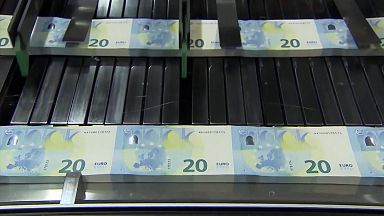
Twenty countries, one currency: The euro is celebrating its 25th anniversary after weathering the storm of various crises and global pandemics and becoming one of the world's most important currencies.
This anniversary provides an opportunity to assess how the Eurozone’ has dealt with these challenges and implemented reforms to ensure the stability of the currency, while also taking into account the achievements and perspectives ahead.
‘Declaration of the existence of a united Europe’
So, why was the euro created in the first place, and how was the currency able to withstand the numerous challenges it faced?
The Real Economy spoke with former President of the European Central Bank (ECB), Jean-Claude Trichet, about some of the milestones that marked the history of the single currency.
The creation of “Euro’ is the need to have a real single market, a real single market, ” explained.
“This was a really big decision, but it was also a kind of claim, a declaration of the existence of a unified European ’. And what we proved was that Europeans really had the capacity to create a serious, powerful currency. Europeans in the Eurozone ’u approves the euro. To me, this is the best of the awards. - ”

Jean-Claude Trichet, who evaluated his time as the President of the European Central Bank, stated that “ was the most important influence on him during two very intense periods.
After “'s bankruptcy, the financial world was collapsing, and many extremely important decisions had to be made very quickly. It took a lot of effort.
“Then came the period of May 2010, which marked the real beginning of the state debt crisis in Europe’. In my time, a total of five European countries were in a very difficult situation. And I believe that this required the extraordinarily courageous decisions of the participating countries, their governments and, of course, the European Central Bank, which is at the forefront of all these issues, ’.
Jean-Claude Trichet, who is looking forward to what the single currency will bring in the future, said “ is convinced that the road to a European confederation, a true European confederation with more unity on the budget and economic fronts, as well as real unity in defence, security and diplomacy, is a long-term imperative.
Following these crises, the Eurogroup created the European Stability Mechanism to help member countries facing economic challenges.
In countries that have adopted Euro’, the euro has changed people's daily lives, making travel, shopping or studying abroad more accessible.
How do young Europeans perceive the euro?
We met with a group of economics students at the University of Nanterre, west of Paris ’, to find out how those born in the euro age perceive their currency.
Thomas, “As I was growing along with this, I realized that having a stable and strong currency was essentially an advantage, ” said.
"I think if there are two challenges that the euro has to solve, it is the implementation of harmonised monetary policies for investing in the digital euro and especially in green projects," “ added.
My student friend Benjamin, from “, the European Central Bank, also has a question mark about the future of ’ and the policies it will implement. They could be more egalitarian, ” said.
According to the Eurobarometer’, 79 percent of Europeans living in the Eurozone’ approve the single currency for the whole of Europe’, while 69 percent’ support the single currency for their own country.
Among the most satisfied are Finland, Ireland and Germany; The least satisfied are Croatia, Cyprus and Italy’.
ItalyMixed opinions on the single currency in ’
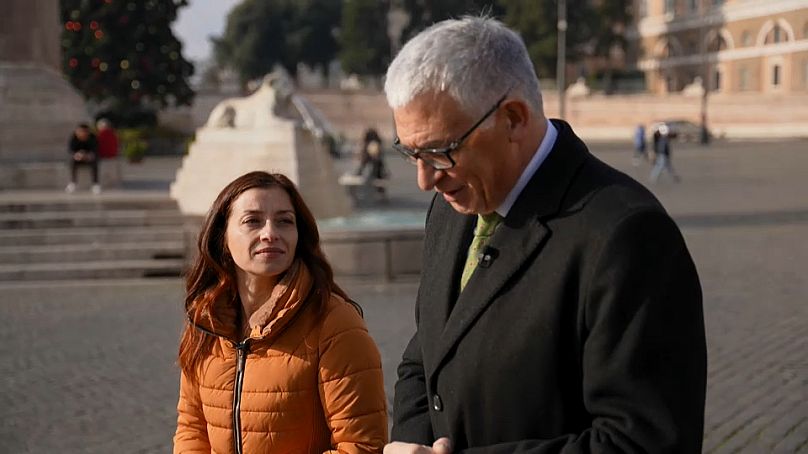
Our final journey will be the Italian capital of ’, Roma’ya, where opinions on the European currency are mixed.
Speaking to Real Economy’, a woman, “, said that this led to a huge increase in the prices of all the products I sold ”.
Another man, “, explained that the situation with the lira was better because it was monetary sovereignty”.
We met Giovanni Farese, Associate Professor of Economic History at the European University of Rome, to find out if there were indeed winners and losers among the members of the eurozone.
Real Economy’ye “Money policy is never neutral, ” said.
For example, economic growth in “ has been disappointing for many of us for the last 25-30 years. Of course, monetary policy is part of economic policy. What is needed is to strengthen other aspects and dimensions of economic policy. But of course, if you have a single monetary policy without a single fiscal policy, you're missing a leg. So the process is lacking.”

How can the eurozone better prepare for future economic challenges?
Reforms such as a unified fiscal policy could enable the eurozone to better absorb economic shocks.
UkraineAnnual inflation rate in the Eurozone’ since the beginning of the war in ’ October 2022’de %It peaked at 10.6. Later November 2023’te %2.4’e down.
Average annual inflation since the creation of the euro %It is 1.95’.
ECB Board Member Piero Cipollone assured that ECB’, whose mission is to keep financial stability and annual inflation below 2%, will continue its commitment in this direction.
The “Eurocystem has been able to respond to changing conditions over the years. If you need Mario Draghi’'s ‘ne, which changes and stabilizes the market, let's remember the ’ quote. So the important thing is to be ready to understand the truth, to understand how to adapt, to adapt.
“Economy is changing, society is changing, technology is changing, people's habits are changing, and electronic payments are increasingly becoming a daily reality. Therefore, Eurosystem ’ needs to prepare for this. And he's doing it thinking about the banknote of the future, the digital banknote. Digital euro.”
The digital euro will open a new chapter in the history of the European currency.


