
Global energy companies used the annual meeting in Azerbaijan’ to demonstrate how the sector is adapting to geopolitical uncertainty, while Baku Energy Week 2026’ discussed artificial intelligence, investment in production and gas security.
In two parallel venues, the Caspian Oil and Gas exhibition in ’ and the Baku Congress Center, the Baku Energy Forum in ’, managers and policymakers signaled that the next phase of the industry will increasingly depend on automation, digital infrastructure and commercially viable emission reduction.
Abid Malik, President of ACWA Power Central Asia, described Baku Energy Week as a growing international platform that brings together stakeholders from all over the energy sector, from hydrocarbons to renewable energies and infrastructure investments.
“This forum also offers an extremely good opportunity to discover more investment opportunities not only in Azerbaijan’, but also in Central Asia, the Caucasus and Eastern Europe’ said.
Malik said ACWA Power’ is currently investing about $740 million in Azerbaijan ’, including the 240-megawatt Khizi-Absheron wind project, which went into operation earlier this year and has already contributed more than 400 million kilowatt hours of electricity to the national grid.
He also highlighted the company's Caspian Sea desalination project, described as the first of its kind in Azerbaijan’ and the wider Caucasus region, where the first water production is expected in 2028’.
Going forward, Malik said, Azerbaijan’'s geographical location places it at the center of regional green energy corridors connecting Central Asia and Europe’.
“Azerbaijan will play a very important role, ” said.
Due to its geographical location, “ will elevate themselves to a different level on the global map with all these initiatives carried out together with Central Asia and Europe.”
A large part of the commercial focus at the Baku Expo Center’nde focused on operational technology.
Companies introduced AI-powered drilling systems, predictive analytics platforms, and automated monitoring tools designed to reduce production costs and increase efficiency in upstream operations.
Digital optimization has become a big priority for manufacturers trying to maintain their margins while maintaining output in a volatile pricing environment.
The use of artificial intelligence in exploration and drilling is rapidly advancing from experimental projects to large-scale implementation, executives said.
Real-time operational analysis, automated maintenance systems and digital field management tools are increasingly being adopted to reduce technical risks and improve recovery rates.
Climate and hydrocarbons
The event also reflects how climate pressure is reshaping investment priorities in the hydrocarbon sector.
Methane reduction technologies emerged as one of the dominant themes of the day, with companies providing leak detection systems, emission monitoring platforms and carbon management solutions aimed at reducing operational emissions without slowing down production growth.
Bilal Khadra, Borusan CAT Power and Energy Segment Leader, described Baku Energy Week’ as one of the leading energy events in the “Caspian region, bringing together governments, investors and energy companies from global markets.
The event is important because it promotes international energy cooperation, attracts foreign investment, and supports discussions on energy security, oil and gas development, and renewable energy, “ said.
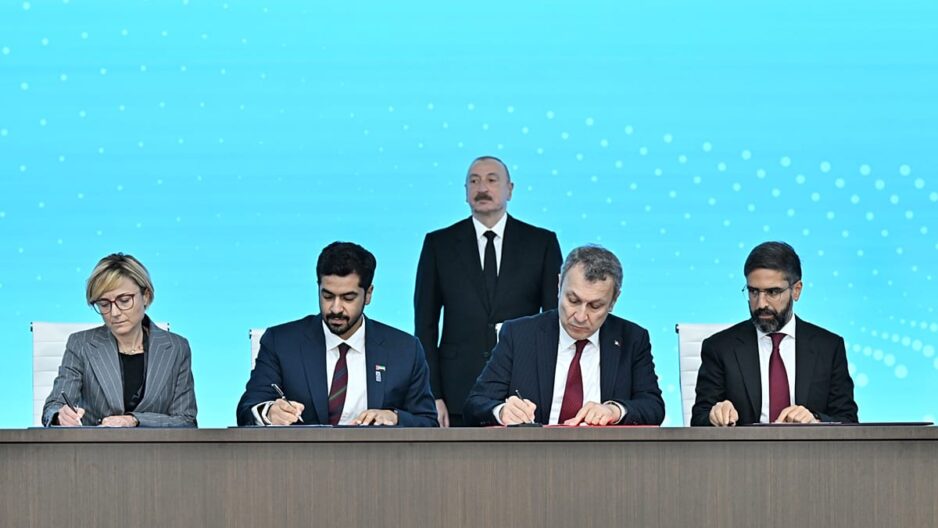
Khadra also drew attention to the important trade agreements announced at the forum, including the 15-year natural gas agreement in which Turkey’ is connected to BOTAŞ, SOCAR, TotalEnergies and ADNOC’ to the offshore Absheron site of Azerbaijan’.
According to Khadra’, the event also reflects ’'s strategic position between energy resources in the Caspian region and European markets, and also serves as a platform for discussions on artificial intelligence, digital infrastructure and cleaner energy investment.
Reductions in emissions
For many companies participating in the event, reducing emissions is no longer just an environmental obligation, but increasingly a financial and regulatory requirement linked to long-term competitiveness and investor confidence.
Industry representatives said that as energy markets evolve, international financial institutions and shareholders place greater emphasis on operational transparency, sustainability performance and emissions reporting.
Motorola Solutions Security Specialist Konstantin Grigorenko said the event is becoming increasingly important for companies seeking regional partnerships and investment opportunities in the broader Caspian energy sector.
“Yes, we specifically chose to participate in this event because it is also not about Azerbaijan’, Caspian and many different companies come here to show us who they are, what they do and what kind of things they are interested in and a lot of interesting people with whom we can discuss how we can help them, ” said.
Grigorenko also highlighted how energy security discussions are expanding beyond oil and gas infrastructure into renewable energy protection and digital monitoring systems.
Referring to large-scale solar energy investments, “ said that if you are building something, you should understand that it must be safe. “Usually they stay in a place where there is no one outside and you have to understand that no one is going to enter this area.”
He said security systems, including environmental protection, video surveillance and central monitoring systems for renewable energy parks, are increasingly being integrated into energy production.
The real question is that it should be very easy to use, and that's why people choose this type of solution, “ added.
Meanwhile, discussions at the Baku Convention Center ’ focused more on geopolitics, gas infrastructure and future investment flows into the Caspian region.
Europe’'s diversification effort and the Caspian basin
Executives and officials examined how Europe’'s long-term diversification strategy is reshaping gas partnerships and increasing the strategic importance of alternative supply corridors linking the Caspian basin to European markets.
Infrastructure development, export capacity and regional connectivity came to the fore in the opening sessions, especially at a time when producers were trying to establish long-term commercial partnerships in an environment where fluctuations in global energy markets continued.
Artificial intelligence has also played a central role in forum discussions surrounding exploration and field development.
Energy companies highlighted how predictive modeling, advanced seismic imaging and automated geological analysis help reduce search risks and improve business decision-making in both advanced and border energy regions.
Another important business theme was capital competition.
Participants discussed how oil and gas producers are increasingly competing for international investment, emphasizing operational efficiency, technological innovation and lower carbon production strategies while maintaining production-oriented growth.
The discussions reflected a broader shift in the global energy industry, where companies sought to position traditional hydrocarbon production alongside digital transformation and sustainability-focused investment strategies.
Baku Energy Week for AzerbaijanThe opening day of ’ also served as an opportunity to strengthen its role as both a regional energy supplier and a rising platform for energy technology, infrastructure cooperation and cross-border investment.
The events will continue throughout the week with expected additional discussions on Liquefied natural gas LNG development, regional transition projects, renewable integration and future investment trends in global energy markets.


