
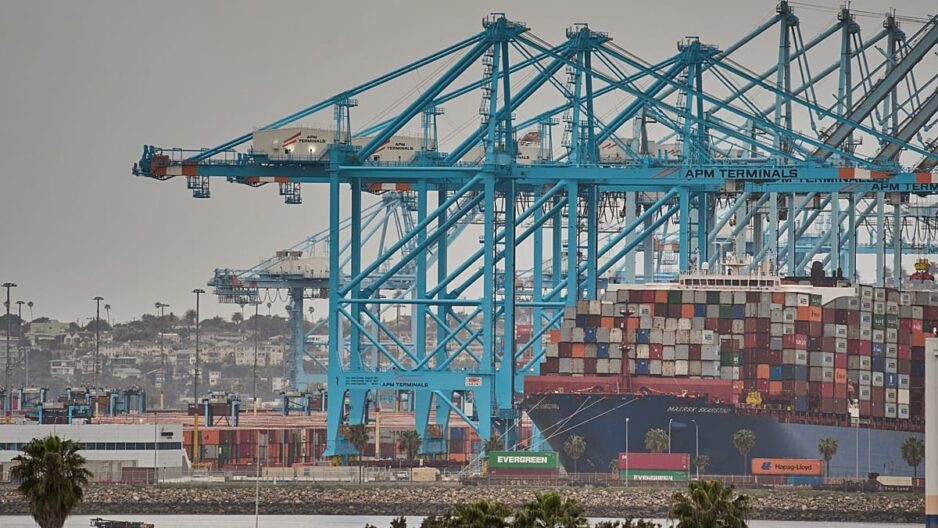
Shipping giant Maersk reported that despite strong demand for container transport, its earnings fell significantly in the first three months of the year.
Net profit from January to March fell to $100 million (€85 million), nearly 12 times lower than a year ago, when extraordinarily strong demand for maritime transport increased earnings.
It comes in %It fell 2.6 percent to just under $13 billion (11 billion euros), while earnings per share fell from $74 in the same quarter last year to $4.
The Copenhagen-based company notes that weak freight rates in the Ocean division are the main barrier to gains, but not in volumes across the enterprise. %He said the 9.3’ increase helped offset some of that decline.
Maersk said the conflict in the Middle East’ has only a limited direct impact on first-quarter results, but warned that this adds new uncertainty to the global outlook.
The conflict that began in “ on February 28, 2026, created an additional layer of uncertainty, ’ said in a statement.
He added that traffic in the Strait of Hormuz, ’, remained almost at a standstill, while weak sentiment puts pressure on consumer confidence.
Despite this, global demand for container transport is in the quarter %From 3 to %Five is up.
Chief executive Vincent Clerc said demand remained resilient in most regions.
“We saw strong demand in most regions this quarter, which supports strong volume growth across our three business segments, ” said.
But he warned that volatility in ocean transport continues to be high, and excessive transport capacity continues to put pressure on rates.
Maersk did not change its forecast for the whole year and said that global container demand will increase in 2026, in line with the overall market in ’. %From 2 to %He said he expected it to go up by four.
However, he warned that the sector continues to face surplus supplies from new ship deliveries, and that uncertainty persists as to when major shipping routes through the Red Sea and Strait of Hormuz will be fully reopened.
Maersk’in stock price Denmark’'s Nasdaq Copenhagen stock exchange at 10:30’ (CET) %It lost 4 percent of its value.
Industry under pressure
The wider maritime sector is also struggling with disruptions.
Hundreds of ships have been stranded in the Persian Gulf ’ for more than two months due to the Iranian conflict, which increases costs and disrupts the flow of trade. Delayed cargoes in the region include crude oil, refined products and fertilizer, while thousands of sailors remain on ships without being able to move freely.
According to U.S. military estimates, there are more than 1,550’ ships in the Persian Gulf, carrying around 22,500 sailors.
Insurance premiums for ships operating in the region also increased sharply due to the threat of attack, increasing pressure on operators already facing rising fuel costs.
German maritime group Hapag-Lloyd said the disruption around Hormuz cost it about $60 million (51 million euros) a week, largely due to rising fuel and insurance bills.
Analysts warn that even if the Bosphorus ’ reopens soon, markets are unlikely to return to normal quickly.
Kaho Yu, head of energy and resources at Verisk Maplecroft’, said refineries, shippers and commodity traders will remain cautious until there is clear evidence that a new threat of disruption has passed.
“Energy markets are unlikely to quickly return to pre-crisis assumptions, ” said.


