
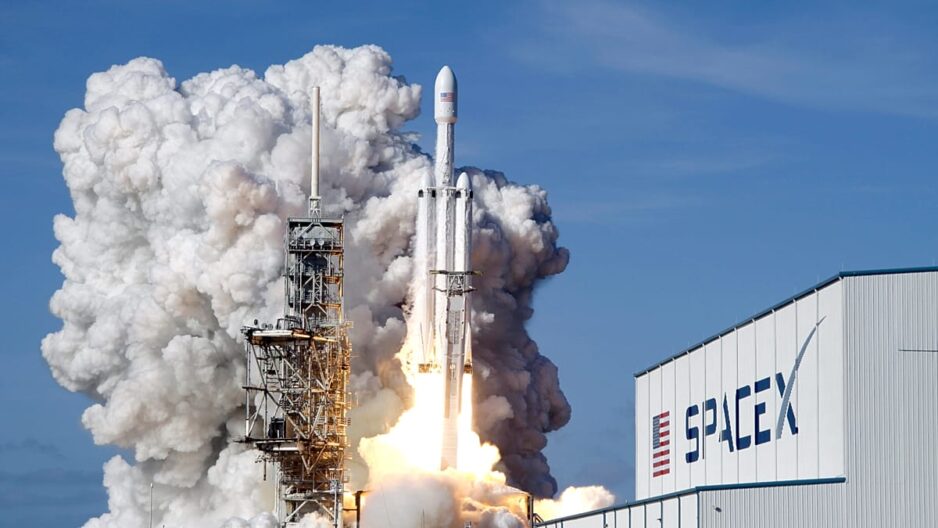
SpaceX has announced plans to raise up to $75 billion (€66 billion) in funding at its long-awaited stock market launch; This will make it the largest IPO in history, and its founder Elon Musk will significantly increase ’'s wealth, potentially making him the world's first trillionaire.
The company, officially known as Space Exploration Technologies Corp., said on Wednesday it plans to sell 555.6 million shares at $135 each. The offer will exceed the $26 billion (23 billion euros) Saudi Aramco’ raised in 2019’, and SpaceX’e will value approximately $1.77 trillion (1.56 trillion euros).
Such a valuation would place SpaceX’i among the world's most valuable stock exchange companies. Only a handful of firms are currently worth more, including Nvidia, which has a market cap of around $5.2 trillion (€4.6 trillion).
Musk’'s control continues
According to Forbes calculations, the public offering will also increase the value of Musk’'s stake in the company by an estimated $223 billion (EUR 196 billion). This could increase its net worth on paper to over $1 trillion (880 billion euros), although much of its wealth is tied to company shares.
The updated file also underscores Musk’'s control over the company. Thanks to Class B shares, each of which carries 10 votes, SpaceX CEO ’ will have roughly the same voting power after being listed. %He'll keep his 82.4’.
Despite rising valuation, losses continue
While SpaceX has offered to enter a blockbuster market, it is currently losing billions of dollars a year. Legal records show that the company reported operating losses of $2.6 billion (€2.3 billion) on revenue of $18.7 billion (€16.5 billion) last year, and losses continued during the first months of 2026’.
The public offering outlines ambitious plans for future growth, including financing missions to the Moon and Mars’a, and expansion of the Starlink satellite network. The document also reiterates Musk’'s long-standing goal of establishing a permanent human settlement on “ Mars”, a population of at least one million, which appears as existential threats that could condemn “ to the same fate as the ”dinosaurs.
Artificial intelligence targets are at the heart of growth plans
Artificial intelligence stands out in SpaceX’'s growth strategy. SpaceX said in its IPO application that the value of the global artificial intelligence market could reach $26.5 trillion (23.4 trillion euros). Although some of his plans, including space-based data centers, have not been technologically proven.
Analysts say artificial intelligence will be vital not only for SpaceX, but also for Musk’'s wider business empire, including electric vehicle maker Tesla. Wedbush Securities analyst Dan Ives even suggested a future merger between the two companies.
SpaceX’in, however, is facing scrutiny of artificial intelligence credentials. According to industry analysts, Musk’'s AI startup is struggling to keep up with competitors like xAI, OpenAI, and Anthropic.
IDC analyst Arnal Dayaratna said the main AI product, chatbot Grok’un “ister OpenAI, is less impressive than anything we've seen from other major players in the field, whether it's Anthropic or (Google’'s) Gemini.
Dayaratna said this does not mean that SpaceX’ has no potential as a major AI player; This is in part a move that could help Anthropic and Musk compete for enterprise customers using OpenAI and Anthropic products, thanks in part to a recent computer agreement with SpaceX’e that entitles them to buy the artificial intelligence coding tool Cursor’u for $60 billion (€53 billion) later this year.
SpaceX plans to use the net revenue from the IPO to fund the expansion of infrastructure for artificial intelligence and rocket business, among other investments, and to strengthen the satellite team that powers Starlink Mobile’a.
The company plans to be listed under the Nasdaq’ta “SPCX” symbol and may begin trading by the end of next week.
And SpaceX isn't the only gigantic market start that investors are currently preparing for. Earlier this week, Anthropic filed a confidential applicationTo officially launch its own IPO clock with the U.S. Securities and Exchange Commission.
OpenAI has not yet submitted an applicationThe initial SEC paperwork is ready, but the ChatGPT maker is widely expected to go public.
Ives, “This list represents the first major test for public markets after years of IPO silence, paving the way for SpaceX, AI giants Anthropic and OpenAI’ to follow shortly thereafter.


