Global steel production capacity continues to increase despite weak demand, which threatens to cause prices to fall and competition to deteriorate.
Steel is a critical material for a wide range of industries, from construction and manufacturing to electric vehicles and data centers.
The OECD says government subsidies are a major driver of global surplus capacity, with most of the increase in steel production capacity over the past two decades occurring outside OECD countries, often with government support.
According to OECD’, in 2024, the average Chinese steel firm received subsidies equivalent to 15 times the subsidies received by producers elsewhere based on total assets.
At the same time, Chinese steel producers exported a record 131 million tons of steel in 2025’te; This is according to 2020’ %With an increase of 153, the European Union was more than ’'s total steel production that year.
The warning comes at a time when OECD’ expects global steel surplus capacity to increase from 640 million tons in 2025’ to 745 million tons in 2028’, as steel production capacity continues to increase much faster than demand.
Global steel demand is expected to increase by only 34 million tons between 2026 and 2028, while producers plan to add up to 139 million tons of new capacity in the same period.
China’in is expected to play an important role in this expansion, with plans to increase its steel production capacity to 38.6 million tons by 2028; This is the largest increase planned by any country.
If these projects continue, the OECD says the global overcapacity will exceed the current annual steel production of all OECD countries by almost 320 million tons, underlining the extent of the imbalance the sector faces.
Policymakers fear that permanent surplus capacity could undermine the profitability and long-term viability of local steel industries, increasing dependence on imports of a material deemed strategically important for construction, defense, energy infrastructure and manufacturing.
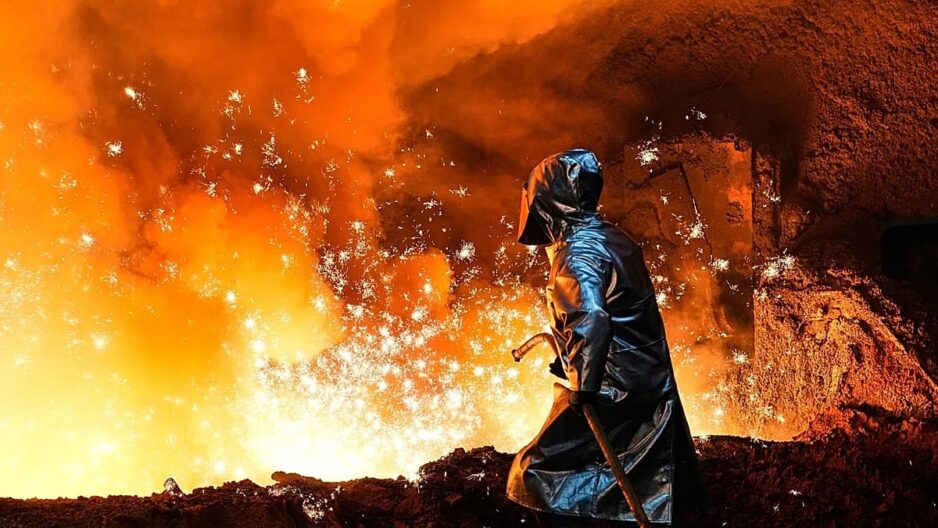
5 November 2025’te DuisburgSteel production at the ThyssenKrupp steel mill in ’
Speaking at the OECD Council of Ministers Meeting, OECD Secretary General Mathias Cormann said: “We need to address the root causes, including harmful subsidies and other non-market applications. This means stronger international cooperation and an equal playing field for steel producers everywhere.”
The OECD also found evidence that some exporters have overcome trade barriers by sending semi-finished steel to Southeast Asia ’ for processing before re-exporting it to OECD markets. China’in exports semi-finished products to the region %The 300’ increase points to a possible route to avoid customs duties and anti-dumping measures.
Energy costs and trade tensions increase pressures
At the same time, the sector is grappling with rising energy costs in connection with the Iran war. Energy, steel production costs %It can make up 40’, making the industry especially vulnerable to high prices.
The report also highlights the increasing pressure on the supply of raw materials. No country producing steel is completely self-sufficient in the inputs required for steel production; Export restrictions on basic materials are increasing worldwide. Forty-two countries are now restricting the export of steel scrap, an important raw material for the production of electric arc furnaces.
Europe is particularly vulnerable to these pressures. The region's steel producers often face higher labor and energy costs, as well as stricter environmental standards, compared to many international competitors.
As a result, European producers are generally less able to withstand long-term low prices compared to their competitors, who enjoy lower costs or stronger government support.
If current trends continue, the long-term viability of the sector and the economic security of many countries will weaken.
Remy Cointreau SA reported a sharp decline in annual profit, but the result exceeded analysts' expectations; Increasing performance in the Americas helped offset the impact of tariffs on key markets, including the US and China.
Euro’'s strong performance against major currencies has made cognac and other liquors more expensive in global markets, while high production costs have also negatively impacted profit margins.
The group has struggled in recent years against U.S. President Donald Trump ’'s tariffs and retaliatory taxes imposed on Chinese ’'s imports of cognac.
In a statement, CEO Franck Marilly said “ had won several major battles in the ever-complicating macroeconomic and geopolitical environment.
Net profit, sales %From €121.2 million in the previous year to €78.7 million in the fiscal year to the end of March, €935.3 million dropped to ’, down 5 percent to €935.3 million.
Remy Cointreau, the current operating profit margin from ’ .7 He saw ’ fall; However, although the company expects U.S. and Chinese tariffs and the strong euro to ultimately put pressure on the margins for the current year, “ is predicting a slight improvement in ”.
However, the company's shares were on the rise with the opening of trades on the Paris stock exchange. Shares around 9:45 a.m. %It was trading at €42.12, up around 12.
This happened at a time when the French spirits group was trying to regain its market share in a challenging economic environment, with the company launching a three-year return plan designed to boost growth and strengthen its business model.
Under the RC Forward program, the company plans to expand in emerging markets and global travel retail, drive growth from its premium cognac portfolio, and increase operational efficiency.
The group said the plan is expected to deliver an additional operating profit of around €100 million and productivity gains by 2028-29’ compared to 2025-26’.
Referring to duty-free sales at airports, Marilly said in a statement that “Our brands are regaining ground in ’, Remy Martin China is strengthening its leadership and market share in ’, and our Travel Retail business is slowly recovering with the goal of doubling its size in three years.” said.
Analysts say rising tensions in the Middle East ’ could create more uncertainty for consumer goods companies if high energy prices continue to weaken spending.
For the next fiscal year, the company aims for a moderate improvement in its current operating margin, as well as a return to organic sales growth.
The company, “Remy Cointreau, expects a return to sustainable organic sales growth in 2026-27’, and the momentum is expected to grow steadily over the year.” said.
Inditex, the Spanish fashion giant behind Zara’, announced its annual launch in the first quarter. %It posted a net revenue of €1.4 billion, up 5.4 percent, and exceeded market expectations.
the Sales Department %8.7 billion Euro’ya with an increase of 5.8, i.e. at constant exchange rates %8.8’e increased; Analysts are roughly %It's beyond the 8’ estimation.
Gross profit, with the help of improvement in profit margins %EUR 5.4 billion increased to ’ with an increase of 6.9; This means that the company retains a larger share of revenue as profit. EBITDA, a measure of basic earnings %An increase of 7.3 to 2.6 billion Euro’.
Inditex shares on Wednesday after the company reported a strong start to the second quarter. %It has risen to more than 5’; Sales from May 1 to June 1 %It increased by 11.5, which assured investors that the Zara owner remained resilient despite signs of weakening consumer spending.
Mamta Valechha, discretionary consumer analyst at Quilter Cheviot’, said “Inditex maintained its strong momentum with recent results that exceeded first-quarter expectations and made a strong start to the second quarter as sales rose more or less in line with the company's previous quarter.
The increase in revenue from one of the world's largest clothing retailers points to strong consumer appetite towards the summer, despite concerns that the more uncertain economic and geopolitical environment could put pressure on spending in the coming months.
Managing geopolitical risks
The results come at a time when businesses around the world are facing growing uncertainty about the global economy and concerns that consumers could cut spending.
Inditex said its wide-ranging supply chain and flexible transportation network have helped keep products flowing to stores worldwide despite recent outages.
Quilter Cheviot’'s discretionary consumer analyst Mamta Valechha, “, said that ultimately Inditex continues to have a flexible business model that can withstand significant economic pressures and currency fluctuations.
He said strong customer demand and the company's ability to supply products close to its main markets helped him keep collections up to date while limiting the need for discounts. Efficiency improvements have also helped maintain profitability.
Retailer, geopolitical tensions, Barclays’in revenue approx. %He acknowledged that he had influenced sales in the Middle East ’, which he estimated formed 5’ini.
Inditex also notes that the current “geopolitical challenges of ”, Barclays’in's revenue is approx. %He also said it had an impact on sales in the Middle East ’, which he estimates constitutes 5’ini.
The company also warned that ongoing instability in the region could affect its performance in the coming months.
Inditex faces a number of other challenges, including higher shipping costs and rising prices of raw materials such as cotton and polyester. Currency movements are also expected to weigh on the results this year.
Inditex completed the quarter with 5,456 stores and a net cash position of €10.8 billion.
For the last fiscal year, in May and November 2026, the Board proposed a dividend of 1.75 euros per share, consisting of the usual component of 1.20 euros and a bonus of 0.55 euros to be paid in two installments in ’.
Although Inditex made a strong start to the year , it did not change its appearance. He said he expects sales growth to continue in the second quarter, supported by strong demand for spring and summer collections and ongoing improvements to its stores and operations.
However, the company believes that currency fluctuations are likely to increase sales all year round. %He said he'd cut it down by about one. It also expects to invest around 2.3 billion euros in the business in the current fiscal year.
Microsoft unveiled a family of seven on-premises AI models at its annual Build developer conference in San Francisco’; This is the clearest sign that the tech giant is taking action to reduce its dependence on AI companies, with billions of dollars pouring in.
After tuning its models for consulting firm McKinsey, Microsoft AI general manager Mustafa Suleiman said the company outperformed OpenAI’'s GPT-5.5’ in terms of quality and predicted ten times better cost efficiency based on public pricing data scaled to model sizes.
At the conference, CEO Satya Nadella, “, said, "We believe it's time for every company to move from consuming a border model to fully participating in the border."
The title version is MAI-Thinking-1’, Microsoft’'s first reasoning model; trained from the ground up with clean, commercially licensed data without being distilled from third-party systems.
It is a medium-sized model with 35 billion active parameters and a 256.000 coin context window, designed for complex multi-step instructions, long context reasoning, and code generation.
In addition, the company has launched MAI-Code-1-Flash’, an encoding model that converts text descriptions to source code for apps and websites, and is now available on GitHub Copilot and Visual Studio Code’.
By running its own models on Azure infrastructure, Microsoft can avoid the fees it already pays third-party providers and pass the savings on to developers.
According to Microsoft’, in blind reviews conducted by independent human rating partner Surge, MAI-Thinking-1 was preferred to Anthropic’in Claude Sonnet 4.6’, and the company said it matched Claude Opus 4.6 in its coding criteria.
Category: Quantum leaps
Also at Build’, Microsoft announced that the Majorana 2 quantum chip is 1,000 times more reliable than its predecessor; This is a milestone that the company says has come a striking distance to a commercially useful quantum computer.
Quantum qubits, the basic unit of quantum computing, are, as everyone knows, fragile: Even the slightest temperature changes or vibrations can lead them astray. The Majorana 2 chip handles this directly.
The qubits in the new chip survive an average of 20 seconds compared to the milliseconds in the original; This is a development that the company likens to upgrading a phone that needs to be charged daily to a phone that can last several years.
Zulfi Alam, corporate vice president of Microsoft Quantum’, said that in “2029’, we will have a quantum machine that can solve commercially viable, reasonable problems. While the chip currently has only 12 qubits, a handy machine requires millions of qubits.
Microsoft’'s approach focuses on topological qubits based on the properties of the semiparticle, first theorized by Italian physicist Ettore Majorana in the 1930s.
The path was not smooth – company had to withdraw a 2018 paper claiming evidence for the particle in the journal Nature – but the pressure continued and the second generation chip partially recovered from the first by replacing aluminum as a superconductor with lead.
The chip and the research supporting it have not yet undergone peer review, and some physicists have requested more information.
IPO race escalates
Microsoft’'s drive for model independence comes as companies allocate billions of dollars to prepare for blockbuster stock market launches.
Just days after raising $65 billion (59 billion euros) in the Series H funding round, which raised its valuation to $965 billion (877 billion euros), Anthropic, the artificial intelligence lab behind Claude’, secretly filed for an initial public offering on June 1, ’. OpenAI is also preparing its own secret file.
Microsoft has committed $13 billion (€11.8 billion) to OpenAI’, and Anthropic’e has invested up to $5 billion (€4.5 billion) while making models from both companies available through Azure.
Foreign investment is widely seen as the main driver of economic growth, innovation and job creation. When companies open new fields, build factories or establish research centers, they not only bring capital to the country, but also create jobs and strengthen local supply chains.
As a result, competition to attract international investors intensified. Governments use investment incentives, tax cuts and international investment forums to persuade companies to choose their own markets.
France has also made attracting foreign investment an important priority in recent years. The government has been promoting the country through the ’ initiative since 2018“FranceSelect ’.
At this year's summit, President Emmanuel Macron said foreign companies had pledged investments worth €93 billion, which ’ described as a record figure.
How successful are European countries in attracting international investors? Which countries attract the most investment projects?
France EuropeContinues to be ’'s largest investment destination
The EY European Attractiveness Survey provides a useful benchmark for international investors to measure competition. Unlike traditional foreign direct investment (FDI) statistics, which can deteriorate due to large transactions or in-house financial flows, the survey tracks the number of individual investment projects.
These include new projects announced or registered by foreign companies in a given year, such as the opening of new facilities, the construction of production facilities or the expansion of existing operations.
According to the last number of the survey, 5,026 new investment projects were announced across Europe in 2025. EY defined the European ’ as a geographical region rather than the European Union. This figure is according to 2024’ %It declined by seven to its lowest level in 11 years.
Despite a sharp decline, France has maintained its position as Europe’'s leading destination in terms of foreign investment. Number of projects 2025’te declined to 852’ye; This represents the largest drop among Europe’'s major investment destinations.
United Kingdom, compared to the previous year %It ranked second with 730 projects, down 14.
Germany remained ’'s third largest foreign investment destination with 548 projects. However, the total %It fell 10 times to its lowest level since 2009 ’.
The long-term trend is even more striking. Compared to 2019, GermanyNumber of investment projects in ’ is down; this, France’ya (%-28) or United Kingdom ’a (%-34) is a much steeper drop compared to.
2025Spain and Turkey were among ’'s strongest performers. Number of investment projects in Spain %He placed fourth, increasing by 20 to 383’e. Turkey is %It ranked fifth with 376 projects, up 7 percent.
Poland, compared to the previous year %With an increase of 10, 2025’te continued its upward trend, registering 285 investment projects. This made it the sixth largest destination for foreign investment in Europe’. The Netherlands also %It was among the few countries that recorded growth with the number of projects increased by 8 to 159’.
Italy, Belgium and Portugal also saw a decline in investment activity in ’. Number of projects Italy’da %8 down to 206’ya, Belgium’da declined to 187’ compared to the previous year in Portugal’ 6 projects were registered with 5 decreases.
Who invests in Europe’?
In 2025, the United States continued to be ’'s largest source of foreign investment projects. American companies have announced 943 projects across the continent, maintaining the position of Europe’'s leading foreign investor.
German firms took second place despite the sharp decline in investment activities abroad. Compared to the previous year in other European countries in 2025 %They announced 484 investment projects, down 24. In recent years, the decline has been unusually high, as the number of projects has generally exceeded 600’.
Despite the decline, Germany remained ’'s largest intra-European investor. France has once again become the leading destination for German investments, attracting 101 projects. For the first time, Turkey ranked second after England ’.
Europe is losing ground globally.
To put ’'s performance in a global perspective, it would be useful to look at foreign direct investment (FDI) flows. UNCTAD’'s 2025 World Investment ReportAccording to ’, global foreign direct investment 2024’te compared to the previous year %It dropped by 11 to about $1.49 trillion.
Europe has been hit particularly hard. According to UNCTAD’, the region attracted nearly $182 billion in foreign direct investment in 2024. That's up from $439 billion last year. %It went down 58.
North America, annually %It ranked second with a foreign direct investment inflow of $343 billion with an increase of 23. and asian, spite a modest decline of 3’, it has attracted $605 billion, continuing to be the world's largest destination for international capital.
However, these figures also bring with them an important methodological warning. UNCTAD excludes so-called “channel economies, such as Luxembourg, the Netherlands and Ireland, from ” to avoid distortions caused by holding company structures and in-group financial transactions.
Why are investors being more cautious?
According to EY’, weak economic growth in much of Europe’ was the main factor behind the decline in investment activities. High energy prices, geopolitical uncertainty and a more cautious corporate investment environment have also put pressure on business decisions.
Concerns over trade tensions and potential new tariffs are increasing pressure on investment plans.
Many investors are increasingly concerned about the combination of Europe’'s relatively high costs and weak growth prospects. EY also points out that frustration stemming from regulatory complexity has increased across the continent.
The labor market rebounded in May, traditionally marked by the start of hiring in conjunction with the summer season. Number of people registeredThe number of employment offices decreased by 36,323 compared to April to 2.32 million, Lowest figure since 2007’ in MayAccording to data released Tuesday by the Ministries of Labour and Participation, Social Security and Migration.
Registered unemployment chart showing each month of May for each year.
Compared to the same month last year, unemployment fell by 134,162 people. The decline has spread to all productive sectors, but a slight increase was noted in the group of people who had not previously worked in any job.
Social Security membership continued to increase. An average of 231,975 contributors were added to the system during the month, with the total number reaching 22.3 million registered employees, the highest level since the start of comparable registrations. Seasonally adjusted figure that corrects calendar effectsAfter 64 consecutive months of growth, the number of employees reached 22.1 million.
Record levels of membership were repeated in different population groups, including youth, women, men, self-employed and foreign nationals. The second reached 3.36 million.contributors and currently all registered employees are approx. %They make up 15 ’ini.
The hospitality sector was the most job-generating sector in May, with nearly 66,000 more registrations than in April. Thus, the sector is approaching 1.68 million participantsIt is due to the increase in tourism and service activities depending on the summer.
Significant gains were also noted in administrative and support service activities; About 27,000 registered workers were added last month, leaving close to 1.5 million workers behind. Health activities and social services on an annual basisWith more than 77,000 registered employees, it has made the biggest contribution to employment growth.
Monthly Changes in Unemployment
The private agriculture plan regained membership in May, adding about 21,000 participants, although it still showed a negative balance compared to the previous year. In turn, the special program for housekeepersIt continued to reduce the number of registered members on both a monthly and an annual basis.
The rate of self-employment also reached a new record; 3.46 million people are self-employed. Nearly 46,000 self-employed have joined the system in the last 12 monthsespecially in professional, scientific and technical activities. By gender, Social Security’te recorded 11.7 million men depositing premiums and 10.6 million women depositing premiums. Women are all working people now. %It's 47.45 ’ini.
In terms of unemployment, the number of unemployed women fell to 1.4 million, the lowest level since 2008 ’ in May. Even so, it stays on a little over 900,000’ menRegistered as unemployed. Youth unemployment fell again to 164,955 people under the age of 25, the lowest level since the beginning of the series. The number of unemployed women in this group was less than that of men.
List of registered unemployment under 25 years of age
The largest sector-by-sector drop in unemployment was in the services sector, with 29,829 fewer unemployed than in April. Unemployment has also declined in industry, construction and agriculture.The only group that increased were people who had never worked in any business before.
Regional differences continued to be important. The Balearic Islands recorded the largest monthly reduction in unemployment and the largest increase in membership, with almost 48,200 more participants than in April. On an annual basis, Madrid takes a leading position in job creation in absolute numbersThere are 127,841 more registered workers than a year ago.
In May, 572,061 permanent contracts were signed for recruitment, which %He created 43.2’sini. Such contracts have increased both compared to the previous monthand in the year to date.
In the meantime, Latest available data on unemployment protectionThe figure, which corresponds to April, shows that 1.78 million social benefits have been paid. The average amount received per beneficiary reached 1,168.30 euros per month; This was 22.6 euros more than a year ago.
Belgian prosecutors are in the advanced stages of an investigation into money transfer company Wise over suspicions that criminal groups are using their accounts for money laundering, officials said on Monday.
The Brussels prosecutor's office said it launched the investigation last year after the British firm's name repeatedly appeared in hundreds of requests for assistance from investigative authorities in other countries.
Prosecution spokesman AFP’ye said in a statement, first confirming the information reported by the European Investigative Collaborations (EIC) network, the “Investigation is currently at an advanced stage and approaching the conclusion.” said.
“The findings are primarily related to the use of Wise accounts for criminal purposes, in particular with indications that anti-money laundering legislation has not been complied with due to the inability to identify customers and their activities.”
Investigators are examining whether criminal groups are using Wise services to launder proceeds from illegal activities, including fraud, corruption and drug trafficking.
The investigation focuses on Wise Europe’, the Belgian-based European subsidiary of the firm, which says it is cooperating with prosecutors and responding to requests for information about its business.
The company said in a statement that such requests for information are a normal part of “operations and are not indicative of any misconduct or non-compliance with anti-money laundering requirements on their own.
The company, “, has not shared any specific findings with us to date, ” added.
Wise, which has more than 19 million active customers worldwide, says it handles about 4.7 million transactions per day.
The company said it processed more than $243 billion (€213 billion) in cross-border transactions during fiscal year 2026.
London Stock Exchange at noonWise shares in ’ approx. %He's down 15.
EuropeSummer came early this year as ’ was overwhelmed by record-breaking temperatures.
In May, mercury peaked at 37°C for the first time in ’, France, while in London, England, it broke the monthly record with temperatures reaching 34.8°C’. The same goes for Ireland with an unprecedented temperature. It's 30.5°C.
However, according to the European Environment Agency ’'s report titled “Overheated and Underprepared, the majority of EU citizens, that is, 68%, have no air conditioning (air conditioning) or ventilator system in their homes.
Which countries struggle the most to afford air conditioning?
Although some countries do not need it (Europe is not equally hot everywhere) more than one in three people () says they can't afford to buy air conditioning.
In some of the hottest regions of the continent, the numbers are particularly high: France in ’ , Greece’da , Portugal’de and Spain’da (), Italy’da () and Romania’da () more than a third.
It is a worrying picture given that more than one in four EU citizens are over 65 years old and some of the oldest populations are concentrated in countries such as Italy, Portugal or Greece.
It is also Malta (%8.5) and Luxembourg () and Ireland () emerged as the countries with the least problems with air conditioning or fan systems.
Of course, there are other ways to keep homes cool, such as shutters, awnings, or exterior shading.
Spain (although, from Portugal () from Italy () or Cyprus’ta () The majority of people say that their homes do not even have these characteristics.
Warm weather is more worrying than other climate issues
That doesn't mean people aren't worried about high temperatures.
Heat, for EU citizens () is the number one concern about climate; The Flood (), fires (.5) or water shortage (.5) is more.
Concerns are particularly high in the Mediterranean’: the Cyprus ’ , Greece’da and Malta’da %From extremely high temperatures of 70, “much ” or “much ” says they are concerned.
In addition, about half of AB’'s respondents are already at home (%Fifty, that's it.) and %More than 60’ in their own neighborhood () It feels very hot.
There is no air conditioning: Italians and Germans face post office queue hell in summer
Local communities report mixed heat responses from local authorities, and it seems quite rare to come across any public building equipped with “ or air conditioning to ” refrigeration centers in general.
Italians in particular seem doomed to melt; only for the ’i reports using air conditioning in public buildings; In Germany, this figure is even lower in ’, %7. Greece, Malta and RomaniaIn ’, this rate is much higher; About the citizens ’i benefit from refrigerated public spaces.
26 May 2026’ in RomePeople trying to protect themselves from the scorching sun in ’
Greeks love air conditioning but stay away from trees when arranging Cyprus work schedules
Planting trees seems to be a cheaper, more coherent and environmentally friendly option, and the EU residents ’si says they have seen this applied in their circles.
However, the proportions of tree plantings reported in ’ in Hungary ’dan Greece’da only %Since it varies up to 22’ye (third lowest rate across the EU), purchase rates vary widely.
Another reaction on the hottest days may be to adjust work or school schedules.
However, only EU citizens ’i complied with these measures; Replies Cyprus’ta ’ to Portugal’ only %It varies up to 8’e.
the Participants ' %Local authorities seem more active when it comes to heatwave alerts, such as phone calls, text messages or communication through the media reported by 57’si.
At the same time, this type of communication seems to be related to emergency response rather than prevention; There are fewer citizens (.5) reported exposure to awareness campaigns about extreme weather health risks and recommended actions.
Tensions between China and the EU have intensified in recent months, prompting the European Commission to gather most of ’'s commissioners for a strategic reassessment during a “ orientation debate on Friday.
In a statement following the discussion, the Commission said “China is a critical partner and participation and dialogue will continue. At the same time, the current state of trade and investment relations is not sustainable.“
Calling the relationship “ non-sustainable” may indicate the depth of the break less than it is.
Relations have deteriorated steadily since European Commission President Ursula von der Leyen’ described Pekin’i ’ as a systemic competitor in her landmark 2023“ speech. But tensions rose to a new level when EU policymakers finally resolved their differences over the EU-US trade deal that had consumed Brussels’i for months, freeing the bloc's greater focus on China’e.
Last year, the bloc registered a record trade deficit of 359.9 billion euros with Beijing’le, and Brussels fueled growing calls at ’ to better protect the EU market from cheap Chinese imports, which threaten all sectors, including the metals, chemical and automobile industries.
Speaking to Euronews’e on condition of anonymity, an EU official, “, said that over the past few weeks we have seen a panic attack in China’. The Chinese issue has been ignored for too long, “ added.
2024In the EU industry since ’, – has lost a total of 200,000 European jobs, especially in the energy-intensive and automotive sectors; Automobile construction alone is projected to lose another 600,000 jobs in this decade.
On Friday, the commission said that the “comprehensive approach remains risk-reducing rather than discriminating, signaling that the bloc is pursuing targeted efforts to reduce its dependence on China”e, rather than severing economic ties altogether. But the risk of a full-scale trade war has never been more realistic.
Here are five key points on how the situation got to this point and where it could go next:
1. Fines andthe Regulatory Printing
During the previous legislative period, the EU adopted a law that angered Beijing ’, especially measures aimed at curbing foreign direct investment. And China has stepped up its fight against the so-called dumping’e, where public subsidies are used to lower the price of competitors through exports sold below market prices in ’.
The European Commission has become increasingly ambitious to counter China’'s subsidized approach, including imposing tariffs on imports of battery-powered electric vehicles. Various product-specific researches are also ongoing.
Earlier this week, the Commission fined Chinese e-commerce giant Temu’ya €200 million for selling unsafe products, and JD.com launched a large-scale investigation into ’'s acquisition of e-commerce retailer MediaMarkt’.
EU lawmakers and governments are also discussing this issue. the Industrial Accelerator Act, global market share in a particular sector. A proposed law that would impose strict conditions on investments in batteries, electric vehicles, solar panels and critical raw materials from the countries that control its ’.
A separate proposal (a renewed Cyber Security Act) could push Chinese equipment suppliers such as Huawei and ZTE away from critical infrastructures.
GermanyContainers in ’ – April 2025.
2. A more systematic approach
In April, the EU agreed to double tariffs on steel imports exceeding EU quotas to counter China’'s overcapacity. The measure is a so-called ’ security measure, a tool backed by some of AB’'s largest economies, including France, Italy, Spain, the Netherlands and Lithuania, which calls for expansion into sectors beyond metals.
In a statement, these countries argued that the protection measures were more “chevik” than other EU vehicles targeting cheap export products. The document also calls for economic security to be taken into account in assessing AB’'s interests when deciding on commercial defence measures.
The European industry is also increasing pressure on China's cheap imports of ’, and the Commission calls on ’ to use its commercial defense measures as “, which is more flexible, faster and preventive.
An important wake-up call for EU policymakers was that Dutch-based chipmaker Nexperia’, acquired by Chinese giant Wingtech, remained in the crossfire of US-China trade tensions and caused serious disruptions in the automotive sector.
The Commission is now preparing to demand that sectors such as the auto industry diversify chip suppliers in certain situations and consider supply chain risks in purchasing decisions.
Despite these various initiatives, EU policymakers have begun to be cautious that current rules are moving too slowly for a fast-moving competitor. After taxes were imposed on electric vehicle batteries, China’'s focus shifted to hybrid vehicles.
Brussels is now moving towards a more systematic approach and sees trade defence as a toolbox for rebalancing relations with China. One of the potential additions is the overcapacity tool to limit imports in certain sectors.
3. China’'s threats of retaliation
Over the past few weeks, China has was threatenedThe EU could retaliate if it continues to close its market to Chinese goods.
Both the “Made in Europe” legislation and the Cyber Security Act Beijing drew ’'s anger, leading to intense lobbying in Brussels and EU member states with warnings that the implementation would trigger a reaction.
Europeans are walking a tightrope, aware that their decisions could trigger a trade war. After AB’ imposed tariffs on ’ electric vehicles in 2024, Beijing also imposed tariffs on EU pork, brandy and dairy products.
At a press conference Thursday, Chinese Foreign Ministry spokesman Mao Ning said “International trade is a two-way street. There is no mandatory trade. China-EU trade relations are inherently based on a win-win relationship. China does not target trade surpluses, ” said.
Ning said “AB’ needs to put its trade ties with China into perspective and honor its commitment to free trade. China will closely follow AB’'s moves and take all necessary measures to protect legitimate rights and interests, ” added.
Some argue that it is too late for Europeans, who depend on China’ for key components of their supply chains - components that Beijing’ can weaponize at will.
In 2025, China blocked the export of rare earth elements vital to AB’'s green technology and defense, as well as the chips required for the European automobile industry. Beijing can also benefit from operating licenses for EU companies and restrict access to its market at any time.
4. Departments of Europe
Europe is far from uniting on China.
Despite its troubled trade deficit with Beijing’, Germany has been slow to move away from a co-operation approach that prioritizes securing German companies' access to the market in China’.
Berlin did not endorse the non-paper agreement last weekend, backed by other major EU economies. Instead, German Economy Minister Katherina Reiche reiterated this week that Germany's ’'s top priority is to avoid jeopardizing exports to China’e.
But the economic cost of Beijing ’e dependence may force Berlin’i to reconsider its stance. The German government is reportedly weighing a tougher line that will signal a significant shift in Chinese policy.
For years, German industry had a relationship with the Chinese market, which critics described as poisonous; This relationship has hampered any meaningful attempt to rebalance the trade deficit for fear of losing commercial access to the broad Asian market.
Spain has become the other major EU country that is reluctant to take action against China’. With relatively cheap energy costs, Spain has become attractive to foreign investors, for which Beijing’ has a growing share.
After initially appearing to support the French-led non-newspaper organisation, he withdrew and claimed to have only participated in the debates, his stance this week has been a source of embarrassment for Madrid.
Spain's Trade Minister Carlos Cuerpo, “, said there was no special political support for anything off-paper” and added that AB’ should establish “ contact with Chinese officials via ”dialogue“.
5. What's going to happen now?
The reassessment process of ’'s attitude towards China’ has been under construction for a long time, based on decades of deepening economic dependence. But the latest acceleration also resulted from a change in the stance of ABD’; The most prominent was President Donald Trump's recent visit to Beijing.
Friday's orientation debate by the commission was only the first step in a process that could translate into a broader repositioning. Given internal divisions and the threat of retaliation, it remains deeply unclear where this will lead.
The results of this exercise are expected to contribute to the debate on economic security at the next European Council meeting in ’ on 18-19 June. China has been on the agenda of EU leaders several times in recent years, but has been pushed aside due to more urgent crises.
While Brussels is considering adding new tools to its policy toolbox, political will remains the main determining factor. Nowhere is this gap as sharp as in the way AB’ uses the anti-pressure tool, also known as “trade bazooka”, designed to counter economic pressure and unfair trade restrictions.
Although we were under a lot of pressure, the anti-pressure vehicle was never used, “ said. “We really need the tools we're willing to use.”
AB’'s new car market continued to grow steadily in the first four months of 2026, with approximately 3.8 million vehicles registered, compared to the same period in 2025. %It increased by 4.2. This is according to data released on Wednesday by the European Automobile Manufacturers Association (ACEA).
The numbers point to a market increasingly dominated by electric and hybrid vehicles, thanks to government incentives in major economies and growing competition from Chinese automakers.
According to ACEA’, between January and April 2026, battery-powered electric cars will be .7Created ’sini; This rate compared to the previous year %It was 15.3’. The growth was mainly driven by the bloc's four largest markets; from Italy (+,5), Spain (+,7), Germany (+%6,6) and France (+%2.3) recorded a profit.
Only in April, battery electric vehicle sales in AB’ compared to the same month last year .7 increase in market share for the month %He went up to 20.6’.
Hybrid electric vehicles in April %It continued to be the most popular single powertrain choice with 12 increases, with monthly sales of approximately %He made up his 36.9’.
Category: Plug-in hybrids %Increasing by 16.4 on April records %He received a share of 9.8’.
On the other side of the notebook are gasoline vehicle registrations. creased by 16.3 to 218,500 units, while diesel vehicle registrations also declined %It declined by 17.1 to around 74,000.
Gasoline and diesel cars accounted for less than 30 percent of vehicles sold across the EU in April.
2026 performance of European brands
Volkswagen Group retained its position as the bloc's largest automaker in the first four months of 2026, and %All new registrations with just over a million sales with an increase of 2.9 .7’sini formed.
However, performance varied across the group. Sales of ŠKODA %Audi increased by 15.5 %While it gained 8.6 percent in value, the main Volkswagen brand %With 3.2 losses, it lost value in many segments.
Stellantis, Fiat’taki For recovery and registrations over ’ increased Opel and VauxhallInfluenced by strong gains in ’ %With a strong increase of 7.8’ %It ranked second with a market share of 17.1 and more than 648,000’ units.
the Renault Group creased by 7.4 to approximately 384,250 units %With a market share of 10.1’, it was the group with the weakest performance in the top third; The Dacia is %It recorded a sharp decline of more than 15’.
BMW Group and Mercedes-Benz respectively %3.9 and %While earning 3.8 percent, Toyota and Hyundai Group %With a 2.5 %It recorded modest declines of 3.1.
The Chinese Fluctuation
The most important trend in April data was the continuation of the rise of Chinese car manufacturers.
According to ACEA figures, BYD’'s EU records have more than doubled year-on-year in the first four months of 2026’ %It increased by 152.9 to over 71,850 units.
Through the Chery Automobile, Omoda, Jaecoo and Jetour brands %Leapmotor, which distributes through its joint venture with Stellantis, increased by 267.1 to more than 48,350 units. %It increased by 558.8 to over 28,700 units.
SAIC Motor, which owns the MG brand and is the largest Chinese group by EU volume, %It increased by 10.4 to over 77,000 units.
Chinese brands have registered approximations of EU automobile registrations between January and April 2026. %6In the same period of the previous year, when forming the ’, this ratio %It was 3.2’. The total market share of Chinese brands in the wider European market, including the United Kingdom and EFTA countries, was %3.7’den during the same period roughly %Increased to 7.3’e.