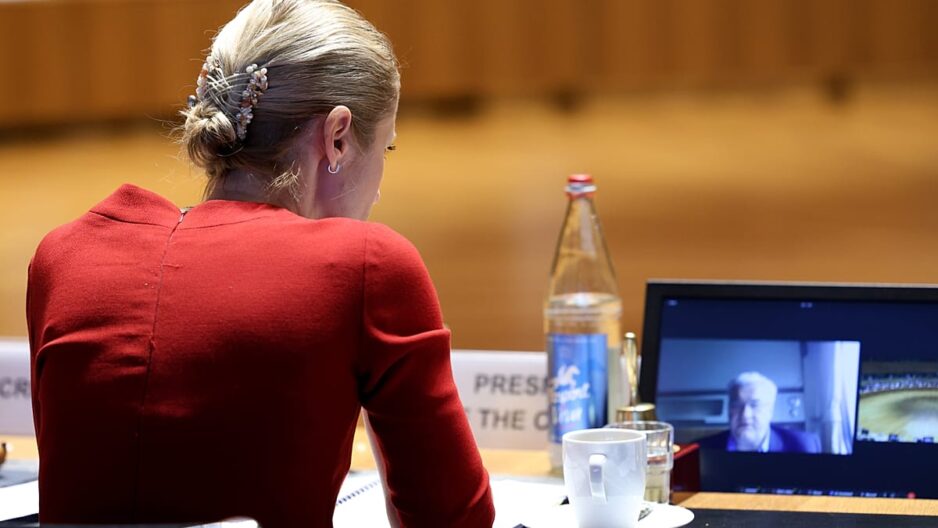
Speaking to Euronews’e, five diplomats from the European Commission are expected to present options on how to restrict imports of goods from Israeli settlements in the occupied Palestinian territories ahead of the EU Foreign Ministers' meeting in July.
After months of stalemate, the EU administration is under constant pressure from the majority of European governments to put forward a concrete proposal to restrict trade with settlements deemed illegal under international law.
At a meeting of foreign ministers in ’, Luxembourg on Monday, EU Commissioner for the Mediterranean ’ Dubravka Šuica said that given strong pressure from member states, the Commission will prepare some options ahead of ’'s next ministerial meeting on 13 July, Euronews’e quoted five diplomatic sources as saying.
However, it is not yet clear what types of options will be offered. The Commission has been reluctant to put forward proposals to restrict trade so far, bearing in mind that Council ’ could not find a qualified majority to suspend the EU-Israel Association Agreement; This is already a much more important measure and is already on the table.
Last week, a report by advocacy group Global Echo Litigation Center suggested that agricultural products produced in Palestinian-occupied areas entered the EU market mislabeled as legitimate Israeli goods.
In this context, the Commission may submit corrective measures if the evidence in the report is verified.
EU foreign policy chief Kaja Kallas told reporters after the meeting that “Many member states have called for proposals from the Commission on trade with illegal settlements. I will submit this request and ask the Commission ’ to draw up a list of options for possible trade measures, including measures aimed at preventing imports of goods from illegal settlements, ahead of the next Foreign Affairs Council.”
Israel has recently implemented measures aimed at strengthening its control over the West Bank and East Jerusalem in areas such as property law, planning and licensing; These steps are contrary to the important agreements signed under the Oslo peace agreement of 1993.
According to the opinion of the International Court of Justice (ICJ), ’, which found Israeli settlements illegal in 2024, settlement activities in the Palestinian territories are considered illegal.
In 2019, the Court of Justice of the European Union (CJEU) ruled that food products produced in Israeli settlements in the occupied territories should be clearly labeled as ’ from the settlement of “Israel, rather than simply being identified as ”Israel Product“.
Proposal to impose tariffs on goods from Israeli settlements, at least for the total population of AB’ %At least 65 of the EU member states representing ’ini %It will be decided by a qualified majority vote requiring the support of 55 ’i.
A group of member states, including France and Sweden, have already advocated this approach, arguing that tariffs fall under trade policy and therefore require only a qualified majority.
French Foreign Trade Minister Nicolas Forissier recently euronews’e saidAB’ said restricting trade with Israeli settlements was normal “, not an attacker.
In turn, the Commission stressed that such tariffs would constitute sanctions under EU law, require unanimity among member states and cannot be agreed on.
Council Legal Service ’, the institution's effective legal advisory body, reportedly opposed this view and strengthened pressure on trade restrictions to curb the illegal expansion of ’ in the West Bank of Israel.
The Israeli government rejects the illegal identification of these settlements and classifies them as “ temporary areas.
In May, after the new Hungarian government lifted the previous veto imposed by former Prime Minister Viktor Orbán’, the EU adopted restrictive measures against extremist settlers and the organizations that support them.
Kallas, “There was a clear understanding that options should be clear. I'll take this back to the Commissioners, ” said.
SpaceX is preparing for its biggest stock market launch ever.
Elon Musk’'s rocket company begins trading on Nasdaq’ on Friday under the code SPCX. The company raised $75 billion (64.5 billion euros) by pricing each of its shares at $135, setting the company's value at $1.75 trillion (1.5 trillion euros) in the largest stock market IPO on record.
The deal will comfortably eclipse Saudi Aramco’'s previous record of $29.4 billion set at 2019’, which was later increased by the general allocation option.
SpaceX did something unusual. EuropeA strong driver to attract retail investors, including those in ’. According to Bloomberg’, individual investors placed orders worth about $100 billion (€86.6 billion) through trading platforms such as Robinhood, Fidelity and SoFi during the IPO process.
This demand alone exceeded the company's goal of raising $75 billion (64.5 billion euros) in funding, underscoring the interest of small investors before entering the stock market.
But below this exaggerated advertisement, a few warning lights are flashing. Here are five risks investors should weigh before the SpaceX’ IPO goes live:
1. Is SpaceX’ worth $1.75 trillion?
Investors will value SpaceX’e at a valuation of $1.75 trillion (1.5 trillion euros), about 94 times its annual revenue of $18.7 billion (euro 16.1 billion) at 2025’. By comparison, Nvidia, one of the market's most valuable tech companies, is trading less than a quarter of that level.
Investment research firm Morningstar, which has valued the company at $780 billion (€675 billion), describes the company as “, which is significantly overvalued, while Goldman Sachs data suggests that sustaining the share price will require revenues of over $100 billion (€86.6 billion) by 2030, suggesting that annual compound growth %It says it's over 40’.
2. A valuation based on a small variability
Investors also need to pay attention to the size of the public eye. Although SpaceX’ is valued at $1.75 trillion (1.5 trillion euros), its shares are only %From 3 to %4’ü will initially be open to public trade.
This means that the market value of the company will be determined by trading a relatively small portion of its equity. Reports show that more than 75% of the $75 billion (64.5 billion euros) offer is already allocated to existing investors and insiders, leaving fewer shares in the open market.
According to Morningstar’, limited volatility and strong demand for AI-related stocks can help support the share price in the early stages of trading, even if the company is valued above what the research firm considers fair value. The firm argues that when lockdown restrictions expire and more shares become available for trading, a clearer picture of investor demand may emerge.
But some analysts believe the limited volatility could continue to support the stock. Estimates suggest that when Nasdaq 100’e joins SpaceX’e, passive investment between $22 billion (€19 billion) and $27 billion (€23.4 billion) could flow, creating additional demand from index tracking funds.
History offers a warning note. Research by University of Florida professor Jay Ritter, often referred to as “Bay Public Offering, found that IPOs between 2012 and 2021 averaged on the first trading day. %It increased by 23.6 percent over the next three years. %It turned out to yield a 10.6 percent return.
3. Not profit, but loss.
SpaceX’'s financial results could also cause investors to pause.
The prospectus shows that the company is growing rapidly but still losing money.
The company owns the Starlink satellite internet service, which generates most of its revenue and is its only profitable business. He also owns the artificial intelligence company xAI’, which merged with SpaceX in February.
According to the application, SpaceX posted a cumulative deficit of $41.3 billion (€35.76 billion) as of March 31, and reported a net loss of $4.27 billion (€3.7 billion) in the first quarter of 2026’.
This compares to $528 million (457 million euros) in the same period of the previous year.
Most of the recent losses are due to xAI’. According to SpaceX’'s public offering application, the artificial intelligence business 2025’te recorded operating losses of approximately $6.4 billion (€5.5 billion). The application also showed that xAI’ was spending heavily in the first months of 2026’ while expanding its artificial intelligence infrastructure.
Morningstar argues that the artificial intelligence unit “ poses a material threat to the loss of value, and Grok” has not yet achieved meaningful market share against competing chatbots.
Supporters say losses are a choice, not a structural flaw.
Revenue from the previous year's $14.1 billion (12.2 billion euros) in 2025’te %It rose 33 percent to $18.7 billion (€16.2 billion). The basic launch and satellite business was profitable as recently as 2024. The vulnerabilities largely reflect the intense investment in artificial intelligence infrastructure; The expenditures said by the supporters are already being compensated by new computing contracts.
4.Artificial intelligence growth gambling
Supporters argue that investors are paying for future growth instead of existing profits.
While Starlink remains the company's main source of revenue, the AI business is expected to play a larger role in the coming years.
The bulls also point to SpaceX’'s dominant position in rocket launch and satellite communications, suggesting that the company is uniquely positioned to benefit from the growing demand for connectivity, computing power, and artificial intelligence infrastructure.
SpaceX launches more rockets each year than the rest of the world combined, and has more than nine million Starlink subscribers, but the newest growth driver is the AI data center business purchased through the xAI merger.
Last Friday, Google agreed to pay $920 million (€796.6 million) per month for compute capacity at SpaceX’e xAI data centers in a 32-month agreement that will run from October 2026’ to June 2029’, covering access to approximately 110,000 Nvidia GPU’s.
This was after the agreement in May, when Anthropic’in paid $1.25 billion (EUR 1.08 billion) per month to lease the entire output of the Colossus 1 data center by May 2029, with total annual computing revenue of about $26 billion (EUR 22.5 billion).
The bulls argue that this contracted income, obtained in less than four months, shows how quickly the company can make money from its infrastructure. Skeptics note that both contracts include 90-day termination provisions after December 2026’, with Google’ itself framing the agreement as “bridge capacity” rather than a permanent commitment.
It's a FILE. Gas turbines seen at xAI plant in ’, Memphis, Tennessee, December 2025
5. Risk the size of Elon Musk
SpaceX’'s success, profile, and past performance are closely linked to Elon Musk’, which has helped attract investors, customers, and business partners. This creates what investors call “kilit person risk”; I mean, concerns about how the company would perform if he didn't lead anymore.
The management structure of the company strengthens this dependence. Musk’'s super-voting Class B shares give him an approximate voting power of %He gives away 85’ini, and outside shareholders have little impact on key corporate decisions. In practice, this means that no one but Musk’ can decide whether or not to remain CEO.
Critics also note SpaceX’'s establishment in ’, Texas; Only the least amount of shares %Investors who own 3’ can file derivative lawsuits. The Danish academic pension fund AkademikerPension has blacklisted the stock, describing its management structure as “ Catastrophe”.
Supporters argue that double-class sharing structures are common among U.S. tech firms, including Meta and Alphabet’. They say intense voting control allows founders to achieve long-term goals without pressure from short-term investors.
Musk’'s reputation also brings political risk. U.S. Senator Elizabeth Warren urged the Securities and Exchange Commission to review the listing, warning that its inclusion in the index in the future could expose millions of passive investors to stocks without actively selecting them.
Others noted that SEC’ completed its review faster than expected, suggesting that this allowed the IPO process to proceed without delay and that regulators saw no immediate impediment to listing.
Disclaimer of Disclaimer: This information does not constitute financial advice; Always do your own research to make sure it suits your specific circumstances. Also remember, we are a journalism site and aim to provide the best guides, tips and advice from experts. If you trust the information here, you do so entirely at your own risk.
Portugal, with the permission of Brussels’, will activate the protection clause of the European Union (EU) budget rules. This will allow the country to temporarily bear the additional energy-related costs resulting from the current crisis, without being seen as a violation.
According to Lusa’, Finance Minister Joaquim Miranda Sarmento, the “Commission understands that it must now create an exemption clause, as in the defense spending rules, and is in demand in many countries. We support this decision and will enact this clause just as we did for the defense, ” said.
When Joaquim Miranda Sarmento arrived at the Eurogroup meeting in ’, Luxembourg, she told Portuguese journalists that Portugal, according to data from the International Monetary Fund (IMF) and the European Commission, ’ was the fifth country in the European Union that provided the most support in proportion to Gross Domestic Product (GDP) in ’.
He added that this situation allows the country to maintain and even increase these support measures, depending on how the conflict in Iran’, triggered by the Israeli and US ’'s attacks, develops.
Portugal therefore plans to take advantage of AB’'s temporary exemption so that it can increase public spending beyond what was originally planned, without being seen as a violation of the European bloc's budget rules. This measure comes on top of another resilience mechanism already in place to cover defense spending.
“Current crisis 2022Different from ’
According to Joaquim Miranda Sarmento’, the current crisis 2022 is different from the crisis in ’. The European Central Bank (ECB) in response to the inflationary pressures caused by the war in the Middle East, ’ argued that the interest rate increase is absolutely not necessary, and the ECB commented on ’'s decision.
According to Lusa’, the Minister of Finance, “Naturally, there is a concern on the part of the European Central Bank. The ECB, which played a crucial role in the 2022 ’ [previous energy crisis], has decided to give the market this first signal, but we will see in the coming months. He could have avoided sending this signal, and I maintain my view that this is absolutely not necessary, but naturally I respect the authority and independence of ECB’, ” said.
“The European Central Bank has already decided to raise interest rates, but we are in a very different situation both in terms of inflation and in terms of Central Bank interest rates, ” added.
While the EU is trying to protect its market from the rise in low-cost Chinese imports, alarm is mounting in the face of a new phenomenon in the European Union: Chinese companies are introducing ways to overcome the bloc's tariff barriers.
France, Italy, Spain, the Netherlands and Lithuania are increasingly fuzzy and complex actions to avoid EU customs duties, the European Commission jointly warned “ on ”.
In an informal proposal last month, which did not name any Chinese company, the quartet called for ’ improvements to AB“'s anti-skipping tool, which would allow ’AB” to guarantee the legal effect and effectiveness of existing trade defense measures.
Euronews found that online Chinese companies offer ways to explicitly avoid EU trade defense measures, including anti-dumping duties imposed on imports sold at AB’ at prices below their normal values in Brussels’in China’.
Skipping practices include setting up production facilities or making small changes to products in countries where EU extra tariffs are not targeted. Not all of this is illegal unless businesses at AB’ provide solid evidence that they are harming their industry, but many are thought to be at least controversial, prompting the European Anti-Fraud Office (OLAF) to launch an investigation into the true origin of certain products.
As the EU faces a wave of China's ’ overcapacity, exceeding tariffs has become an even more pressing concern. European manufacturers have filed a growing number of complaints against Commission’a, alleging unfair trade practices in various sectors and the strain on the resources of EU officials.
Transfer through third countries
One of the ways Chinese companies are already pursuing is to establish production facilities in so-called “gate countries, such as Morocco, Tunisia, Turkey or various southeast Asian countries, which benefit from favorable trade agreements or are not subject to EU anti-dumping taxes.
Other methods include minor product changes designed to change the customs classification and minor changes designed to transfer goods through ’gate “ countries to create the impression that the goods were actually manufactured there, even though they were entirely made in China”.
Euronews’in research has revealed that some Chinese companies do not hide their activities and openly offer online services to overcome trade barriers.
Xin Rui Da Logistics, a logistics supplier from Shenzhen’, specializes in “anti-dumping research and providing transit trade solutions for third countries. the Website.
The company says it has solved the problems of many Chinese businesses and foreign importers with restricted products in “, such as anti-dumping, compensatory, quota restrictions and trade barriers such as CIQ (Customs, Inspection and Quarantine), ” says, and “ explains that it has re-exported from Malaysia, Sri Lanka, Taiwan, India, Thailand, Singapore, Indonesia, Bangladesh, Hong Kong”.
Xin Rui Da Logistics is currently working on a variety of products, from e-bikes to steel, aluminum and plywood product categories; All of these have been hit by AB’'s anti-dumping taxes in recent years.
The company did not respond to the interview request.
Sale of converted chemicals
The chemical sector, where competition between the EU and China is particularly intense, is particularly exposed to the risk of exceeding customs tariffs. European manufacturers are already under pressure due to the surplus of China’in production capacity, which is flooding the EU market with imports and increasing competitive pressure.
On the complaint of EU producers, the European Commission imposed an anti-dumping tax on a specific chemical imported from China’: titanium dioxide (TiO2), a strategic chemical used in green technologies and aerospace. The missions were temporarily brought to ’ on July 2024 and finalized on January 9, 2025.
But some Chinese producers are looking for ways to adapt to the new tariffs to export the chemical to AB’.
ChinaZontai Titanium Dioxide ’in manager Nina Zhu, a company based in Guangdong province, south of ’, He wrote itA few months before AB’ introduced its customs duties on LinkedIn’de: “AB’'s anti-dumping taxes will be introduced at the end of the year. It is advisable to prepare inventory in advance to provide you with a variety of titanium dioxide solutions.”
Euronews’in contacted Zhu, who confirmed that the company can supply products with TiO2 content below 80 percent’ to avoid EU tariffs.
Linkedin (linked
Later, 2025’te NanJing Titanium Industry International described in theThe recently commercialized new type of mixed TiO2’ “, with excellent performance, qualifies as the highest quality”, adding: “Furthermore, its unique features allow you to bypass certain regional anti-dumping taxes, saving you significant costs. It's a game-changer for your business!”
The company did not respond to Euronews’'s requests for comment.
Linkedin (linked
In some cases, as soon as the EU launches an anti-dumping investigation that could result in additional taxes, Chinese companies begin offering such services.
This is what led to the introduction of new tariffs in January 2025, following the Commission's decision to launch an anti-dumping investigation against Chinese TiO2 producers in ’ on 13 November 2023.
In a LinkedIn post on January 23, 2024, an executive of Titan Industry’, a Shandong-based company, offered EU customers certificates of origin for shipments via “ Vietnam or Thailand to deal with anti-dumping taxes imposed by ”AB. Such certificates may have obscured the true origin of the product produced in China’.
Since then, the company has removed the post from social media, saying it has stopped offering such transfer solutions because Euronews’e is not allowed to.
Instead, “ said it would build a new TiO2 factory in ’, Vietnam.
‘Shoot the mole’
Like many other Southeast Asian countries, Vietnam is often seen as ’, a country where Chinese companies invest in exporting to AB“. However, in some cases, companies cannot maintain a real production presence in the country.
The situation is hitting a ’ mole, according to Deborah Elms’e, a trading expert from the Hinrich Foundation ’ in Singapore“ problem.
Euronews’e said: “If you go after a particular company for illegal transfer, you'll discover that this is the mailbox address of a company that changed its name and moved to another location very quickly.”
“If the tariffs are high enough, there is always an incentive for companies to try to circumvent this illegally.”
Linlin Liang, spokesman for the Chinese Chamber of Commerce ’'s European Union (CCCEU), told Euronews’e that CCCEU’ is not aware of Chinese companies offering online solutions to overcome EU tariffs.
Liang, “Generally, the risks of circumvention are not specific to any country” said, adding that AB’ has a rooted anti-survival system“, and the important thing is that these ”tools are implemented in a transparent, evidence-based and proportionate manner“.
“Unfortunately, EU trade defence measures have so far largely targeted imports from China’, ” said.
Beijing has repeatedly threatened to retaliate if AB’ tightens its trade defence measures. But with AB’'s trade deficit with China reaching a record high of 359.9 billion euros in 2025’te, the European Commission announced last week that the current state of the “ trade and investment relationship is not sustainable.
AB’'s executive branch is expected to propose strengthening AB’'s trade defence system to EU leaders, who will meet for a summit in mid-June. The draft results shared by diplomats do not include the name Çin’in, but China’in is expected to be at the center of the discussions when the leaders meet.
OLAF is investigating
In its 2025 annual report, it said the issue of exceeding tariffs had become important enough for OLAF’ to take over investigations into such cases.
In particular, the report pointed to a case involving e-bikes, which would likely be imported from Indonesia’ to AB’, if the bloc's anti-fraud authority had not intervened.
It turns out that most of the components are actually of Chinese origin and are processed only in Indonesia’; This means that the goods must be labeled as of Chinese origin. OLAF assessed that if the products are exported to AB’, this plan could lead to €7.2 million avoiding EU import taxes. In the end, they weren't.
Thomas Grjebine, an economist at the French Centre for Research and Expertise in World Economy ’, Euronews’e “ChinaThe greater ’'s competition, the more difficult it will be, ” said.
In an important report for the French government's advisory body recently, it warned of the impact of Chinese competition on EU industry.
Grjebine, “We will not launch investigations into thousands of products, this is a complicated situation, ” said. Moreover, the investigations are carried out at the European level and customs checks are mostly carried out at the national level.“
Beyond commercial defense measures targeting specific products, industries such as the EU's automotive, metals and chemicals are facing an increase in cheap Chinese imports, while questions about the protection of all industrial sectors are also being raised.
But Morocco, Tunisia and Turkey, China, which has invested billions of dollars in building factories in ’, already knows how to overcome industry-wide tariffs, leaving AB’ with even more challenges.
EU Trade Commissioner Maroš Šefčovič promised on Friday a new tool designed to help European enterprises diversify suppliers and prevent the shortage of critical materials from China’.
Šefčovič at the Brussels Economic Security Forum’, organised by the European Policy Centre and in partnership with Euronews’, said “Diversification now requires a special tool. “Recent industrial cases, particularly the supply of chips and rare earths, have strengthened my belief that a step change is necessary.”
His announcement followed disruptions in European strategic industries last year when China’ blocked exports of green technologies and rare-earth elements needed for the defense sector, as well as chips used by the automotive industry.
But such a move could exacerbate tensions with Beijing, which threatens retaliation if AB’ closes its market to Chinese companies.
“Industry must do its part”
Šefčovič later told Euronews’e that the approach would require companies to source from three different suppliers, but that “ still had to decide what to actually do with the ” legal proposal.
The proposal will ensure that companies do not fully trust a single supplier, such as China. However, businesses in AB’ may be reluctant to support such a measure if it increases production costs.
The commissioner said economic security is a common “ responsibility, and European ” companies should address geopolitical risks as part of their core business.
“Industry is on the front line. We have to look out for them, but the industry has to do its part. - ”
In 2025, Dutch authorities took over chip maker Nexperia’ due to concerns that Chinese owner Wingtech Technology’ could move important operations and intellectual property rights to China’e. Beijing responded by temporarily blocking the export of Nexperia’'s products and the chips required for the European automotive industry.
The threat facing Europe’ is not solely due to the supply of chips. This is also the block ’i is also due to its dependence on the rare lands of China, refined and processed by the Asian giant.
During trade tensions with the U.S. last year, China also halted rare-earth exports. The shipments resumed after several weeks of negotiations, but the truce was agreed to only for one year until October 2026, when the Sword of Damocles ’ hung over the European ’.
Relations between China and the EU are increasingly tense as Brussels prepares new tools to protect itself from China’'s increased capacity surplus. The bloc faces a record trade deficit of 359.9 billion Euro’, and despite continuous dialogue efforts, Beijing continues to struggle to achieve equal terms with ’.
At the same time, European enterprises complained about China’'s unfair trade practices, while several member states, including France, Italy, Spain, the Netherlands and Lithuania’, urged the Commission to take a tougher stance through new trade defense tools.
But two proposed EU legislations (the so-called Industrial Accelerator Act and the Cyber Security Act), aimed at tightening Chinese companies' access to the EU market, have already received threats of retaliation from Beijing’, raising the possibility of a trade war if AB’ advances further.
China’'s major factory sector lost momentum last month, renewing questions about how long the world's second-largest economy can withstand the deepening global energy crisis and stubborn problems with domestic demand, according to official figures released on Sunday.
The official manufacturing purchasing managers index (PMI), published jointly by China's National Bureau of Statistics (NBS) and China's Logistics and Purchasing Federation, fell 0.3 percentage points from April to a full 50 percentage points in May, the lowest reading of the index since February.
On a scale from 0’ to 100’, the shape is precisely at the threshold that separates the expansion from the contraction; This is a mathematically neutral result and is far from reassuring in context.
The detail behind the headline number raises concern.
New orders fell from 50.6’ to 49.9’ in April, while production fell to 51.2’ and raw material stocks fell to 48.6’.
However, according to the chief statistician of NBS’, Huo Lihui’, a relative power has emerged; high-tech manufacturing PMI’ increased from the previous month to 52.9’a and 52.1’e for equipment manufacturing.
An energy shock that could inevitably affect China’i
2026Most of the global economic debates in ’ have been dominated by the Iranian war and the closure of the Strait of Hormuz, where about one-fifth of the world's oil flows in peacetime, since March.
This cut caused oil prices to rise, which the International Energy Agency (IEA) described as one of the biggest supply shocks in the history of global oil markets. For most Asian countries, the main importers of oil flows at the crossing point, the consequences were severe.
But China has been relatively sheltered so far.
Beijing’in is estimated to have accumulated about 1.4 billion barrels of strategic and commercial oil reserves before the conflict began; This represents approximately 220 days of import coverage.
Increasing combustion of other fossil fuels, such as coal, rapid investments in renewables and diversified supply lines further mitigated the impact.
In a research note last week, HSBC’'s chief economist for Asia, Frederic Neumann, wrote that although the “Energy crisis remains the dominant wind for Asia, China is relatively more sheltered given its robust energy security structure, ”.
However, as the Iran war prolongs, the risks to the Chinese economy increase.
It's a FILE. Coal piles stand near a chemical factory in ’in Datong city, 14 March 2026
Exports stand but the domestic front struggles
Where Beijing's economy continues to show its deepest fissures, the decades-long slump in the real estate sector erodes consumer confidence, while HSBC notes that April figures are only the softest reading since the pandemic period. ter reaching 0.2, China has sharply revised ’'s 2026 forecast for retail sales growth. %from 5.2’den %He dropped 2.8’e.
Morgan Stanley ’'s chief economist in China, Robin Xing, wrote last week: “ Domestic demand is declining, but high-end manufacturing and exports remain at the border.”
Beijing, the lowest rate for 2026 since 1991’ %With a 4.5 %It set a one-year growth target of between 5 and “ of the previous three years. %5” went one step down from its target.
Morgan Stanley thinks ’'s annual economic growth target is achievable, but marks global oil market conditions as the defining joker.
U.S. exports to ’ have fallen year-on-year for most of the past twelve months, but global sales remain strong, particularly in Europe and Southeast Asia.
US President Donald Trump's meeting with Chinese leader Xi Jinping in Beijing in mid-May has brought back some optimism about bilateral trade.
While artificial intelligence (AI) is reshaping global trade and economic power, Europe is at risk of falling into the trap of technology “addiction, according to a new report.
Insurance company Allianz’'s report suggests that the world economy is being reorganized around technology industries such as cloud computing, data centers and semiconductors, where Europe’ is weaker than the US and Asia’.
Asia, this part of the world economy %With 65’i and seven of the world's top 10 AI exporters, it dominates the export of AI-related goods. This sector grew from $1 trillion in 2014’te (880 billion euros) to $3.8 trillion in 2025’te (3.3 trillion euros).
The U.S. has tripled its AI-related imports since 2023’, largely due to the country's investments in data centers and cloud computing. It is also home to almost half of the world's data centers.
Meanwhile, Europe’'s imports related to artificial intelligence were only in the same period. %It increased by 40, which highlighted what Allianz’ describes as an expanding “ infrastructure vulnerability, ”.
“ has a modest role in the bloc's AI supply chain, which leaves the region facing ” with limited strategic leverage and meaningful exposure to supply chain disruptions, the report said.
American ‘ connected to termination key’
The American technology giants, Avrupa’'s operational computing capacity %It controls 40’ and nearly half of its upcoming data center projects.
These firms benefit from a weak market for private investment in companies and low competition from local firms, the report said.
USA also Europe’'s cloud computing market ’'s market share, Avrupa’'s corporate software revenue ’una and customer management software %It has a market share of 73’. This causes players outside the U.S. to compete for “ remaining margins. In the report, “ said that structural constraints, fragmented regulation, complex permission processes, network connectivity delays, the absence of a native hyperscaler, and limited VC or state-sponsored funding reinforce this dependency.
Europe is also dependent on hardware outputs from Asya’, such as graphics processing units (GPU’s) required for training AI models. Block, all IT equipment ’sini imports more than half of the hardware materials needed for its data centers from five Asian countries: Taiwan, China, South Korea, Malaysia and Vietnam.
The report found that this dependence on Asian hardware complemented ’'s dependence on “, which would increase the ” of the USA if no independent investment was made in that area.
According to the report, “Europe, within this framework, is constantly using the US’ termination key for ‘'s cloud data, under the threat of ’; This means that the country can shut down these services at any time. “If AI-related markets are created abroad, this will widen the EU-US service imbalance.”
Europe’'s double gap‘
Unlike the U.S. ’, where private companies pour hundreds of billions of dollars into artificial intelligence infrastructure, or China ’, where the government facilitates investments, “ is suffering from insufficient private capital and fragmented public policy, which the report calls open ”.
To avoid falling into the trap of ’ technology addiction, the European Union must eliminate regulatory and capital constraints for “, the report said.
For example, the report notes that the combination of limited land options in cities, complex permitting processes and environmental regulations makes it difficult to build data centers. Some projects may take up to four years to come to life.
Data center projects in parts of Avrupa’ could take up to five years, the report said, as providers could not connect to some aging power grids with limited capacity and a new center could not meet peak power demands.
Despite these concerns, the report suggests that Avrupa’ still has some competitive advantages in the areas of industrial engineering, automated and regulatory artificial intelligence.
France and Sweden applauded initiatives such as independent computing projects aimed at taking public services in ’ out of the hands of US technology companies such as Google or Amazon Web Services (AWS) and instead investing in European solutions.
These initiatives promised “ counterweights, but their scale was still modest, the report said.
The 13th in Baku’ At the World Urban Forum’ (WUF13), the Middle East and North AfricaHousing discussions in ’ went beyond construction goals and funding figures, focusing on resilience, dignity and long-term social stability.
Officials and philanthropic leaders from Saudi Arabia, Palestine and Morocco, as they face the realities of conflict and reconstruction, described how the region is increasingly linking housing policy with employment, climate cohesion and urban inclusion.
Among the strongest messages came from Lamia bint Majid Al Saud’, Secretary General of Alwaleed Philanthropies, who argued that housing solutions cannot be copied from one country to another.
Strategies should be built around data and local realities instead of “ approaches, ” said. “, we don't see this as a problem. It's about understanding communities and being creative with solutions.”
Afrika ’ drew attention to projects in which climate-resistant houses were built using natural materials and at the same time, local masons were trained and employment was created next to housing.
According to Alwaleed Philanthropies’, more than 1.2 million homes worldwide have been supported by models adapted to local conditions.
Al Saud also explained how Saudi initiatives are increasingly linking housing assistance, especially for women, to economic empowerment.
The organization, in partnership with Saudi authorities, provides housing units, vehicles and employment training, and connects beneficiaries to ride-hailing platforms such as Uber and Careem to generate additional income.
His intervention reflected a broader shift in the MENA debates at WUF13’: housing is no longer seen only as infrastructure, but as part of a wider economic and social ecosystem.
Reconstruction came to the fore in the intervention of Palestinian Local Government Minister Sami Hijawi’nin, who used the forum to draw attention to the humanitarian and urban destruction caused by the war in Gaza’.
Despite serious financial pressures, Palestinian officials rely heavily on international cooperation, development banks and public-private partnerships to prepare for future reconstruction efforts.
Calling for stronger global support for the reconstruction of housing and urban infrastructure, “ said the Palestinian people have decided to stay on their territory.
Hijawi stressed that unemployment has risen sharply due to the war and underlined ongoing talks with international organizations, including the World Bank, to expand financial support programs.
For Palestinian officials, WUF13 served not only as an urban development forum, but also as a diplomatic platform to mobilize international support for reconstruction and long-term housing repair.
Fas’'s Minister of State for Housing Adib Benbrahim presented his country's housing strategy as a regional model of state-led urban transformation, backed by public-private sector investments.
Morocco, with programs aimed at the eradication of slums, middle-class housing, and urban renewal, became the capital of King VI. During Muhammad's time, he made housing the pillar of social policy.
According to Moroccan officials, more than 720,000 ’ homes have been developed through public-private partnerships, and more than 325,000 ’ people have benefited from slum resettlement programs since 2004.
The country is also moving towards a new subsidy model launched in 2024’te; shifts direct financial support from developers to citizens; It gives families more freedom to choose where to live and encourages social diversity.
In addition to housing construction, Morocco is investing in schools, health facilities and urban infrastructure in poor neighborhoods as part of broader urban transformation efforts.
QatarEnergy has signed an agreement with ExxonMobil and the Egyptian Ministry of Petroleum and Mineral Resources to investigate how the gas discovered off the coast of Cyprus can be developed and exported through Egypt’'s existing infrastructure.
The memorandum of understanding signed by oil minister Karim Badawi puts the Qatari state-owned energy company at the center of a broader effort to link Cyprus offshore gas fields with Egyptian export facilities and European buyers.
QatarEnergy said the deal will explore future growth opportunities and trade arrangements using Egypt’'s gas infrastructure that serves both domestic consumers and international markets.
Cyprus’ does not have its own liquefaction facility; This means that the gas extracted from offshore sites must be transferred by pipes underwater to Mısır’a, where it will be processed and liquefied before being sent to European markets.
Cyprus has spent more than a decade converting its offshore exploration into commercial exports, and President Nikos Christodoulides said the recent approvals were a turning point that moved the country from exploration to the exploitation of natural gas resources.
Egypt, Cyprus’ to Europe’ya is becoming a gateway to natural gas
Egypt has already played a central role in this plan. In April, partners in the Aphrodite field of Cyprus ’ signed a 15-year agreement to sell all natural gas available from the reserve to the Egyptian Natural Gas Holding Company, with the option of extending the agreement for another five years.
With the agreement signed on Thursday, this agreement shows how the Egyptian ’ has become the main point of departure for Cypriot natural gas. The agreement is also based on QatarEnergy’'s existing partnership with Cyprus’ta ExxonMobil.
The two companies are partners in Block 10’, where the 2019 discovery of Glaucus, estimated to contain about 3.7 trillion cubic feet of gas, is one of Cyprus’'s most important offshore finds.
A second discovery, Pegasus 2025’te, was detected in the same block, and in March, the consortium officially announced that both sites, with a total reserve of about 7 trillion cubic feet, were commercially viable.
Saad Sherida Al Kaabi, managing director of QatarEnergy, said the agreement is an important step in advancing regional energy cooperation in the Eastern Mediterranean ’.
The route could also be important for Europe, which has been looking for more diverse gas sources since Russia’'s invasion of Ukraine’ disrupted the long-standing flow of energy. It is unlikely that Cypriot gas will change the European ’'s energy balance on its own, but the Eastern Mediterranean may add another supply option from ’.
The plan is still in the early stages. The final investment decision has not been made, and details such as infrastructure links and commercial terms have not yet been agreed on.
If the 2028 target is met, this will signal Cyprus’'s first gas exports and a new supply route to Europe’.
Brazil’'s Ambassador to the EU Pedro Miguel da Costa e Silva Euronews’e said that the EU’'s decision to ban meat imports from Brazil’ from September is “surprise”, and Brasilia’ is in talks with the European Commission to reverse this move.
Da Costa e Silva’'s comments came a day after a committee of EU national experts voted to ban Brazilian meat imports due to the use of antimicrobials to encourage the growth of animals.
The decision comes just days after the EU-Mercosur free trade agreement between the EU and Mercosur countries (Brazil, Paraguay, Uruguay and Argentina) entered into force temporarily to liberalize trade in agricultural products.
Da Costa e Silva euronews’e “The decision was a surprise for us yesterday” said.
Brazil is the first country to be removed from the list of countries that comply with EU food safety standards for antimicrobials.
Da Costa e Silva stated that his team met with the Directorate General of Health of the European Commission for “ to obtain ” explanations about the decision, adding that “Brazil has initiated a technical dialogue with the Commission to reverse the removal of ’ from the list.
While the free trade of agricultural products between the EU and Mercosur remains highly contentious, EU farmers warn that low production standards in Mercosur countries could create unfair competition.
The ban on Brazilian imports will cover live food-producing animals and commodities, including derivatives such as beef, poultry, eggs, aquaculture and honey, and will take effect from September 3, 2026, ’.
Commission spokeswoman Eva Hrncirova euronews’e said: “In order to be included in the list of third countries authorized to export to the Union, Brazil’ must ensure that the exported products comply with the Union's requirements for the use of antimicrobials for the entire life of animals of origin.”
Hrncirova said that Commission’ is already working closely with Brazilian officials on the issue. “After compliance, the EU will be able to allow/continue exports, ” added.