EuropeEnergy transport corridors to ’ are powered by artificial intelligence and new digital systems

The rapidly developing Middle Corridor trade routes connecting Asia’ to Europe’ through the Southern Gas Corridor and the Caspian region are emerging as strategic energy transport bridges amid global disruptions, but these energy transit systems and their safety require urgent investments in logistics connectivity and infrastructure.

At the Baku Energy Forum’, the increasing importance of the Southern Gas Corridor ’ for European energy security as an alternative to Russian gas was an important issue focusing on future capacity expansion, regional cooperation and the long-term stability of pipeline infrastructure in the wider Caspian region.

Gio Cristofoli, BP’'s Regional President for Azerbaijan, Georgia and Turkey, told Euronews’e that in the “South Corridor, BTC pipeline and SUPSA pipeline, ’ already has a world-class infrastructure that allows the diversification of energy sources to Europe’, as the geopolitical situation really emphasizes the importance of Azerbaijan” as a key energy center.

The Forum's focus on the Middle Corridor’ also means the rapid development of transport, logistics and infrastructure through railways, ports, pipelines and trade routes as interconnected assets.

The digitalization of new technologies and the rise of artificial intelligence already have a significant impact on the efficiency and security of smarter energy systems through digital pipeline monitoring systems, predictive maintenance platforms, and intelligent operational technologies.

But business leaders at the event said infrastructure modernization would require a significant amount of long-term investment due to increased demand for technologically advanced pipeline systems through automation and intelligent infrastructure management to reduce operational costs and increase efficiency.

In order to maximize production efficiency and maintain long-term operational stability, innovation and advanced technologies have become indispensable, Cristofoli said.

euronews’e, regional leader of BP’, said: “ We use artificial intelligence to develop seismic data to really see where we can drill wells.”

“We bring the latest technology in the use of drilling, robotics and drones for inspection systems that people can't go to. Technology is indeed the key to unlocking volumes in the coming years, ” explained.

Emin Sevdimalıyev, media secretary of Azerbaijan State Oil Company SOCAR’, Euronews’e said: “1990When we first started in ’, the landscape was completely different” and “twenty or thirty years ago, we could only imagine innovations such as cloud computing or artificial intelligence.”

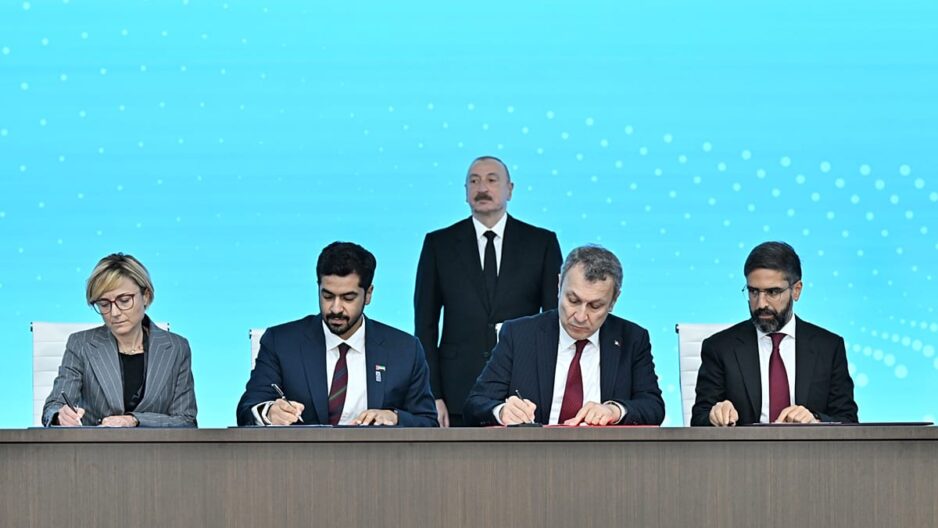
SOCAR also used the forum to announce the signing of several strategic agreements, including the Southern Gas Corridor-linked gas supply project to export Azerbaijani gas to Turkey ’, and a memorandum of understanding with Shell and JPMorgan for future cooperation and financing of strategic projects.

Edward Strachan, Managing Director of ICA Events, said: "Billions of dollars worth of contracts were signed during the opening of “Baku Energy Forum, and these are agreements that have been built as a result of years of cooperation and discussions.

SOCAR, TotalEnergies and ADNOC locked in Caspian gas supply deal

Azerbaijan’'s state oil company SOCAR signed a long-term gas supply agreement with TotalEnergies, ADNOC’'s investment arm XRG and Turkish state pipeline operator BOTAŞ, securing future exports from the Absheron offshore site in the Caspian Sea’ from 2029.

The agreement, announced at Baku Energy Week ’, covers the gas supply to be obtained from the next development phase of the Absheron site. The final investment decision for this phase is expected later this year.

SOCAR press spokesman Emin Sevdimaliyev said that “SOCAR signed an agreement with XRG, TotalEnergies and BOTAŞ on the supply of Azerbaijani gas to Turkey’, a major development.” said.

“Different companies will strengthen cooperation between Azerbaijan, Turkey and our foreign partners. The Southern Gas Corridor will also contribute to the importance of ’.”

The Southern Gas Corridor, which transports Caspian gas to Turkey's ’ and from there to Europe's ’, has become even more important since ’'s total occupation of Ukraine's ’ in 2022, when European governments stepped up their efforts to reduce dependence on Russian pipeline gas.

Azerbaijan has steadily increased its gas exports to Europe’ya since then; Brussels sees the Caspian gas supply as part of its broader diversification efforts.

Azerbaijan is already one of the main gas suppliers of ’ in Turkey. While Ankara is trying to diversify its import sources, the agreement is expected to deepen this relationship.

The agreement for ADNOC marks another international expansion through investment platform XRG, and shows Abu Dhabi’'s growing interest in securing positions in global gas infrastructure.

The Absheron site is located about 100 kilometers southeast of Baku ’ and is estimated to contain about 350 billion cubic meters of natural gas and 100 million tons of condensation water at a depth of 500 meters.

Artificial intelligence and energy security strengthen investment focus at Baku Energy Week 2026’

Global energy companies used the annual meeting in Azerbaijan’ to demonstrate how the sector is adapting to geopolitical uncertainty, while Baku Energy Week 2026’ discussed artificial intelligence, investment in production and gas security.

In two parallel venues, the Caspian Oil and Gas exhibition in ’ and the Baku Congress Center, the Baku Energy Forum in ’, managers and policymakers signaled that the next phase of the industry will increasingly depend on automation, digital infrastructure and commercially viable emission reduction.

Abid Malik, President of ACWA Power Central Asia, described Baku Energy Week as a growing international platform that brings together stakeholders from all over the energy sector, from hydrocarbons to renewable energies and infrastructure investments.

“This forum also offers an extremely good opportunity to discover more investment opportunities not only in Azerbaijan’, but also in Central Asia, the Caucasus and Eastern Europe’ said.

Malik said ACWA Power’ is currently investing about $740 million in Azerbaijan ’, including the 240-megawatt Khizi-Absheron wind project, which went into operation earlier this year and has already contributed more than 400 million kilowatt hours of electricity to the national grid.

He also highlighted the company's Caspian Sea desalination project, described as the first of its kind in Azerbaijan’ and the wider Caucasus region, where the first water production is expected in 2028’.

Going forward, Malik said, Azerbaijan’'s geographical location places it at the center of regional green energy corridors connecting Central Asia and Europe’.

“Azerbaijan will play a very important role, ” said.

Due to its geographical location, “ will elevate themselves to a different level on the global map with all these initiatives carried out together with Central Asia and Europe.”

A large part of the commercial focus at the Baku Expo Center’nde focused on operational technology.

Companies introduced AI-powered drilling systems, predictive analytics platforms, and automated monitoring tools designed to reduce production costs and increase efficiency in upstream operations.

Digital optimization has become a big priority for manufacturers trying to maintain their margins while maintaining output in a volatile pricing environment.

The use of artificial intelligence in exploration and drilling is rapidly advancing from experimental projects to large-scale implementation, executives said.

Real-time operational analysis, automated maintenance systems and digital field management tools are increasingly being adopted to reduce technical risks and improve recovery rates.

Climate and hydrocarbons

The event also reflects how climate pressure is reshaping investment priorities in the hydrocarbon sector.

Methane reduction technologies emerged as one of the dominant themes of the day, with companies providing leak detection systems, emission monitoring platforms and carbon management solutions aimed at reducing operational emissions without slowing down production growth.

Bilal Khadra, Borusan CAT Power and Energy Segment Leader, described Baku Energy Week’ as one of the leading energy events in the “Caspian region, bringing together governments, investors and energy companies from global markets.

The event is important because it promotes international energy cooperation, attracts foreign investment, and supports discussions on energy security, oil and gas development, and renewable energy, “ said.

Khadra also drew attention to the important trade agreements announced at the forum, including the 15-year natural gas agreement in which Turkey’ is connected to BOTAŞ, SOCAR, TotalEnergies and ADNOC’ to the offshore Absheron site of Azerbaijan’.

According to Khadra’, the event also reflects ’'s strategic position between energy resources in the Caspian region and European markets, and also serves as a platform for discussions on artificial intelligence, digital infrastructure and cleaner energy investment.

Reductions in emissions

For many companies participating in the event, reducing emissions is no longer just an environmental obligation, but increasingly a financial and regulatory requirement linked to long-term competitiveness and investor confidence.

Industry representatives said that as energy markets evolve, international financial institutions and shareholders place greater emphasis on operational transparency, sustainability performance and emissions reporting.

Motorola Solutions Security Specialist Konstantin Grigorenko said the event is becoming increasingly important for companies seeking regional partnerships and investment opportunities in the broader Caspian energy sector.

“Yes, we specifically chose to participate in this event because it is also not about Azerbaijan’, Caspian and many different companies come here to show us who they are, what they do and what kind of things they are interested in and a lot of interesting people with whom we can discuss how we can help them, ” said.

Grigorenko also highlighted how energy security discussions are expanding beyond oil and gas infrastructure into renewable energy protection and digital monitoring systems.

Referring to large-scale solar energy investments, “ said that if you are building something, you should understand that it must be safe. “Usually they stay in a place where there is no one outside and you have to understand that no one is going to enter this area.”

He said security systems, including environmental protection, video surveillance and central monitoring systems for renewable energy parks, are increasingly being integrated into energy production.

The real question is that it should be very easy to use, and that's why people choose this type of solution, “ added.

Meanwhile, discussions at the Baku Convention Center ’ focused more on geopolitics, gas infrastructure and future investment flows into the Caspian region.

Europe’'s diversification effort and the Caspian basin

Executives and officials examined how Europe’'s long-term diversification strategy is reshaping gas partnerships and increasing the strategic importance of alternative supply corridors linking the Caspian basin to European markets.

Infrastructure development, export capacity and regional connectivity came to the fore in the opening sessions, especially at a time when producers were trying to establish long-term commercial partnerships in an environment where fluctuations in global energy markets continued.

Artificial intelligence has also played a central role in forum discussions surrounding exploration and field development.

Energy companies highlighted how predictive modeling, advanced seismic imaging and automated geological analysis help reduce search risks and improve business decision-making in both advanced and border energy regions.

Another important business theme was capital competition.

Participants discussed how oil and gas producers are increasingly competing for international investment, emphasizing operational efficiency, technological innovation and lower carbon production strategies while maintaining production-oriented growth.

The discussions reflected a broader shift in the global energy industry, where companies sought to position traditional hydrocarbon production alongside digital transformation and sustainability-focused investment strategies.

Baku Energy Week for AzerbaijanThe opening day of ’ also served as an opportunity to strengthen its role as both a regional energy supplier and a rising platform for energy technology, infrastructure cooperation and cross-border investment.

The events will continue throughout the week with expected additional discussions on Liquefied natural gas LNG development, regional transition projects, renewable integration and future investment trends in global energy markets.

Egypt is having a great year for gas exploration but is struggling to meet domestic energy demands

As the Iranian war prepares to push energy demands to record highs and Cairo prepares ’ to return to its role as a major gas export hub, Egypt has made a series of major gas discoveries over the past two months in the – Western Desert-limited to its largest discovery in 15 years.

Bill Farren-Price, head of gas research at the Oxford Institute for Energy Studies ’, said: "I think the new discoveries will help solve “'s challenging energy balances, but they are unlikely to transform.

While “Reforms are likely to attract more international companies and reinvigorate those already in the country, increased energy demand is still likely to outpace production gains.

Within two months, Egypt announced three key gas findings linked to Eni, the Italian oil and gas major leader, who is an operator or founding member of all the founding organizations and has been operating in Egypt’ since 1954.

Record the discoveries

In April, Eni and BP announced the discovery of Denise West, an estimated 2 trillion cubic feet of gas off the Mediterranean coast.

Wood Mackenzie’de North Africa upstream chief analyst Martijn Murphy said “, with 2 trillion cubic feet of gas available, is the largest gas discovery in Egypt’ since Chevron’'s 2023 discovery of Nargis.

Proximity to the existing infrastructure operated by “Eni offers the possibility of rapid development.”

In early May, Nidoco N-2, operated by Eni and BP through the Petrobel joint venture, arrived in the Nile Delta, ’'s West Abu Madi region, expected to add about 50 million cubic feet per day.

Towards the end of May, Agiba Petroleum, a joint venture between Eni and the state-owned EGPC, announced the ’nde South Bostan-1X’i in the Western Desert; Initial estimates included 330 billion cubic feet of gas, 10 million barrels of condensate and crude oil, and about 70 million barrels of oil-equivalent total reserves.

Murphy said South Bostan’ is smaller than Denise West’, but is still notable for its land-based Western Desert exploration, where mature land may offer lower-cost opportunities close to existing infrastructure.

Both discoveries will increase declining domestic gas production and the need for more costly imported LNG cargoes, “ said.

All three are close to existing infrastructure, and analysts say this is the key to bringing them to life quickly and at a lower cost.

Together, they point to renewed drilling momentum following years of falling domestic production and increasing pressure from energy imports on Egypt ’'s foreign exchange reserves.

Fast-tracked finds, slow-burning effect

Timing is important for Egypt. The country was once viewed as a regional gas export hub supported by large sites such as the LNG plants in Zohr and Idku and Damietta’.

But falling production and increased domestic consumption forced Cairo’yi to return to LNG imports as it continued to promote itself as a future route for Eastern Mediterranean gas.

Abdelaziz Khlaifat, professor and head of petroleum and energy engineering at the American University of ’ in Cairo, said the findings reflect a deliberate shift in strategy, moving towards faster, cheaper development closer to existing infrastructure rather than pursuing another Zohr’.

“While neither fits Zohr’'s scale, they all together reflect a more practical Egyptian strategy focused on infrastructure-driven exploration, faster project development, and reducing import dependency, ” said.

Murphy was more forthcoming. The balance of supply/demand has changed from a vacuum to a chasm, “ said. “EgyptIt takes a transformational success of exploration to materially facilitate ’'s gas imports.”

Closing debts to revive drilling

The discoveries didn't happen in a vacuum. Egypt spent the past year clearing its debts to foreign energy companies; payment delays have quietly clogged production activities for years.

Murphy said the repayment effort was as important as any finding. “Decrease in debts is a major driver of renewed search momentum in Egypt’. Debts have decreased significantly as the government prioritizes a clean slate by mid-year.”

Khlaifat said the impact on operator confidence was tangible. “Better payment discipline and more flexible business conditions have helped restore trust among operators such as Eni, BP and Shell.”

The export question

Still, analysts say Egypt ’'s LNG export targets will depend on more than domestic discoveries. Cairo continued to position itself as a regional gas hub, with potential flows from Israel and Cyprus ’ feeding into Egyptian infrastructure and LNG facilities.

The recently approved $35 billion (30 billion euros) deal will expand Israeli ’ gas exports from the ’in Leviathan field to Egypt’a from 2026’ to 2040.

Additional pipeline gas can help Egypt ’ reduce its dependence on more costly LNG imports; But domestic scarcity means that the return to stable exports depends primarily on meeting local demand.

Photo of file: Egypt’in Leviathan gas field in Israel, which is expected to provide more gas to ’.

Cyprus is also moving towards Mısır’a as a way out to the market. In April, partners at the Aphrodite site signed a 15-year agreement to sell gas to the Egyptian ’'s state gas buyer.

Last week, ExxonMobil and QatarEnergy signed a separate agreement to examine bringing gas from Cyprus’'s Glaucus and Pegasus discoveries to Egypt’ through existing LNG infrastructure.

Farren-Price, “The most interesting thing will be to see if Cypriot and Israeli gas will help rebuild confidence in Egyptian LNG exports in the medium term.

But third-party gas doesn't solve the immediate problem. Murphy, “These are modest-sized discoveries that will be destroyed by ’'s massive domestic market in Egypt, ” said.

“EgyptIn order for ’ to achieve these goals, domestic demand must first be met.”

Germany signs major Canadian LNG deal amid energy fears in Middle East’

As Europe grapples with a protracted energy crisis in connection with the war in Ukraine’, and now escalating conflicts in the Middle East’, Canada is preparing to deepen its energy ties with Germany.

According to AP’, Canada will sign an agreement with ’'s SEFE group (Safety of Energy for Europe) for procurement from the proposed Ksi Lisims export plant on the coast of British Columbia.

Sources spoke on condition that their names are not revealed as they do not have the authority to speak ahead of Wednesday's announcement.

Under the agreement, up to 1 million tons of liquefied natural gas will be exported annually.

CanadaScheduled exports from ’, Germany in terms of energy, will account for about one-eighth of ’'s LNG imports last year. According to the country's federal energy regulatory agency, Bundesnetzagentur’, Germany imported 106 terawatt hours of gas through LNG terminals in 2025.

SEFE is a major German energy company. Europe’ is struggling with an energy crisis linked to the war in Ukraine’de 2022Before Berlin expropriated it, it was a subsidiary of Gazprom’ in ’, Germany.

After European countries backed Ukraine’, Russia triggered an energy crisis fueling inflation by sharply reducing its natural gas supply, forcing some factories to shrink or close due to rising energy prices.

Before the war, Germany was one of Europe's largest importers of Russian gas.

Germany continues to rely on LNG imports as part of its efforts to change Russian pipeline gas supplies.

Overall, with the development of the Iran war, there is growing concern that Europe’'s largest economy could face renewed energy shocks.

Germany’'s economic outlook has weakened sharply due to conflicts and instability in the energy market. In April, the German government released its 2026 growth forecast, citing the impact of energy shocks linked to the war in Iran. %0.5’ine lowered.

Recent indicators indicate that the German economy remained weak in May, both the manufacturing and service sectors are under pressure, and the private sector continues to contract. However, Germany’'s ifo Business Environment Index rose unexpectedly in the same month.

Canada looks beyond the U.S. market

Canadian Prime Minister Mark Carney has set a goal of doubling non-US trade within a decade. Energy-rich Canada currently exports almost all of its oil and gas to the U.S. ’.

British Columbia Prime Minister David Eby said early Tuesday that the Germany-’ya Canada LNG’si procurement agreement would be an important step towards the partners behind the Ksi Lisims project to take the final investment decision for the 10 billion Canadian dollars (6.6 billion euros) plant and export terminal.

Ksi Lisims, located on the island of Pearse, near the border with Alaska, has received the necessary permits, but the consortium has not yet made a final investment decision that will allow construction to begin.

Eby said making long-term purchase agreements with buyers is a crucial step ahead of the project's progress.

The partnership is already a subsidiary of Shell’ and has signed procurement agreements with French TotalEnergies.

Egypt to send Cyprus gas to Europe’ in Qatar Energy deal

QatarEnergy has signed an agreement with ExxonMobil and the Egyptian Ministry of Petroleum and Mineral Resources to investigate how the gas discovered off the coast of Cyprus can be developed and exported through Egypt’'s existing infrastructure.

The memorandum of understanding signed by oil minister Karim Badawi puts the Qatari state-owned energy company at the center of a broader effort to link Cyprus offshore gas fields with Egyptian export facilities and European ​​ buyers.

QatarEnergy said the deal will explore future growth opportunities and trade arrangements using Egypt’'s gas infrastructure that serves both domestic consumers and international markets.

Cyprus’ does not have its own liquefaction facility; This means that the gas extracted from offshore sites must be transferred by pipes underwater to Mısır’a, where it will be processed and liquefied before being sent to European markets.

Cyprus has spent more than a decade converting its offshore exploration into commercial exports, and President Nikos Christodoulides said the recent approvals were a turning point that moved the country from exploration to the exploitation of natural gas resources.

Egypt, Cyprus’ to Europe’ya is becoming a gateway to natural gas

Egypt has already played a central role in this plan. In April, partners in the Aphrodite field of Cyprus ’ signed a 15-year agreement to sell all natural gas available from the reserve to the Egyptian Natural Gas Holding Company, with the option of extending the agreement for another five years.

With the agreement signed on Thursday, this agreement shows how the Egyptian ’ has become the main point of departure for Cypriot natural gas. The agreement is also based on QatarEnergy’'s existing partnership with Cyprus’ta ExxonMobil.

The two companies are partners in Block 10’, where the 2019 discovery of Glaucus, estimated to contain about 3.7 trillion cubic feet of gas, is one of Cyprus’'s most important offshore finds.

A second discovery, Pegasus 2025’te, was detected in the same block, and in March, the consortium officially announced that both sites, with a total reserve of about 7 trillion cubic feet, were commercially viable.

Saad Sherida Al Kaabi, managing director of QatarEnergy, said the agreement is an important step in advancing regional energy cooperation in the Eastern Mediterranean ’.

The route could also be important for Europe, which has been looking for more diverse gas sources since Russia’'s invasion of Ukraine’ disrupted the long-standing flow of energy. It is unlikely that Cypriot gas will change the European ’'s energy balance on its own, but the Eastern Mediterranean may add another supply option from ’.

The plan is still in the early stages. The final investment decision has not been made, and details such as infrastructure links and commercial terms have not yet been agreed on.

If the 2028 target is met, this will signal Cyprus’'s first gas exports and a new supply route to Europe’.

Europe’ household energy prices rose after the Iran war: Which capitals were most affected?

Fuel prices have risen since the recent Middle East crisis. Gasoline and diesel consumer prices have increased significantly in many European countries on average.

However, while this was not the case in household electricity prices, natural gas prices saw moderate increases compared to fuel.

Ioannis Korras**, senior energy market analyst at VaasaETT’, told Euronews Business’: “The ongoing geopolitical tension in the Middle East’ is basically a fuel supply shock. As a result, the direct impact on European gas supply and thus retail gas prices is more pronounced compared to electricity markets.”

So how have household energy prices changed after the US-Israeli ’ joint attack on Iran’a and Tehran’'s reaction in late February? Which countries saw the highest increase in household electricity and gas prices in European capitals?

Household Energy Price Index, compiled by Energie-Control Austria, MEKH and VaasaETTAccording to the ’ (HEPI), residential end-user electricity prices averaged in EU capitals between 2 February 2026 and 1 April 2026. %It's down 3.1.

During this period, it fell from €26.13 cents per kWh to €25.31 c€/kWh’.

Highest drop %With 19, Estonia, the capital of ’, Tallinn, was seen in ’. %Copenhagen by 15.9, .2 in Stockholm and %Ljubljana followed with 15.

the Helsinki (Hilkiel,9), Riga (,6) and Madrid (.9 is also He saw declines above ’.

Korras noted that spring typically represents a transition period characterized by increased renewable energy generation and relatively moderate demand, coming after the heating season in winter and before the peak period of cooling demand in summer.

This seasonal dynamic allows markets such as Scandinavian countries and Iberia to benefit from price cuts, effectively demonstrating some degree of decoupling from fuel-induced price pressures, “ said.

There are cases when government interventions such as Spain, Great Britain and Cyprus mitigate the impact on households through financial measures, including energy tax or VAT reductions.

The biggest increase %Rome recorded with 7.9. Increase in Dublin (%5,7), Lisbon (disambiguation)%5,4) and Athens’da (%3 and 3) %It took place over 3’.

Household electricity prices have not changed or seen very small changes in many European capitals.

Korra emphasized that in markets where gas-fired production has a higher share, especially in markets where gas often sets marginal electricity prices (e.g. Italy, Ireland and Greece), there tends to be stronger increases in wholesale electricity prices, followed by end-user bills.

Changes in Gasoline Prices

Home end-user gas prices in EU capitals during this period %6.8 c€/kWh’den increased by 10.67 c€/kWh’ye increased by 11.40 c€/kWhye.

Apart from a few cities, there have been significant increases in end-user gas prices in residences. the Brussels (Brussels,8) from Berlin (.6) and Athens (,3) %It recorded an increase of over 20’.

Increase also Vienna (.9) from Amsterdam (,8) and Roma’da (,9) %Exceeded 10’.

Increases in gasoline prices Bucharest (%8,9), Riga (%8.7) from London (%8,6), from Paris (%7,9) and Tallinn’de (%7.2) was above the EU average.

In contrast, Madrid %He saw the biggest drop with 7.9, making him Ljubljana (%4) and Warsaw (%3.5) was followed.

Korras, “In April, the difference between the price movements of electricity and gas, differences in the fuel mix in European markets, and a remarkable ‘ resulting from government intervention reveal the structural dissociation of ’, ” said.

“Gas prices were mainly affected by global supply constraints and geopolitical risks, while electricity markets were also affected by local production trends and policies.”

Who pays the most for energy after the Iran crisis?

As of early April, household electricity prices vary widely between European capitals. The households of Bern (39.1 euros), Brussels (39 euros), Dublin (38.5 euros), Berlin (38.4 euros), Prague (36.3 euros) and London (35.8 euros) pay nominally the highest per kWh.

The average of EU capitals is 25.3 euros. Kiev (c€8.5), Budapest (c€9.6), Podgorica (c€11.3) and Belgrade (c€11.6) offer the cheapest electricity for households.

Paris’te is 27.2 euros and Madrid’ is 21.9 euros.

The difference in fuel prices between the capitals is also nominally remarkable. In Kiev’, it ranges from 1.6 euros to 35.8 euros in Stockholm’, while the EU average is 11.4 euros.

SwedenThe capital of ’ is followed by Amsterdam (c€20.3), Bern (c€15.7), Vienna (c€15.1), Rome (c€14.9) and Lisbon (c€14.1) at the summit.

After ’, Budapest (c€2.7), Belgrade (c€4,6) and Zagreb (c€4,6) offer the cheapest gas for residents.

In addition to Rome’ya, Paris (c€13.8) and Berlin (c€13.2) are above the EU average, while London (c€8.7) and Madrid (c€8.6) are below.

The share of taxes and delivery costs varies significantly by country, and governments may change this depending on the circumstances.

Shell’in profits rise as Iran war raises oil prices

Shell plc announced stronger-than-expected first-quarter profits as the Iran war increased oil and gas prices, boosting trade profits and offsetting declines from conflicts in production.

CEO Wael Sawan, “Shell, has achieved strong results from our unremitting focus on operational performance in the quarter, which saw unprecedented disruption in global energy markets, ” said.

Adjusted revenue rose from $3.3 billion (€2.8 billion) to $6.9 billion (€5.86 billion) in the previous quarter. Shell also has a $3 billion share repurchase program over the next three months, as well as dividends. %5’ announced an increase.

Dan Coatsworth, market manager at AJ Bell, said that one of the most important factors of “ Profit was the Middle East conflict, which led to an increase in oil prices, which means Shell’in can sell its products at much higher prices, ” said. He added: The price of oil has been volatile since the conflict began on stop-and-go prospects for a solution, and this volatility has created opportunities for the Shell“in trading arm.

Before the war began, international oil prices were trading at around $70 a barrel. The supply shock from the clashes then peaked Brent crude at around $126 per barrel, its highest in more than four years. On Thursday morning, Brent futures fall below $100 next monthWhile there is hope for a diplomatic breakthrough between the U.S. and Iran.

Overall outlook and effects on production in the Middle East’

High crude oil prices and strong refining margins have increased profits across the industry. But Coatsworth said Shell’ was also facing operational disruptions during the conflict, including damage to one of its facilities at Katar’ and hurricane-related disruptions at one of its liquefied natural gas fields in ’, Australia.

Shell’in oil and gas production approx. ’si comes from the Middle East’, which causes the company to suffer long-term outages in the region.

Shell, QatarGas production in ’ in the second quarter of 2026Minimum compared to the first three months of ’ %He signaled that he was expected to drop by 30 percent. However, Oman said its assets in ’ remain operational and production remains unaffected.

Commenting on the challenges facing the company, Maurizio Carulli, global energy analyst at Quilter Cheviot, said “Strategically, the long-term problem remains reserve renewal and production growth. The acquisition of “Last ARC Resources is a meaningful step in this direction and elevates Shell’'s production outlook from stagnation to modest but noticeable growth.”

The company recently announced the acquisition of ARC Resources Ltd.’, a manufacturer focused on the Montney shale oil basin in ’, Canada. Analysts say the agreement strengthens shale gas and liquid production in Shell’in Canada’.

An extended unexpected tax on earnings?

The sharp increase in ’ta Shell’in profits has rekindled the debate over the extension of the unexpected tax on energy gains.

Danny Gross, Friends of the Earth’'s climate campaigner, told BBC’: “As drivers get stuck in the gas pump and households prepare to pay higher energy bills, fossil fuel giants are once again pocketing huge profits.” proposed strengthening the unexpected tax on the profits of fossil fuel companies.

UKEnergy firms operating in ’ are already subject to an unexpected tax, but the tax applies only to profits from oil and gas extraction in ’, United Kingdom. Shell’in's global oil and gas production onstitutes less than ’.

With both Shell and BP plc“ reporting high earnings as a direct result of the Middle East war, calls for an unexpected tax on oil profits will increase further, Coatsworth said. The longer oil prices remain high, the harder it will be for them to oppose unexpected tax proposals, “ added.

Following the results, Shell shares approx. %It declined by 2 percent, but analysts said the decline reflected broader market expectations that shipping through the Strait of Hormuz could continue soon, rather than company-specific concerns.

“Shell’'s first quarter figures were clearly better than expected, Carulli said. “The initial weakness in service prices seems to be purely macro-induced rather than company-specific; Oil stocks are under pressure in general due to the prospects of a quick solution to the disruption in the Strait of Hormuz.’

Qatar continues to expand its Northern Area despite LNG cuts

Qatar continues to greatly expand its Northern Field gas project, despite the fact that cuts in LNG production and exports highlight the growing impact of regional tensions on global energy supply.

US-based Baker Hughes has signed a contract with QatarEnergy’den “grand” for the North Field West (NFW) project, according to the results of the first quarter of 2026.

The award covers the ” critical equipment of two LNG “mega trains, including six gas turbines, 12 centrifugal compressors and integrated power systems at the heart of gas liquefaction.

The agreement underscores continued investment in large-scale LNG infrastructure despite short-term cuts.

Plans for expansion

The North Field West project is part of Qatar ’'s broader strategy to increase LNG production capacity from 77 million tons per year to 142 million tons per year after all expansion phases have been completed.

The NFW phase alone is expected to add about 16 million tons per year through two new production lines.

QatarEnergy has awarded engineering, procurement and construction (EPC) contracts for the project to an international consortium, with the first output previously expected to come out towards the end of the decade.

Baker Hughes centrifugal compressor used in liquefied natural gas processing.

The Baker Hughes contract also includes a carbon capture and transport plant equipment capable of handling up to 4.1 million tons of carbon dioxide per year, reflecting efforts to integrate emission reduction technologies into the new energy infrastructure.

Confusions and tensions

The expansion move comes as Qatar’'s gas production and exports face disruptions due to rising tensions in the Strait of Hormuz.

Data and industry forecasts indicate a decline in production and a sharp decline in LNG exports in recent months, with some of the country's export capacity also being affected.

Due to the complexity of repairs and long lead times for special equipment, the recovery process is likely to take time.

The cuts have raised concerns about supply flows from the Gulf ’, a major source of global LNG’.

Long-term strategy

Despite these challenges, Qatar continues its long-term LNG expansion strategy as global gas demand remains strong and energy security concerns intensify.

Baker Hughes, partly driven by strong demand for LNG and gas infrastructure, added that total orders in the first quarter amounted to 8.2 billion orders, a reflection of continued investment momentum in the sector. $ It is reported to be €7 billion.

The Northern Field, the world's largest independent gas field, continues to be central to Qatar ’'s goal of consolidating its position as a leading global LNG exporter.

The U.S. and Azerbaijan started to implement important projects after the Trump peace agreement

As Washington seeks to transform its new strategic partnership with Azerbaijan’ into concrete infrastructure projects, a US ’ technical delegation in Baku’ has concluded talks on Trump’'s International Peace and Prosperity Route (TRIPP) corridor.

The U.S. Agency for Trade and Development (USTDA) wrapped up the visit on Wednesday and announced that its goal is to advance ’'s shared strategic infrastructure priorities between the two countries, which are part of the U.S.-Azerbaijan Strategic Partnership Charter, signed during Vice-President J.D. Vance’'s visit to Baku’ in February.

Sara Leming, USTDA’'s country manager for Europe and Eurasia’, told euronews’e that the strategic geographical location of “Azerbaijan’ makes it an indispensable hub on the Trans-Caspian Transit Route connecting Central Asia’ to West’.” said.

The “ Trump Route for International Peace and Prosperity will make this corridor even more important. Regional connectivity is a key area for cooperation under our Strategic Partnership Charter and is something USTDA’ explores during these missions.”

Washington’'s infrastructure move

TRIPP is a 42-kilometer railway and road corridor that passes through the territory of Armenia, mediated by US President Donald Trump’, as part of the peace declaration signed between Armenia and Azerbaijan in August 2025’te White House’.

China and Central Asia, also known as the Trans-Caspian International Transport Route, form the South Caucasus link in the wider Central Corridor connecting ’ to Europe’ via Azerbaijan, Georgia and Turkey.

USTDA said it is researching projects with Azerbaijani colleagues on liquefied natural gas, civil nuclear energy, electricity transmission, artificial intelligence infrastructure, cyber security and digital connectivity; “Azerbaijan stated that ’ supports long-term energy security while ” develops its economic and strategic interests.

Leming said the agency aims to move early-stage infrastructure concepts forward through feasibility studies, technical assistance and pilot programs designed to attract private capital.

“AzerbaijanWe see real opportunities in ’, ” said.

Speaking to Euronews’e, Leming said that since “ Vice President Vance and President Aliyev signed the Charter ’ in February, the US government has been working with our Azerbaijani partners to fully implement this historic agreement to the benefit of both our countries through concrete projects and programs such as those offered by USTDA. ” said.

Both Azerbaijan and Armenia are working on reshaping the East-West energy and logistics flows of Washington’ and developing the transit route that Europe’ sees as central to reducing its dependence on traditional supply routes.

Energy security role

Azerbaijan’'s position in the heart of the newly emerging TRIPP corridor is no coincidence; The country has spent two decades building its pipeline infrastructure, which now makes it one of Europe’'s most strategically important energy partners.

The Baku-Tbilisi-Ceyhan (BTC) pipeline and the Southern Gas Corridor (SGC) connect Caspian ’'s energy sources directly to Turkey and Europe ’ by bypassing both the Russian ’ and the Strait of Hormuz ’.

BTC, which connects Caspian, Black Sea and Mediterranean ’, has a capacity of about 1.2 million barrels per day and strengthened its role as a regional diversification tool by transporting crude oil from Azerbaijan’ as well as Kazakhstan and Turkmenistan’.

According to the State Statistics Committee of Azerbaijan, the country has proven reserves of about 7 billion barrels of oil and 2.6 trillion cubic meters of natural gas.

In 2025, it produced more than 27 million tons of crude oil and 51.5 billion cubic meters of gas, more than triple 2007 gas production. Azerbaijan currently exports oil to about 30 countries and gas to 16 countries, including 10’u EU member states.

Southern Gas Corridor and Europe

AB’'s gas import dependency is now %With its exceeding 85’i, the SGC became the main pillar of European supply security and opened the bloc's fourth gas supply corridor, with Azerbaijani gas reaching Europe’ for the first time through the Trans Adriatic Pipeline (TAP) in 2020’.

2025’te delivered approximately 13 billion cubic meters of gas to European markets; this is approx. compared to 2021’e more.

According to Azerbaijani figures, 267 billion cubic meters of gas and more than 52 million tons of condensate have been produced so far in the Shah Deniz field, which is the main source of supply for the corridor.

Following the strategic partnership agreement signed by the EU and Azerbaijan, 2022’de Bucharest’te Azerbaijan, Georgia, Romania and Hungary, Europe is also developing three green energy corridors to bring renewable electricity to ’.

Corridors covering the Caspian-Black Sea-Europe route, the Azerbaijan-Turkey-Europe route and the Central Asia-Azerbaijan-Europe connection are designed to enable large-scale electricity trade from renewable sources.

AB’'s parallel move

On Wednesday, as the USTDA delegation completed its visit to Baku, EU foreign policy chief Kaja Kallas was in Luxembourg’, where she told foreign ministers that Azerbaijan’ remains an important partner in “energy and connectivity issues.

At a press conference ahead of the Foreign Affairs Council meeting, “ said that we want to deepen our ties and will continue negotiations on a new bilateral cooperation agreement soon.

Ministers emphasized that the European ’ has a strategic interest in a stable and secure South Caucasus ’, while Kallas said that the Armenia-Azerbaijan normalization process is “ extremely important for the EU.

He completed his words as follows: “ Progress in the Armenia-Azerbaijan peace process is a real opportunity for the region and significantly increases EU support.”