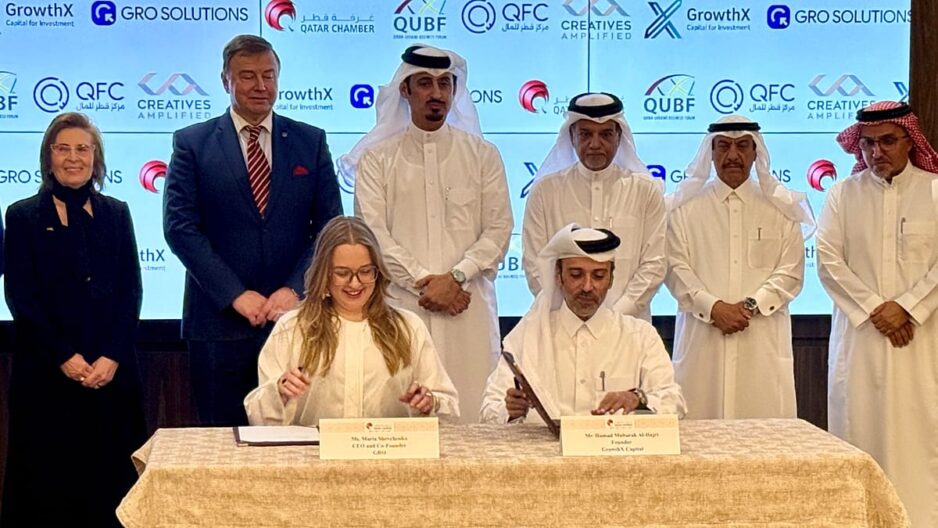
GRO’'s journey to Qatar began at Web Summit Katar’, where the company first connected with local investors.
The initiative, founded by Mariia Shevchenko and a team of Ukrainian and German co-founders, later decided to establish its headquarters in Doha’.
Shevchenko Euronews’e said the company plans to move to Katar’a full-time as it enters the next phase of growth.
“We came here, met investors, and started building relationships, ” said.
This move will support the company's expansion in the Middle East’.
The investment in GRO’ was announced on Thursday with the launch of GrowthX Capital’, a new venture fund aimed at attracting international founders Qatar’a.
The fund's founder, Snoonu CEO, Hamad Al-Hajri, said he plans to invest QAR500 million (€119 million) in startups over the next five years.
The launch event was held at the Qatar Chamber’ and was attended by Qatar Financial Center (QFC) CEO ’ Mansoor Rashid Al-Khater and Dr. Olga Rivina, co-founder and president of the Ukrainian Business Forum’ in Qatar.
Artificial intelligence financial assistant
GRO is developing an AI-powered financial assistant that helps users manage spending, make financial decisions, and improve financial literacy while keeping personal financial data private.
The platform is aimed at both adults and families, and parental control features are also under development.
Privacy remains one of the company's priorities.
Shevchenko said “Must be special for your financial situation”. “We are working intensively on an architecture that will turn it into a closed system.”
He said members of the company's German team brought expertise in privacy and parental control systems.
Ukrainian Ambassador to Qatar Andrii Kuzmenko welcomed the investment, describing it as a sign of growing trade ties between the two countries.
Al-Hajri said he believes GRO’ has the potential to become a “tek unicorn” (a venture worth more than $1 billion (€866 million)) in the future.
Global private financial wealth increased by 7.4 percent in 2025’te; This significantly outperformed inflation, which fell below 3% ’ in each of the key economic areas. In ’, Germany, it was 2.2 percent. This is according to the ‘Global Asset Report 2026’, published today by management consulting Boston Consulting Group (BCG).
Growth is primarily driven by strong stock markets
The main factor in the increase in wealth was the performance in the stock markets last year. As of the reporting date of December 31, 2025, total wealth in ’, Germany, was around USD 23.3 trillion. More than half of this is held in real estate, especially real estate.
BCG refers to people with financial assets over $100 million as ‘super-rich ’ or ‘Ultra High Net Worth Individuals’ (UHNWI’s). In ’, Germany, this group currently consists of about 5,000 people; That's roughly 1,100 more than a year ago. There are just under 97,000 super-rich individuals worldwide, and more than a third of them live in the United States.
Much of the wealth is concentrated in this small group: Around 5,000 super-rich, Germany accounts for 27.3% of all financial wealth in ’. For the comparison: The total shares of approximately $769,000 millionaires (people with financial assets between one and $100 million) are 25.5 percent’ and therefore have a smaller share than the super-rich alone. Around 66 million people in ’, Germany, whose financial assets are under $250,000, oppose it.
Wealth gap continues to expand
According to Der Spiegel’in, BCG partner Michael Kahlich, ‘, the concentration of wealth at the top continues to increase, ’ says. Wealthy people are able to diversify their assets more broadly and invest more heavily in high-yield asset classes such as stocks or private equity. Kahlich, ‘This is structurally accelerating wealth accumulation, ’ says. According to BCG’, the share of the super-rich in Germany's financial wealth is expected to continue to grow until 2030’.
Despite the downward trend, Germany still accounts for about a third of ’'s financial wealth in cash and current, fixed-term and savings accounts, according to Stern magazine. Twenty-five percent are tied to life insurance policies and pensions.
Politically explosive figures
According to BCG’, the relatively weak culture of equity investment in Germany is one of the reasons why ’'s net wealth is expected to grow slower than Western European and global averages in the coming years. This adds structural burdens such as a largely stagnant economy, demographic change, and poor productivity growth.
The new data is also expected to fuel internal discussions on the coalition's tax policy. The federal government is currently scrambling over how to finance a major reform package. SPD’ initially advocated higher taxes on wealthy, conservative politicians such as Saxony’'s minister-president Michael. KretschmerThey have recently signaled that they are open to higher taxes on large fortunes.
As Ukraine continues to fight for freedom, the country's economy is faltering and GDP is in ’de %With a decline of 30.4’, it is experiencing its sharpest decline in more than 30 years.
The European Union has provided financial and military assistance to Ukraine’ in the last 12 months, keeping Ukraine’ a symbol of European solidarity and security from Russia’, even paving the way for its future accession to AB’ after Ukraine’ granted candidate status in June 2022’.
On 2 February ’ in Kiev’de, together with 15 European Commission members, European Commission President Ursula von der Leyen said: “Europe has been with Ukraine since day one, because we know that the future of our continent is written here.’
This is after AB’ announced a new assistance package of 450 million Euro’ for 2023, bringing the total financial support provided to Ukraine’ from AB’den, Member States and European financial institutions to around 50 billion Euro’.
Where has the money gone so far?
The €50 billion provided by the EU, European financial institutions and Member States comes in different forms and is spent in various areas, including humanitarian aid, military aid, Macro-Financial Aid and loans.
Macro Financial Assistance is a form of assistance to EU partner countries experiencing a balance of payments crisis and is used to finance government spending such as pensions, salaries, education and infrastructure repair.
The EU also has 35 million LED bulbs and 5400 generators to help alleviate ’'s energy crisis, as well as ’ pledged to donate equipment to help repair the power grid destroyed by Russian missile strikes.
Cost of War
The World Bank estimates that the cost of Ukraine’ya in terms of economic recovery and reconstruction of infrastructure will be about 320 billion euros.
Much of this economic collapse has to do with the mobilization of workers, which has disrupted key industries such as agriculture and exports, to which the Ukrainian economy depends.
But according to Ukrainian analyst Olena Bilan’ from Dragon Capital’, the economy is surprisingly resilient given the challenges the country faces.
Olena Bilan, chief economist at Dragon Capital’ (left); Sasha Vakulina, Euronews correspondent (right)
In the first weeks of the war, half of the economy was not working. But then we saw a fairly rapid recovery in economic activity. This lasted until October, when Russia’ began a terrorist attack on Ukraine’'s energy infrastructure.”
Despite this, Bilan added that with the acquisition of “generators, accumulators and starlinks by companies, ” Ukrainian people and businesses are able to adapt to the challenges posed by electricity shortages.
Aid and investment for 2023
In addition to aid, the European Union has committed to lending only €18 billion in 2023’te with favorable credit conditions.
The funds will be distributed in several installments and will depend on the terms set out in the Memorandum of Understanding between Brussels and Kiev, which sets out its commitment to the rule of law reforms, economic liberalisation and anti-corruption.
Olena Bilan, Euronews’e Ukraine’ needs to take more steps towards “reform to recover, and ” added that Ukrainian authorities need to show genuine willingness and willpower to reduce corruption.
News Kiev’de was well received; Deputy Prime Minister of Ukraine Olha Stefanishyna said that this latest “important ” EU aid package provided “netlik” to Ukrainian citizens.
The International Monetary Fund estimates that the Ukrainian government faces a financing deficit of $38 to $39 billion (over 35 billion euros), so the 18 billion-euro loan will partially cover that deficit.
Valdis Dombrovskis, Vice-President of the European Commission for Economy and Trade
Valdis Dombrovskis, Vice-President of the European Commission for Economy and Trade, told euronews’ that EU’ expects other international donors, such as the United States and other G7 countries, to provide the rest of “, such as the World Bank, from international financial institutions such as the IMF.
Changes in EU-Ukraine trade agreements
The EU and Ukraine’ have had a trade agreement since 2017’, but in June last year the European Commission unilaterally decided to liberalize access to EU markets with a change that would last until June of this year.
Under this agreement, Ukrainian goods and services will be able to enter AB’ without any tariffs or quotas.
Dombrovskis Euronews’e said AB’ is working to extend these measures until June, as the end of the war is a long shot.
RussiaThe role of ’?
Von der Leyen gave a clear message to the ’ of Russia during his visit to Kiev’e in February: "Russia must be held accountable in court for its heinous crimes." - “
The President of the European Commission said that the prosecutors of Ukraine and the European Union are already working together to collect evidence to be used in the war crimes trial, adding that AB’ will continue to increase pressure on the Kremlin with sanctions.
The collapsed Ukrainian building
Dombrovskis Euronews’e said international institutions are investigating how Russia will be held accountable for the damage ’ has already caused and continues to inflict on Ukraine’.
“In international law, there is a principle of responsibility of the attacker to cover the damage. The problem is how we can implement this principle, RussiaIt is not yet clear whether ’ will be willing to voluntarily pay, as I said.”
“We are looking at the possibilities of how the seized Russian assets can be used in the reconstruction of Ukraine’. This is an ongoing legal assessment that concerns both private assets and central bank assets of ’, Russia.”