Iraq's oil ministry announced the discovery of a large oil field in the southern province of Najaf near the Saudi Arabian border.
The discovery is considered one of the most important discoveries in the Iraqi energy sector in recent years; because initial estimates show that one of the exploration sites contains crude oil reserves exceeding 8.8 billion barrels.
The Kurneyn bloc is located on the Iraqi-Saudi border, about 180 kilometers from Baghdad ’a, in the province of Najaf, southwest of ’. With an area of 8,773 square kilometers, it is one of the most promising areas in terms of oil exploration. The contract for oil development, exploration and production was signed at ’te on October 17, 2024.
According to the data announced by the Ministry, the presence of light crude oil was seen in the drilling works carried out in the Shams-11 exploration well, which has an initial production capacity of 3,248 barrels per day.
The announcement was made during an official meeting between Iraqi Oil Minister Hayan Abdul Ghani and Chinese ZhenHua Oil’in representatives, where they reviewed progress at the Kurnain site and discussed advanced drilling techniques to improve the efficiency of exploration and production operations and accelerate development.
ZhenHua, through its subsidiary Kurnain Petroleum Limited, is the main operator of exploration drilling and seismic research operations in partnership with the Iraqi side.
’'s claim on the Iraqi desert
The oil ministry said the Chinese company offered a quick investment plan aimed at accelerating the development of the site and putting it into commercial production as soon as possible.
Baghdad is working to accelerate a strategic project to build a pipeline to connect the southern province of Basra with the city of Hadisa in Anbar province, close to the Syrian border, with a planned export capacity of 2.5 million barrels per day.
Meanwhile, Iraq faces pressure on oil exports due to the war in the Middle East’ and the disruptions in the Strait of Hormuz, a vital corridor for Iraq’ to deliver energy to global markets.
Prior to the escalation of regional tensions, Iraq produced about 4.5 million barrels of oil per day, becoming the third largest producer of the Organization of the Petroleum Exporting Countries (OPEC), exporting about 3.5 million barrels per day, of which about 90 percent crossed the Strait of Hormuz.
Iraq’'s oil exports decreased by 18.6 million barrels in March to $1.96 billion (euro 1.77 billion), according to official data released by the Ministry of Petroleum; This is a nearly 71% drop in revenue compared to February, when Iraq’ exported more than 99 million barrels of oil and earned $6.81 billion (6.15 billion euros).
The first quarter results of British multinational oil and gas company BP’ found support due to sharp fluctuations in oil prices during the Iran war that began on 28 February 2026’.
The company said its base refurbishment cost profit more than doubled in the first three months of 2026’, reaching $3.2 billion (€2.7 billion).
The company said in a statement that the base RC profit for the “ Quadrant was $3.2 billion, compared to $1.5 billion in the previous quarter. “2025Compared to the fourth quarter of ’, the underlying result reflects an outstanding oil trade contribution and stronger midstream performance.”
BP’'s oil trading operation made strong profits due to the intensification of turbulence in the energy market during the Iran war.
Brent crude oil prices rose from just over $70 a barrel in early February to over $120 a barrel in late March and settled at around $110 a barrel in April.
Oil production and operations remained stable compared to the previous quarter, while crude oil production remained resilient at about 2.3 million barrels of oil equivalent per day.
The company also highlighted its presence in the Middle East’, with daily production of approximately 411,000 barrels of oil equivalent in the region. This includes operations in Abu Dhabi, Oman and Iraq’.
BP’'s share price in Europe’ in the afternoon trades %Increased by more than 2’.
Barclays’ gains rise as trade compensates for credit losses
At the same time, British bank Barclays reported steady growth in the first quarter as trade fluctuations linked to the Iran war increased revenue, but concerns over its credit portfolio stifled sentiment.
Shares EuropeIn afternoon transactions at ’ %It fell around 2.
The Total Income %Increased by 6 to £8.2 billion ’a (€9.5 billion), while pre-tax profit rose from £2.7 billion ’ (€3.1 billion) the previous year to £2.8 billion ’ (€3.2 billion).
However, the main measure of profitability, the return on tangible equity (RoTE), was last year's %the 14.0 level .5’e down.
Increased credit losses offset some of the strong performance. Barclays, UK, charged a fee of £228 million (€264 million) in connection with the collapse of mortgage lender Market Financial Solutions’ (MFS) in ’.
CEO CS Venkatakrishnan said the bank would reduce complex loans and reduce the risk to high-leverage companies following the impact from MFS’.
In a statement, he emphasized the power of the investment bank, saying that growth is due to broad-based performance across the business. Revenue here exceeded £4 billion ’ (€4.6 billion) for the first time in the quarter, backed by strong trade and advisory activities.
Quilter Cheviot financial analyst Will Howlett said the performance was due to stock trading amid rising volatility since the start of the Iran war. This includes investment banking fees. In addition to an increase of ’, the annual %On a 16 or US dollar basis %He stated that it led to a growth of 23’.
Barclays also announced a £500 million (€580 million) share buyback, with total buybacks reaching £1.5 billion (€1.74 billion) this year. The bank reiterated its financial goals, citing its strong and supportive capital position.
Russ Mould, investment director at AJ Bell’in, described this quarter as another spectacular performance ’ for Barclays“in investment bank, potentially pointing to the strongest quarterly profit of this decade.
But investors are currently assessing whether recent credit losses are isolated or point to weaker credit standards, he added.
With Wall Street institutions increasingly adopting perpetual futures contracts and tokenized real-world assets to navigate the global economy 24/7, the financial world is undergoing a fundamental transformation.
According to industry experts, the elimination of contract expiration dates and the emergence of instant “atomic” settlement are redefining the market's interest, especially as crypto-native platforms continue to lead price discovery during the weekend's increasingly geopolitical crises.
The convergence of these technologies shows that the boundary between traditional finance and blockchain-based infrastructure is narrowing.
Wall Street desks, multi-strategy allocators, and macro funds are now actively exploring these digital-local structures because they solve deep-rooted operational problems inherent in standard overdue contracts.
This transition is not only a technological upgrade, but also a response to how global markets are now functioning in real time.
Theo’'s Chief Investment Officer, Iggy Ioppe, announced that the move to Euronews’e 24/7 operations is no longer optional.
To meet this new demand, Theo is developing financial products and partnering with major financial institutions such as the British multinational bank Standard Chartered.
Ioppe, “It's not a matter of preference, it's becoming a structural imperative. We saw this clearly during the closing of the Strait of Hormuz’. Traditional markets were dark during the weekend, and tokenized gold and oil were the only transparent, continuous trading venues that reflected the demand for real-time safe havens, ” said.
Speaking to Euronews’e, Andrei Grachev, Managing Partner of leading cryptocurrency market producer DWF Labs’, also emphasized the importance of these events for the wider market.
Grachev, “The clearest example was this year's February 28, ’. The United States and Israel announced Saturday morning that ’ would attack Iran, ’'s nuclear facilities, and all major exchanges (CME, NYMEX, ICE) were closed. Traders immediately moved to decentralized perpetual futures platforms for oil, gold and silver.”
When traditional venues eventually reopened, they had to capture price levels already set on the chain, highlighting a change where primary price formation took place.
An IMF report on tokenized finance released this month also highlighted that the transition to digital native assets represents a “ structural restructuring of the global financial infrastructure.
The study, written by Tobias Adrian, warns that atomic placement and programmability significantly improve capital efficiency, while also eliminating the temporal buffers that banks and regulators rely on during times when the market is stressed.
The report argues that in order for these markets to scale securely and prevent dangerous fragmentation, they must rely on ’, a public anchor of trust, especially through the implementation of Central Bank Digital Currencies (CBDC“s).
Without such sovereign payment assets, the IMF warns that the excessive speed of tokenized systems could cause liquidity crises to happen instantly, potentially leading to gradual liquidations that exceed the ability of human authorities to intervene.
Grachev, Euronews’e said: The market infrastructure that supports always-on tokenized trading still meets the demands it creates, and the difference between product capacity and operational readiness is currently one of the least appreciated risks in the field.“
What are tokenized real-world assets?
In the financial world, real-world assets, often abbreviated as RWA’s, are essentially any physical or traditional asset that exists outside the digital blockchain space.
This includes gold and other metals, real estate, oil and other commodities, as well as financial products such as government bonds and company shares.
In the context of modern markets, these assets are being “tokenized”; This means that their values and property rights are converted into a virtual token on a blockchain. It may be helpful to think of it as a digital receipt that lives in a secure and global ledger, representing a specific part or all of the asset.
BlackRock CEO Larry Fink has been one of the loudest advocates of this technological change, and in his 2026-year letter to investors, ’ stated that “tokenization can help accelerate the future by updating the installation of the financial system and making investments easier to make, trade, and access.
To support this vision, BlackRock aggressively turned to the field with the launch of the BUIDL fund, which tokenizes U.S. Treasury bonds on a public blockchain and has already reached nearly $3 billion (€2.44 billion) in assets under management.
BlackRock CEO Larry Fink, January 2026’da Davos, SwitzerlandU.S. President Donald Trump introduces ’ at the World Economic Forum in ’
What are continuous futures contracts?
A perpetual futures contract is a way to bet on the future price of an asset without actually owning it and, more importantly, without the need to compromise until a certain deadline.
In a standard futures contract, just like a lease expires, you're actually making an agreement that needs to be closed or renewed at a date set on the calendar. A “ perpetual contract completely eliminates this expiration date and allows you to keep your location forever.
When signing the contract, a “funding rate” is applied, which usually has to be paid on an hourly basis. This funding rate is positive or negative, depending on whether there are more open or short positions. If positive, long positions pay short positions, if negative, short positions pay long positions, making the ratio a balancing mechanism.
Basically, having a continuous futures contract is a way to synthetically hold the underlying asset.
The scale of this market is already quite large; The global conceptual volume for permanent futures exceeds $60 billion (€50.9 billion) per day. Especially as regulatory frameworks catch up in ABD’, the flow of corporate capital is expected to accelerate.
Fabian Dori, Chief Investment Officer of Sygnum’, a global digital asset banking group based in Switzerland, told Euronews’ that institutional adoption of “permanent assets will ultimately depend on the regulatory and custody infrastructure surrounding them, as well as liquidity and pricing conditions.
This new tool ensures that markets are always open as it allows for continuous trading even when spot markets are closed, but it also demands “atomic settlement, which means the need for transactions to be financed and concluded in real time.
In traditional finance, the T+1 or T+2 swap cycle provides a temporary buffer by dictating that the transfer of securities and related payment must be completed within the next 1-2 business days, giving market makers time to effectively source inventory and manage counterparty risk.
Atomic compromise reduces this window to zero and requires assets to be in position before or at the exact moment a trade takes place. This creates huge and sudden peak liquidity demands that must be managed through automation and advanced treasury models, while reducing the risk of counterparty stagnation.
Expert Patrick King and trader Robert Oswald, working at the New York Stock Exchange’, April 2026
Currently, the settlement of perpetual futures contracts on blockchains is done entirely with privately issued stablecoin ’s, and the IMF considers this a risk in ’'s latest report.
To solve this problem, the IMF suggested that a ’ public anchor, such as the CBDC“s, is needed to provide a secure and programmable payment asset issued by the central bank.
Beyond the agreement, the infrastructure of price data remains a critical concern. Providing liquidity 24 hours a day requires high-quality oracle’s and data streams that don't lag or stale when traditional markets close.
Ioppe, Euronews’e stated: “Price data infrastructure is probably the most critical challenge unresolved in 24/7 tokenized markets. When you consistently provide liquidity in decentralized and regulated spaces, the quality, latency, and reliability of your price flows directly determine your profit/loss and risk exposure.”
Regulated competition “ is always openAs ” enters the space, crypto-native platforms are forced to raise their standards. The implementation of the GENIUS Act ’ in the USA’ is already accelerating the trend of corporate capital moving towards areas that offer both innovation and governance.
Andrei Grachev believes that in the long run, the winners will be those who adopt these standards.
Grachev concluded his words as follows: The remaining platforms will be those that use this speed to really improve their standards, rather than going beyond regulations. As corporate allocations increase, compliance infrastructure will increasingly determine which venues attract meaningful capital and which don't.”
The right to move and reside freely within the EU is the cornerstone of European citizenship. But while this is possible in theory for many people with disabilities, the reality is very different.
The new EU-wide European Disability Card and the updated EU parking card for people with disabilities aim to solve this issue by allowing users to prove their disability anywhere in the bloc.
According to the European statistical agency Eurostat’, about 101 million people, or 27 percent of EU citizens over the age of 16, are disabled.
Eight EU countries (Belgium, Italy, Finland, Malta, Cyprus, Estonia, Slovenia and Romania) have been piloting the European Disability Card since 2016’. The success of the trial prompted Brussels ’ to press for full implementation throughout the bloc, and on 8 February this year the European Parliament and Council reached a provisional agreement.
MEPs also agreed to update the European Parking Card for Persons with Disabilities with a standard EU design to end the confusion and fraud caused by the current fragmented nature of national cards.
The agreed text is expected to be formally adopted by both the Parliament and the Council and to be put to a vote at the last plenary meeting of the European Parliament, , from 22 to 25 April.
the European Disability Forum“ described recent policy developments as a significant victory, but stressed that they were a first step. For example, the new rules will only apply to short stays of up to three months, except for holders of disability cards who have moved to another member country for a mobility program such as Erasmus+.
In addition, member states will have 30 months to adapt the new rules and 12 months to formally implement them; This means that it will take another three and a half years for the card to become accessible throughout the EU.
Yannis Vardakastanis, President of the European Forum for Persons with Disabilities (EDF), euronews’e said: “Cards is the first step. They remove some obstacles while traveling. They make it easier, but they don't allow us to take advantage of the right to move, study, and study. Disability assessment needs to be re-evaluated. Our disability does not travel with us.”
More than just making travel easier
Both cards will replace national cards already issued by local authorities. Once the application is submitted, it will be issued in physical or digital format within ninety days, except where longer medical check-ups are required. Receiving and renewing the European Disability Card will be free of charge, except if it is lost or damaged.
Cardholders travelling to other EU countries will be able to benefit from discounts on local transport, assistance on trains and other public transport, reduced or zero entry fees, priority access and reserved parking spaces.
The new rules will also include care support staff or care support animals. Those who don't have additional support and need more help can add the letter ‘A’ to their card, earning extra help when shown.
When a provider, such as a gallery or museum, participates in the program, cardholders in other participating countries have the same rights.
Živa Rogelj, Director of Education National Gallery of Slovenia, explained that they are trying to make the gallery as accessible as possible, “not just free entrance for the people with disabilities but also personalised guided tours or personalised creative workshops free of charge, ” she said.
Former Paralympic athlete Primož Jeralič used disability and parking cards in many EU countries thanks to the pilot program.
Former Paralympic athlete Primož Jeralič was almost completely paralyzed from the waist down after a skiing accident at the age of 24. He's using both cards today.
I have been a disabled person for about 16 years and it has been difficult to travel to introduce myself, especially in the European ’. Now that I have an EU Disability Card, I can easily be recognized as a disabled person, ” said.
“I must say that at first I was afraid to show my handicapped card. But I was really surprised because this card is recognized all over Europe’. I travel a lot and have used this card in Belgium’da, Italy’da, Austria’da, Croatia’da, Germany’da and all over Europe’.
Possible next steps
National Council of Disabled Organizations of Slovenia(NSIOS) calls for two cards to be made into a single card to avoid any confusion with local authorities and to make it less stressful for people with disabilities to travel.
Gašper Oblak, NSIOS representative, “We want to raise awareness among people with disabilities. And we want to attract more providers to the card. And finally, we hope that one day the EU card and the parking card will be combined into a single card, ” said.
Pieter is a member of Paul Moen. EDC Fan TeamBelgium’da is a pan-European volunteer organization that strives for better participation of people with disabilities. Pieter’ has autism, and Euronews’e said police sometimes confuse his disability with drunkenness.
“We also want this card to be used in emergency services. You can also use this card when you are in a panic or stressful situation and contact the police, ambulance or hospital. You can prove your disability to doctors or nurses with this condition.”
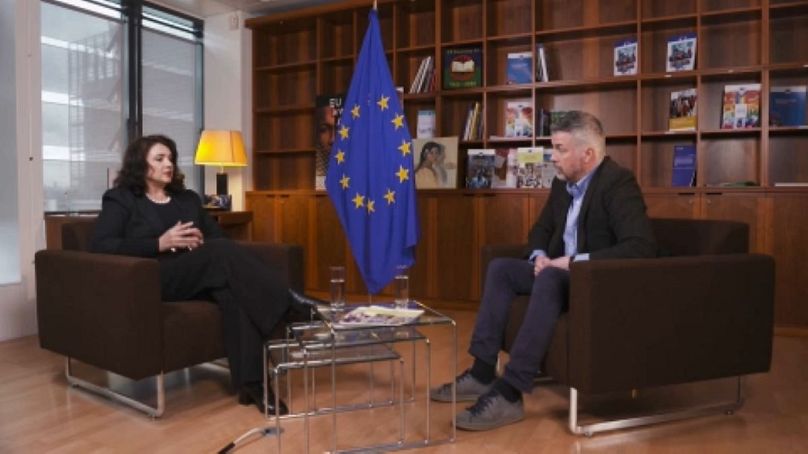
EU Equality Commissioner, Helena Dalli, He explained that the card was a step towards better integration, but also acknowledged that it had some limitations.
“With this card, all the rights that a disabled person has in a country will also apply to all disabled people who visit that country, so this recognition is very, very important.
Euronews’e said: “Of course, we have to abide by the agreements and we cannot go any further than we have done because it is in the jurisdiction of the member states. But this is definitely an improvement over what's happening right now. - ”
EU’ Commissioner for Equality Helena Dalli and Euronews correspondent Paul Hackett Brussels’de
The EDF has been petitioning for the EU Disability Card for over a decade. While the organization acknowledges that the new rules will create greater awareness and acceptance, it argues that cards will not make things easier for people with disabilities who want to move permanently to another member country.
The disability card does not include social security, social assistance and other residence-based benefits. In the long term, people with disabilities who want to move to another state will lose their right to benefit from social security-related benefits in their own country. They may have to wait months or even years for assistance to be processed in their new country of residence.
Despite this, Commissioner Dalli explained that the legislative process was rapid: “I am happy to say that this directive is one of the fastest; I mean, I've never passed legislation this fast before. This shows that member states are keen on this card, which is very important and will greatly improve the lives of people with disabilities.”
The EDF also recommended that cards should not be issued automatically unless a disabled person requests them or explicitly agrees to the issuance or renewal of the card. This will eliminate the need for people with disabilities to show cards as proof of disability for better access to services.
If you want to learn more about the European Disability Card or how to get it, click on the link here. Click on the video in the media player above to watch the episode.
About 63 percent of small and medium-sized businesses in ’ say a lack of workforce and skills has left them behind in their overall business operations. The EurobarometerThe survey was found.
In an announcement to support European businesses, increase staff retention and equip professionals with the skills they will need in the future, the European Commission and its partners said: The Duchess of ValAt the end of January, ‘ announced that it had signed the Tripartite Declaration for a Developing European Social Dialogue.
The EU has pledged to bring more professionals to the European labour market, facilitate recognition of foreign qualifications, improve working conditions and provide professionals with the tools they need to work in specialized roles.
Brussels provides around €65 billion in EU funds for education. thanks the European Skills Agendaand the Agreement of SkillsAround two million workers across Europe have already received advanced training.
Creating a digital workforce in ’, Slovenia
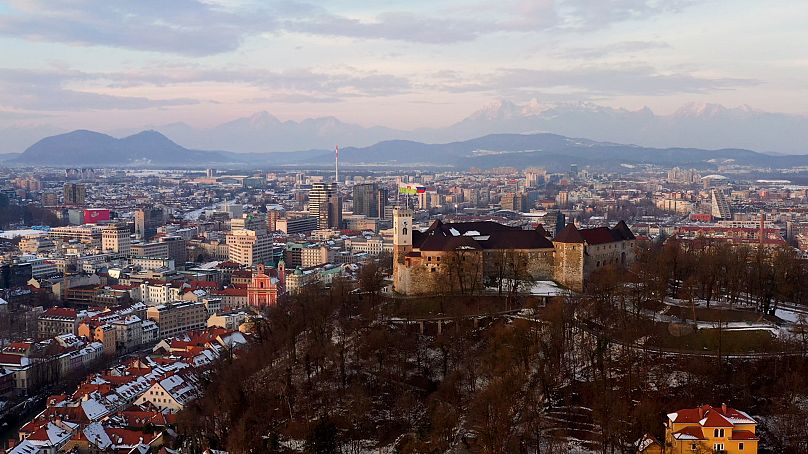
CEO’ Rok Zajc the Thick GroupEuronews’e, the digital marketing agency in Ljubljana’, said it had a hard time hiring certain profiles, especially high-skilled professionals.
It's Ljubjlana, Slovenia. There is a high demand for ICT employees in this dynamic and connected country.
Zajc, “From design, to performance marketing, we try to find different profiles from software developers and senior designers. But, for example, you actually need a lot of personal motivation and some different courses to get to the top for what we provide, ” said.
There is a great shortage of personnel in the information and communication technologies sector (ICT). AB’ needs another 11 million people to join this sector to achieve its goal of winning 20 million ICT professionals by 2030.
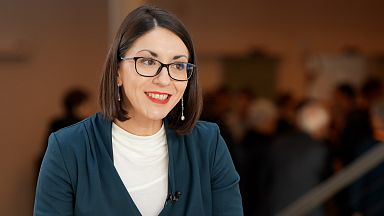
“What governments can and should do is reskill the existing workforce to ensure they get the skills they need, ” said. Dr Emilija Stojmenova DuhSlovenian Minister of Digital Transformation.
Euronews’e, the engineer who became a politician, announced last year that 30,000 people in ’, Slovenia, were taking advantage of free courses to help them adapt and acquire the skills needed to meet market demands.
Stojmenova Duh, “Only 17% of experts in the ICT field are women. So maybe my favorite project is a digital project that's all about giving young women skills and improving their skills. We were collaborating with the industry so that the industry could get the right workforce, ” said.
We are all aware that digital skills are not only needed for the ICT sector, we need digital skills in every sector.
Dr Emilija Stojmenova Duh
Minister of Digital Transformation
PortugalTraining engineers in ’
22% of employers in ’'s heavy industries say they can't find the staff they need. The highly lucrative metallurgical and metalworking industry also struggles to find professionals with the right qualifications in Portugal’.
The industry has undergone a significant digital transformation. Robots currently do most of the heavy lifting, but the outdated idea that this is a physically demanding industry still exists.
Engineers and machine operators in this sector need technical skills. Nuno Teixeira CEO’ the Alsil GroupIt seeks to attract professionals from both domestic and Portuguese-speaking countries.
Teixeira, “, said that companies should provide opportunities for individuals to thrive, grow professionally, and balance this with their personal lives if they want to attract people.
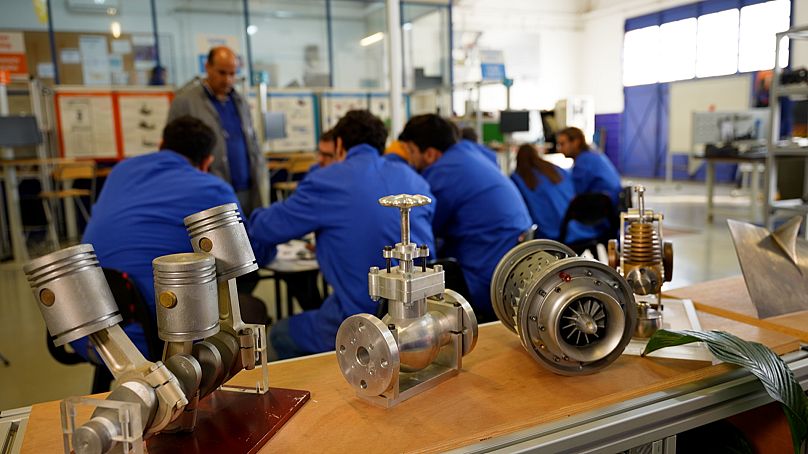
Eduardo and Rui are CNC programming and operations technicians and have recently been employed by the Alsil Group. After enrolling in a professional training program, their career went in a new direction. CENFIMA public and private education centre supported by the European Social Fund Plus.
Rui, who used to work as a geological engineer at “, said that this is a very challenging area where new and challenging things come up every day, so it's something that really interests me and I see it as a promising future.
PortugalMetallurgy and Metalworking Industry Professional Training Center in ’People are studying at ’ (CENFIM).
Manuel Pinheiro Grilo, director of CENFIM, “, said that in terms of employment, it represents about 230,000 jobs that are evolving not only to adapt to new technologies, but above all to respond to the work required.
According to AIMMAP’a (Portuguese Association of Metallurgical, Metalworking and Related Industries), Portuguese ’ metallurgical companies generate approximately €23 billion a year in revenue from their exports.
Ensuring that professionals take responsibility for their careers
Improving the skills of professionals is of great benefit to companies looking to fill specialized positions, while Slovenia's ’da Minister Stojmenova Duh warned that responsibility does not belong only to public and private organizations competing against the clock to hire professionals with the right skills.
“We are aware that this is not enough after finishing high school, faculty, each individual is our responsibility. The world is changing. We need to learn new skills. That's why lifelong learning is something we really need to consider. - ”
By increasing renewable energy, Europe has pledged to reduce ’'s dependence on fossil fuels by 2027. Moving away from oil and gas was a key goal even before the war in Ukraine, where AB’ aimed to become climate neutral by 2050. How realistic and affordable are the final plans?
Independence of energy
In addition to tackling climate change, Europe’ needs to reduce its dependence on fossil fuels.
The European Commission has prepared the action plan: Reinforce AB’– to end addiction by 2027. This includes scaling up and accelerating renewable energy.
It is estimated to cost 210 billion euros, with a large investment required. InvestEUAB’'s flagship investment programme comes into play.
Working in partnership with the European Investment BankAiming to reassure investors, AB’ has a 26 billion-euro guarantee. It is expected to generate over €370 billion in revenue from public and private sector financing.
Their investment focuses on four areas: sustainable investment, innovation, social inclusion and job creation. And the least of these %The 30’ of Europe needs to contribute to ’'s carbon neutrality.
Solar energy plan
Part of the REPowerEU plan is to double European ’'s solar capacity over the next two and a half years, and Spain is one of the countries where InvestEU’ funds its solar power plants.
There are as many solar panels as you can see between Valladolid and Salamanca. The region is home to seven solar parks built since 2020’, in part thanks to InvestEU’.
SpainThe countryside between Valladolid and Salamanca in ’ is home to many solar parks
Solaria’'s Silvia Alonso Guijarro euronews’e said: “Spain is a great place to build these solar panels, solar plants because we are one of the countries with more sundials per year. These seven photovoltaic solar power plants have a capacity of 261 megawatts, which means they generate 477 gigawatts/hour of energy per year.”
This amount of energy is enough to supply electricity to more than 120,000 ’ households. The project was made possible thanks to the partnership between public and private investors, and the European Investment Bank (EIB) has been enabled to play an important role in providing this financing.
The total cost of the project was 189 million euros. The EIB put 54m euros on the table as a credit or guarantee mechanism, while providing 14m euros as an intermediary.
This meant that more than a third of the total cost of the project had already been covered, providing private investors with enough assurance to finance the remaining 89 million.
Fernando Torija, EIB’'s bureau chief at ’ in Spain, says such guarantees are vital.
“We are betting on the future of these companies. This is perhaps telling other investors who have invested in the company, whether they are financiers or stockholders, and putting the company on the map saying, okay, I kind of have a quality stamp from ‘EIB’.’
InvestEU’'s main goal was to lead a green and digital economic recovery. But the war in Ukraine’ and the sanctions imposed on Moscow’ mean that the capital will be directed directly to help end Europe’'s dependence on Russian gas and oil.
Solaria CEO Darío López Clemente said the company and EIB’ are working closely on plans to develop several more solar parks in ’, Spain.
“Our intention is to continue to develop projects. We are also working with the EIB for a larger financing and a larger project package. The crisis with Ukraine, I think, put the real needs of the European ’ on the table. We are absolutely dependent on other energy sources that we don't have at Avrupa’, and we need to be aware of how important energy is to us. And the only way to solve this situation is with renewable energy, because it's an emergency. – should not be in four or five years, it will be too late to develop all this power in a maximum of one or two years.”
The European Commission recently launched the REPowerEU plan, which also aims to overcome non-financial barriers such as administrative permits and mandates.
EU Energy Commissioner Kadri Simson
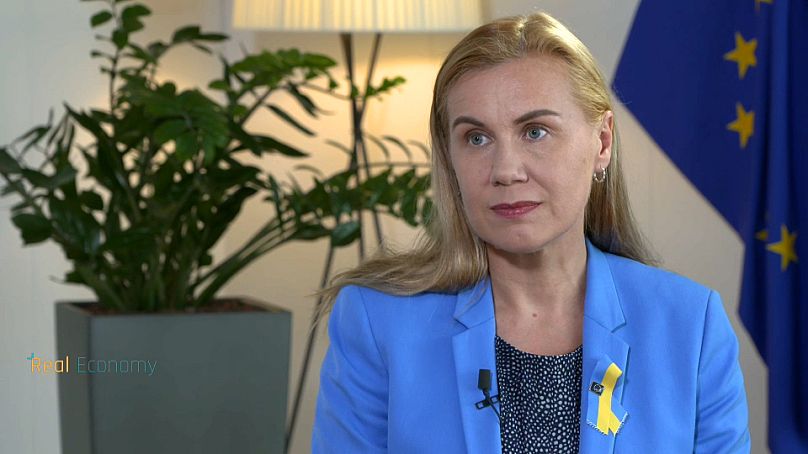
Naomi Lloyd of Real Economy’ spoke with European Union Commissioner for Energy Kadri Simpson to learn more about AB’'s efforts to reduce its reliance on Russian oil and gas.
Naomi Lloyd, euronews:
“RussiaIs it realistic to think that you can end ’'s dependence on fossil fuels by 2027?”
EU Energy Commissioner Kadri Simson:
“We do our best to get rid of this addiction as quickly and quickly as possible. REPowerEU, Russia, is planning how we can replace ’'s imports with alternatives. We have reached out to several trusted trading partners. But that's not enough. We don't want to replace fossil fuels 100 percent with other fossil fuels. This means that we will replace natural gas with renewable sources wherever possible. In the construction sector, we will also prioritize electrification in transportation. And on top of that, we will prioritize saving.”
Naomi Lloyd, euronews:
You talk about ending the dependence on Russian fossil fuels, but you want to import oil and gas from other countries. Wouldn't that condemn us to new addictions?”
EU Energy Commissioner Kadri Simson:
“We plan to replace only a third of Russia's imports with other fossil fuels. So yes, we will diversify our supply routes. In parallel, however, we are accelerating our own green transition. We will do this where we can replace fossil fuels with renewable energies.”
Naomi Lloyd, euronews:
Can you tell us about the plans to increase the acceleration of renewable energy under “REPowerEU?”
EU Energy Commissioner Kadri Simson:
“There are some ways we can promote renewable energy very quickly, for example on roofs. So according to our proposal, all newly built buildings should have roof panels. The biggest bottleneck is allowing. Currently, it can take as long as seven years to get a permit for an offshore wind park. However, the European Commission has made a proposal that the ‘ public interest is a right that we call priority’. This significantly shortens the leave time.”
Naomi Lloyd, euronews:
“RussiaYou calculated that ending ’'s dependence on fossil fuels would cost 210 billion Euro’. Can Europe afford it? - ”
EU Energy Commissioner Kadri Simson:
“In the past years, Russiaremembering that we pay about 100 billion euros each year for imports of oil, gas and coal to ’. Then it makes sense to change that dependency. We know that member states still have untapped bailout funds, so there are 225 billion worth of loans that member states can use for green projects. Financing is the key. InvestEU is a very useful tool at our disposal because we will be able to act approximately in the period 2020-27. 372 billion Euro.”
European Commission President Ursula von der Leyen, speaking at the Mercator Institute for Chinese Studies in ’ last March, announced the European bloc's intention to reduce economic dependence on China’e. Von der Leyen used the term ’riski reduction“, which states the need to reduce risks from Beijing”e overdependence.
China already supplies 98-100 percent of Europe ’'s heavy rare-earth element needs, Turkey 98 percent of its boron needs, and South Africa 71 percent of its platinum needs.
So how will the European Union implement its risk mitigation strategies while relying on imports from China’, which are necessary to create low-emission technologies for a greener future?
Creating a stable and resilient economic environment
John Seaman of the French Institute of International Relations, ’, explained that the transition to a net-zero society is making Europe’ increasingly dependent on China’e because it needs more batteries for electric cars, solar panels and other renewable energy components.
“The question now is: How do you reduce the risks associated with these dependencies? And how do you negotiate with China to ensure that China does not use ’'s resources in ways that harm European ’'s own interests?
EU put forward the European Critical Raw Materials ActMarch 2023The ’te Council of Europe adopted its position on the proposal in June.
As part of a broader strategy, the EU aims to diversify its supply chains in the digital, green and health sectors, make better use of existing trade rules, defend critical sectors and boost trade with other countries.
FILE – Workers use machinery to excavate rare earth mine in Ganxian county, central China’in Jiangxi province, December 30, 2010
Do these ambitions resonate with industrial players?
by Emilie Jolivet the Road GroupA consulting firm headquartered in Lyon’, southeast of ’, thinks: “Most of our customers want to regain control over their packaging, especially predominantly from China and Taiwan’. For example, they want to move to Southeast Asia’.
The EU has also started the European Chips Actchip production capacity to meet the needs of the global market by 2030. %He's aiming for a 20’sine.
Jolivet, “We cannot solve supply chains where complex and component cost are also very important. The European Union’'s effort to invest 43 billion Euro’ is very important. Achieving full autonomy in semiconductors will not be enough, but this is the first step towards specializing or re-specializing in this sector, ” said.
European Commissioner for the Internal Market Thierry Breton speaks at the signing ceremony for the Chips Act at the EU headquarters in ’, Brussels, on Tuesday (February 8, 2022).
France leads the charge
World Bank says demand for critical raw materials due to accelerating green transition by 2050 %He says it's expected to increase by 500 percent. France is trying to rebuild its supply chains, especially for semiconductors and batteries.
The CEA isIt is a French government-funded technological research organization that carries out innovation projects along the industrial value chain. Simon Perraud, deputy director of the Grenoble plant, explained that if France and Europe want to control ’'s future energy systems, they need to control and diversify their industrial value chains.
Perraud, “For example, it is important to invest and continue research and development to support this entire industrial ecosystem through the expansion of the autonomy of electric vehicles, the use of less critical materials in batteries, and the development of battery recycling processes to recover more metals. And all of this at a lower cost, ” said.
Making batteries with less critical materials is the goal of French startup Olenergies’in. It is developing cobalt- or manganese-free Lithium Iron Phosphate (LFP) batteries to power large renewable energy storage or data centers.
Olenergies’in CEO’ and founder Julien Le Guennec, “We choose to use materials that can be found almost anywhere on the planet and easily recycled; This will allow us to produce batteries that last at least four times longer than traditional lithium batteries and, above all, are very sensitive to digital optimization, ” said.
New supply chains are turning into rising costs
These batteries, which are less powerful but more environmentally friendly, can be adapted thanks to artificial intelligence. However, China is 20% more expensive than ’ imports. In order to stand out in the highly competitive LFP battery market, it is necessary to produce large quantities quickly.
Olenergies hopes to open its first giga factory in the race for technological breakthroughs by 2026.
FILE Niila Inga, reindeer shepherd from the – Laevas Sami community, 27 November 2019’da SwedenWalking in the snow as the sun sets on Longastunturi mountain near ’in Kiruna.
Swedish state-owned mining company LKAB has announced that it has discovered one million metric tons of rare earth metals in Kiruna’ in the north of the country in January 2023’te.
Although it will take time to extract these very important minerals, Europe serves as ’'s largest deposit. EuropeIt is predicted that these metals will become more important than fossil fuels in ’'s transition to more renewable energy use.
This is positive news for Europe, but as John Seaman’ warned, rebuilding Europe’'s supply chains will lead to higher prices and therefore higher inflation.
Special thanks to “CEA Grenoble”a for providing us with some of the images used in this section.
The first-quarter earnings season will begin later today with major U.S. banks, including JPMorgan Chase and Wells Fargo, followed by Bank of America, Citigroup and Morgan Stanley next week. After a turbulent week at Wall Street’, the results of these leading lenders will provide critical insights into the broader economic impact of President Trump’'s wide-ranging tariffs on business sentiment and outlook.
Analysts expect banks to deliver strong results in the first three months of the year, during which time the U.S. economy will still be resilient. However, with a more cautious tone expected due to rising economic uncertainties, attention is likely to shift towards forward direction. Growth outlooks, an important benchmark for investors, are expected to be revised downwards when assessing the long-term effects of the trade cut.
Prior to the recent tariff-driven market turmoil, the banking sector was among the stronger performers, backed by steady credit growth, improved liquidity conditions, and an increase in mergers and acquisitions (M&A) activities. As of February 19, shares of JPMorgan and Wells Fargo’ are approx. %It was valued at 13. However, in the midst of the escalating trade war ignited by Trump’'s tariff announcements, both stocks While depreciating more than ’, the sentiment was reversed.
Tariff-related uncertainties likely to put pressure on earnings
Following last week's mutual tariff announcement, Morgan Stanley analyst Betsy Grasek downgraded the U.S. banking sector's rating from ‘cazip’ to ‘compliant’. In a note to “, trade developments are moving our base scenario towards a serious gross domestic product slowdown, and with the risk that our bearish scenario will increase sharply, ” wrote. Grasek added that investment banking revenues may be more susceptible to recession risks than traditional lending.
Dilin Wu, a research strategist at ’, said economic uncertainty and rising recession risks from the tariff war could stifle credit demand. Wu said banks may need to face higher credit loss provisions that will further reduce “financial performance, adding that volatility in financial markets caused by uncertainties about ” tariffs will likely hamper capital market activities, negatively impacting investment banking revenues, especially mergers and acquisitions and equity issuances.
Investors' attention will likely focus on banks' perspectives and guidance on signs of the long-term impact of tariffs. Kyle Rodda, senior market analyst at Capital.com’, wrote in an email: “These hard facts mean that markets need to price the blow to corporate profits; The upcoming U.S. reporting period (launched unofficially by several U.S. banks on Friday) will be closely monitored in terms of declines in earnings and revision or complete removal of guidance.”
The Fed is wary of further interest rate cuts
The Federal Reserve ’'s interest rate path has become even more complicated as tariffs have increased expectations that inflationary pressures will renew. On Thursday, Boston Federal Reserve Bank President Susan Collins signaled that the central bank could delay further expansion: “Renewed price pressures may delay further normalization of policy, as confidence is needed that tariffs will not destabilize inflation expectations.”
While banks often benefit from high interest rates thanks to improved net interest margins, tighter policies can slow down credit growth, putting pressure on household spending and broader economic activity. As a result, estimates of banks' net interest income (NII) (the difference between what they earn from loans and what they pay on deposits) will likely be more prudent. Analysts at Bank of America’ expect a cautious stance from the management when the first quarter results are announced.
Bank earnings forecasts
Despite the negative winds caused by tariff uncertainty, bank earnings are expected to remain strong in the first quarter and all economic impacts of tariff increases are likely to occur later in the year.
According to consensus estimates compiled by Reuters, JPMorgan ’'s earnings per share (EPS) is 4.61 $ (€4.08) is expected to report; This is compared to the same period last year. %It represents an increase of 3.8’. Wells Fargo’'s EPS’ %It is expected to rise by 3.3 to $1.24 (€1.1). Bank of America’, compared to the previous year %With an increase of 8’, EPS’ is expected to report $0.82 (€0.73). Citigroup’'s earnings this quarter %It is expected to reach $1.86 (165 euros) with an increase of 18. by Morgan Stanley’nin EPS’de %It is expected to reach $2.22 (€1.97) with a 10 increase.