European Car Manufacturers in Difficult Situation

Things are going badly for the European auto industry. Fewer cars are sold than expected, and most of the new electric models remain available. Volkswagen (VW) is not the only one facing forced factory closures; Renault and Fiat are also producing more cars than they can sell.

According to a study by Bloomberg Intelligence, one in three plants in Europe - BMW, Mercedes, Fiat, Renault and Volkswagen - is operating below capacity due to low demand. At present, some factories cannot produce even half of the cars that can leave the production lines.

The situation is particularly dire at the Mirafiori plant in Turin, where Stellantis Group ⁇ 's fully electric Fiat 500e ⁇ is produced. Production here fell by more than 60 percent in the first half of 2024. In Belgium, the Audi factory, where the expensive Q8 e-tron is produced, is also on the verge of collapse.

Europe's rival China

Sales problems are also depressing at the Renault plant in Douai ⁇ in northern France and the VW plant in Dresden ⁇ . Electric cars produced here can hardly find buyers, and manufacturers are hurting.

In a statement to ING chief economist Carsten Brzseski DW ⁇ ye, ⁇ We are in the midst of a structural change. This applies not only to VW, but to the entire automotive industry. We can see that this international trend towards increased electromobility leads to more competition.

The pressure on Europe's car manufacturers, especially from China, is increasing. Despite the penal duties imposed by AB ⁇ on electric cars made in China, manufacturers from the People's Republic ⁇ are determined to have a permanent place in the EU market.

In addition to the Geely brand, Lynk & Co., Chery, Great Wall Motor and BYD want to produce e-cars in their own factories in Europe in the future.
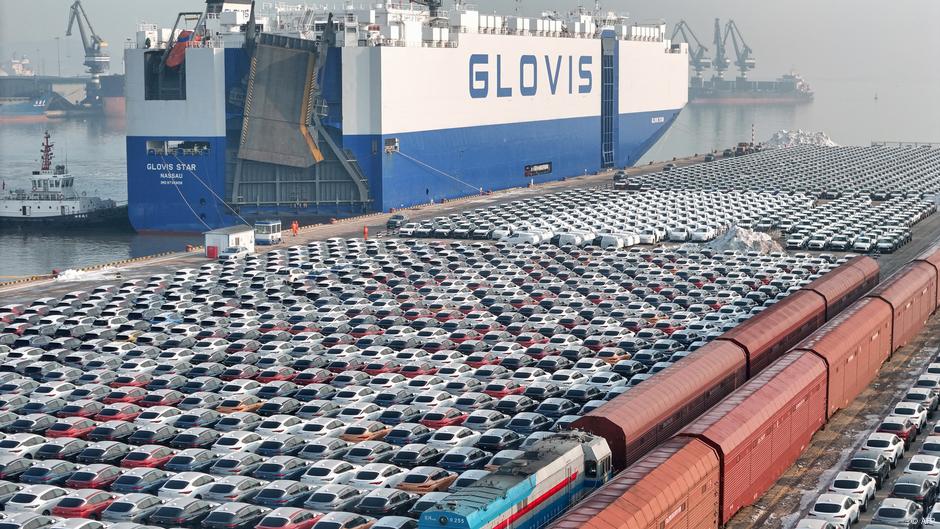

Cars waiting to be loaded on board in the Yantai Port of ChinaPhoto: AFP

Have the Car Managers Failed?

Why are European car manufacturers having such a hard time switching to electromobility? Did the managers miss the train, unlike their counterparts in China?

Carsten Brzeski says the industry is struggling with many problems at the same time. Many problems come together in the automotive sector, such as stronger international competition and lower competitiveness among Europeans.

Hans-Werner Sinn, who has been president of the Ifo Institute in Munich for many years, does not see this as a management failure in an interview with DW: For example, we cannot say that Volkswagen or others have missed the trend in the market. Rather, European politicians failed to realize that China was acting swiftly and decisively in this area. This may be a deficiency. ⁇

Stating that the agreement called ⁇ Green Agreement ⁇ , prohibition of internal combustion engines in AB ⁇ from 2035 ⁇ and increasingly strict emission standards have radically invalidated market laws in a short time and put the sector on a politically-driven transformation route, Sinn argues that if a route correction is not made, Europe will be the loser.

According to Sinn ⁇ e, the increase in e-car production in China and France was seen as an opportunity to break the technological dominance of German automotive manufacturers in internal combustion engines. However, countries such as France and Italy have begun to question the issue again. Because they realized that the Chinese benefited the most from the radical change towards electromobility.

The zigzags drawn by politicians also have an impact on these uncertainties, Carsten Brzeski writes: What will happen to the internal combustion engine now? Will he stay or not? When will it be phased out? Will it be extended again or not? In addition to these uncertainties, the German government's decision to remove the e-car incentive premium by the end of 2023 also sowed salt and pepper in the wound. In this case, it should not be surprising that e-vehicles remain in the hands of manufacturers. ⁇

Prosperity will be in jeopardy

According to ING chief economist Brzeski ⁇ , there is no doubt that a possible decline in the automotive industry in Germany and Europe will jeopardize the current prosperity. In Germany alone, the automobile industry, together with suppliers, sub-industry and all other companies that indirectly do business with car manufacturers, account for seven to eight percent of the economic output.
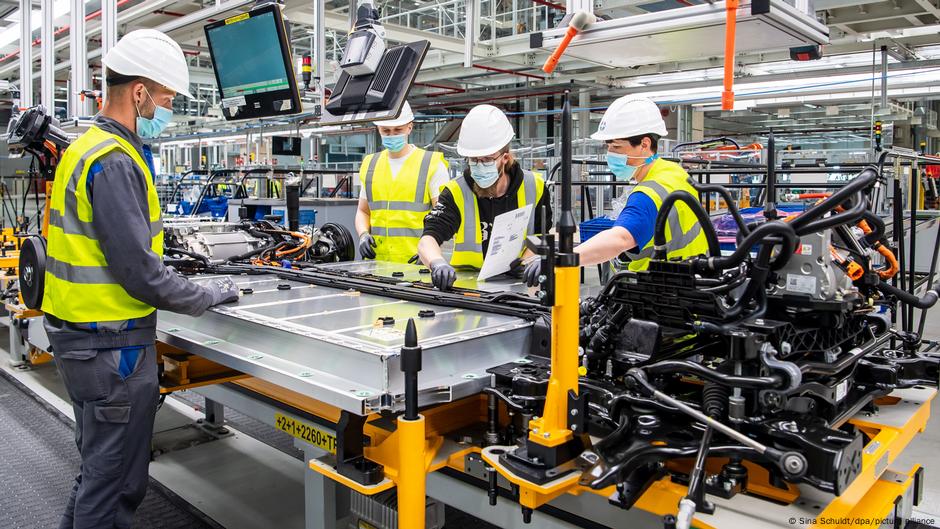

Production of the ID.4 model car at the Volkswagen factory in Emden, GermanyPhoto: Sina Schuldt/dpa/picture alliance

International climate club call

Munich economist Sinn ⁇ in has in mind a ⁇ climate club ⁇ of the largest CO2 emitter, as proposed by German Chancellor Olaf Scholz. All major players, such as China, India, Brazil, the US and the EU, will have to limit fossil fuel production and use. Sinn believes that this idea, put forward by Nobel Prize-winning US economist William Nordhaus, could actually help the climate. Everything else would be a dark central planning policy that doesn't really belong to the market economy.

EU plans such as the ⁇ Green Agreement ⁇ or ⁇ taxonomi ⁇ , which make the entire economy subject to climate and environmental protection, seem fundamentally well-intentioned. But these plans run the risk of undermining prosperity as they would override market laws. As an economist, Sinn sees this as a catastrophic scenario: You can end up ruining the economy this way. I recommend an urgent U-turn from this error. ⁇

Pressure on politicians and unions?

Frank Schwope of the School of Applied Sciences (FHM) for SMEs in Hannover ⁇ is relatively comfortable: The fact is that Volkswagen makes high net profits. For example, in 2023, it reached a record profit of 22.6 billion euros. Analysts expect a profit of 20 billion euros this year. In other words, the crisis has not reached here yet, but it will definitely make itself felt in the future. ⁇

According to Sinne ⁇ e, the VW administration is trying to put pressure on politicians and unionists by creating a ⁇ threat scenario ⁇ to bring down current salary demands and introduce new electric car incentive premiums.

The decline in sales continues

One of the brands that hit the brakes was Italian automotive giant Fiat. Production of the Fiat 500e at the Mirafiori plant in Turin was halted for a month due to a decline in sales.

Hans-Werner Sinn summarizes the current picture in the automobile industry as follows: Volkswagen is just an early victim. New ones will be added to this soon.

Scholz ⁇ tan Kazakhstan opening

German Chancellor Olaf Scholz and Kazakhstan's President Kassym-Jomart Tokayev met in Astana ⁇ da at the extended meeting between the delegations after private meetings at the Presidential Palace Akorda ⁇ .

President of Kazakhstan Tokayev emphasized the special importance of the visit of Prime Minister Scholz ⁇ un, who held official meetings for the first time in his country.

Pointing out that this visit will take multilateral cooperation between Kazakhstan and Germany to a new level, Tokayev discussed the possibilities for further strengthening of bilateral relations. We discussed the deepening of integration, especially in the fields of trade, economy and investment.

Pointing out that Germany is one of the main trading partners, Tokayev reported that in 7 months of this year, the mutual trade volume reached 2.3 billion dollars, and since 2005, Germany's share of direct investment in Kazakhstan has reached 6.7 billion dollars.

Olaf Scholz also stated that they will work to improve the conditions of economic relations, directly invest in Kazakhstan and expand mutual trade opportunities, and we are very pleased that our cooperation in the field of energy is gradually progressing. We want to improve economic cooperation in all other areas.

They agreed on cooperation

Prime Minister Scholz added that it was also welcome for them to exchange views on the international challenges they are facing.

During the expanded meeting, the parties agreed on the establishment of mutually beneficial commercial and economic cooperation in the fields of energy, green transformation, mining, transport and logistics, climate protection, environment and agriculture.

After the talks, Tokayev and Scholz signed the Joint Declaration on cooperation between Kazakhstan and Germany.

In addition, the governments of the two countries signed a memorandum of understanding on technical cooperation between the central banks, a declaration of intent for the establishment of the Kazakh-German Institute of Science and Technology at the Eastern Kazakhstan Technical University, and a memorandum of understanding on the establishment of the Kazakh-German school.

China's deflationary spiral enters a dangerous new phase

China's ongoing deflation since last year is now showing signs of spiraling, threatening to worsen the outlook for the world's second-largest economy and increasing calls for urgent policy action.

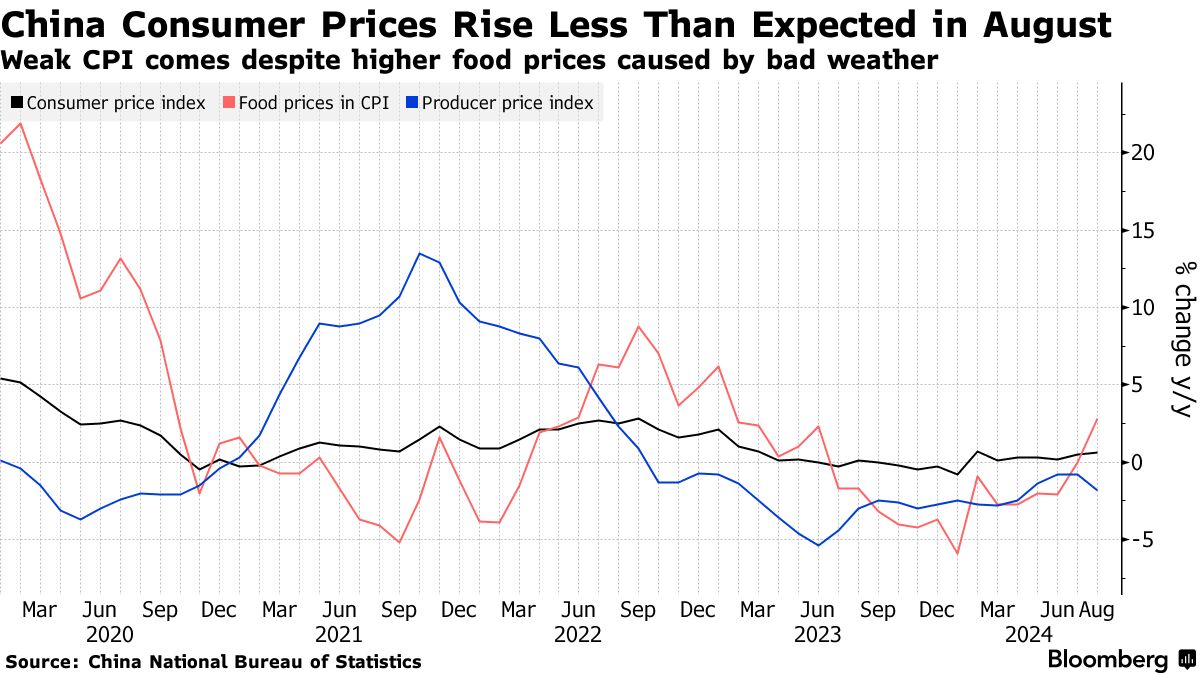
Data released on Monday confirmed that, at a time when revenues were falling, the increase in consumer prices, with the exception of food costs, was hardly recorded in large parts of the economy.

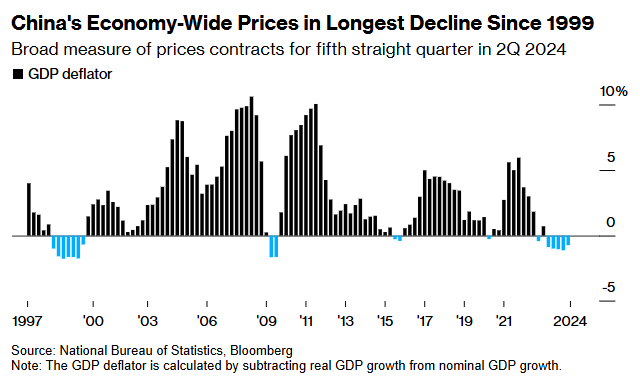
According to analysts at banks including Bloomberg Economics and BNP Paribas SA, a broader measure of prices across the economy, known as a gross domestic product deflator, will likely continue its current five-quarter decline in 2025.

Robin Xing, Morgan Stanley's chief Chinese economist, said: "We are definitely in deflation and probably going through the second phase of deflation, referring to evidence from wage declines. Experience from Japan shows that the longer deflation lasts, the more incentives China will need to overcome the debt-deflation problem.

The danger for China is that deflation will grow like an avalanche, encouraging households shaken by falling paychecks to cut spending or postpone purchases because they expect prices to fall further. Company revenues suffer, investments stall, and lead to further pay cuts and layoffs, driving families and companies into bankruptcy.

Special surveys show that this is already happening. According to findings by Caixin Insight Group and Business Big Data Co., in government-preferred economic sectors such as electric vehicle production and renewable energy, entry-level salaries are almost as high as in the peak of 2022 in August. is down. A survey of 300 company executives by the Cheung Kong Graduate School of Business showed that growth in labor costs last month was the weakest since China's first Covid lockdowns began to ease in April 2020.

This is a cycle that the world has seen ⁇ during the recession that followed a bubble that exploded in the real estate and financial markets ⁇ during a period previously known as ⁇ lost decades ⁇ in Japan ⁇ beginning in the 1990 ⁇ . While Chinese officials are trying to suppress discussions about deflation, warning analysts to refrain from using the term, the term is beginning to enter into public dialogue.

Former Central Bank Governor Yi Gang said last week that eradicating deflation should be a priority for policymakers, and he made a rare confession by a leading figure in China that falling prices threaten the outlook.

Yi called for proactive fiscal policy and supportive monetary policy at a panel at the Bund Summit in Shanghai on Friday, saying authorities should focus on combating deflationary pressure. He added that China's immediate goal should be to turn the GDP deflator positive in the coming quarters.

So far, officials have not signaled any significant deviation from the panacea methods of encouraging production rather than addressing weak demand through steps such as greater government spending on public services and consumer subsidies.

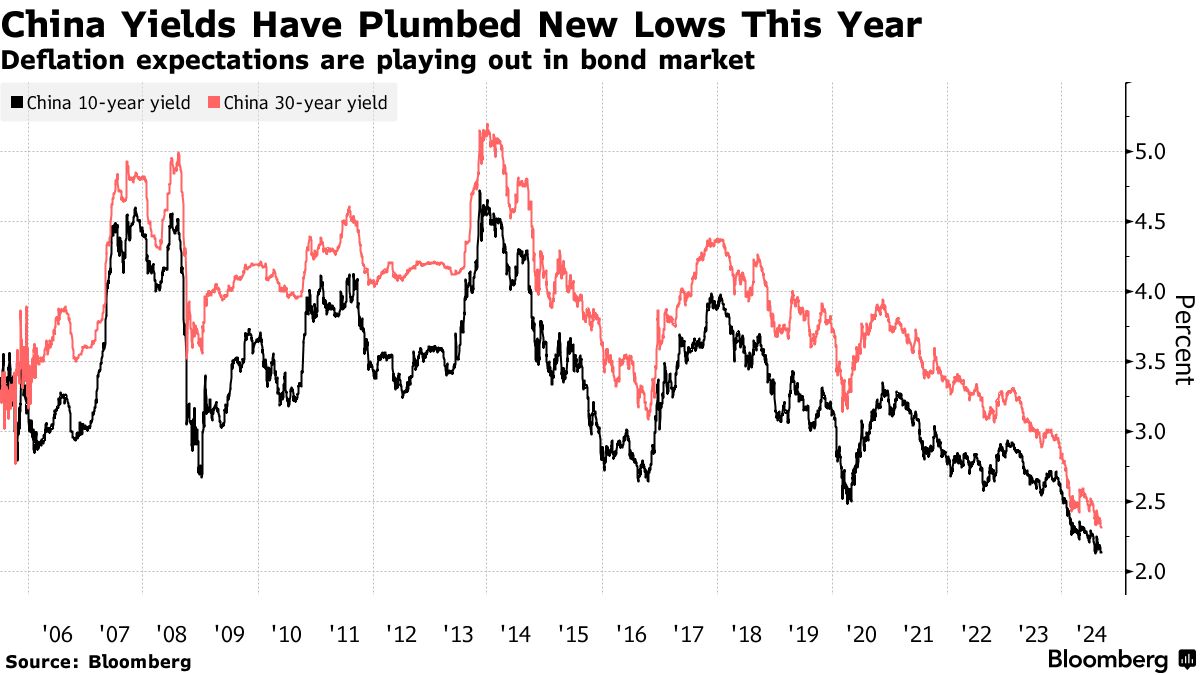
China's core inflation, which excludes volatile items such as food and energy, fell to a three-year low in August as a sign that price pressures have weakened further. Deflation expectations are reflected in the markets, triggering a bond rally that pushes bond yields to record lows and raises official concerns that banks are too exposed to interest rate risks.

Weak price pressures, China's second quarter only %4 is clearly seen in the growth rate of the growing nominal GDP ⁇ of the country this year %It is well below the real economic growth target of around 5. Luo Zhiheng, chief economist at Yuekai Securities Co., wrote in a note earlier this month that nominal expansion is a more beneficial indicator when price increases are weak because it better reflects changes in wages, profits and government revenues.

Inflation was weaker than forecast in three of the last four months, only in August. %0.6 has increased ⁇ this increase is largely due to the increase in food prices %This is due to an increase of 2.8.  Core inflation last month only %Increasing by 0.3 in the 18th month %It's down to 1. The fall in producer prices since late 2022 underscores the pressure on inflation. According to official data, raw material and sales prices of manufacturers contracted in the second month in August, while the wages of service and construction companies decreased the fastest since April 2020.

The dilemma that even monetary easing in China can be deflationary due to the supply side of the economy is controversial. Meanwhile, the deflationary mindset is beginning to settle. Consumer confidence is at a record low, with households reporting an increased desire to save rather than spend or buy a home. According to Liu ⁇ , an aluminum industry employee, the solution lies with policymakers in Beijing as the pain deepens. The government needs to take at least some concrete measures to increase consumption and improve people's expectations.

Threat of strike at US ports raises cargo backup concerns

According to transport industry experts, the upcoming strike at key U.S. ports on the East Coast and Gulf of Mexico is alarming about potential cargo delays that could take weeks or months. Retail giants such as Walmart (NYSE:WMT) are among the importers that are accelerating their shipments, waiting for the September 30 deadline, when about 45,000 dockworkers could leave work.

The International Port Workers' Association, which represents these workers, has stated that it is ready to go on strike from October 1 if negotiations for a new contract fail. Analysts at Sea-Intelligence, a Copenhagen-based maritime consulting firm, warned that even a one-day strike could create a pile-up that would take four to six days to clear up. According to Sea-Intelligence CEO Alan Murphy, a week-long strike in early October could cause disruptions to continue until mid-November.

Murphy also said a two-week strike could disrupt port operations by 2025. This assessment is supported by maritime giant A.P. Moller-Maersk. A.P. Moller-Maersk noted that a one-week pause may require up to six weeks for recovery, and delays have the potential to increase every day the strike continues.

The urgency of transporting goods ahead of the strike led to a sharp increase in transport costs. Peter Sand, Xeneta ⁇ 's chief analyst, reported that the spot market price for a 40-foot container from the Far East to the East Coast of the USA rose above $10,000 in early July and rose significantly from around $2,100 in early April. Sand stressed that the risk of port strikes requires transporters to act early and decisively.

However, as the expiration date of the contract approaches, the opportunity for preventive shipments also decreases. In addition, shipping deviations caused by Houthi attacks in the Red Sea extended shipping times from Asian factories to East and Gulf Coast ports by 45 days or more. Considering this situation, Sand warned that sending cargo next week could be in vain, as goods could be stranded at sea if the strike takes place.

Reuters contributed to this article.

This article was created, translated and reviewed by an editor with the support of artificial intelligence. See our Terms and Conditions for more information.