

Albania applied for EU membership more than 15 years ago, and although there is no set date for accession, AB’'s latest progress report shows that the Balkan country is well on its way to developing a functioning market economy that can withstand market forces and the competitive pressures of being in the bloc.
Candidate countries must meet various economic criteria in order to be accepted. This includes demonstrating macroeconomic stability, high-quality economic management, an appropriate labor market and adequate infrastructure.
Albania's economy experienced a strong recovery in ’ in 2021, and this recovery continued in ’ in 2022. This happened despite the massive earthquake in 2019’, the Covid-19 pandemic and the triple shock caused by the war in Ukraine’.
EuropeAs in other parts of ’, inflation in Albania’ has fallen recently, but remains high due to tight labor markets. However, real GDP growth is projected to be 3.3 percent for this year. What is the driving force behind Albania's economy?

A construction explosion
Brussels to help pave the way for Western Balkan countries to join the bloc, Stabilization and unification process. This sets out political and economic goals for the region.
The lack of rapprochement between countries in the Western Balkan region and the rest of the European Union remains a major problem in allowing these countries to join the EU. This currently equates to about 35 percent of AB’'s average levels.
Economic convergence is sometimes defined as the conditions that enable ‘, or a country with a slower level of development and economic growth, to capture ’, a country richer than ‘.
In the case of Albania, the country is investing heavily in the construction and tourism sectors to boost economic growth.
The country's railway network is being completely overhauled with the help of AB’'s Economic and Investment Plan (EIP) for the Western Balkans.
In addition to innovating the railway network, train stations and signaling system, EIP is also used to develop renewable energy projects such as solar photovoltaic power plants, as well as digital infrastructure.
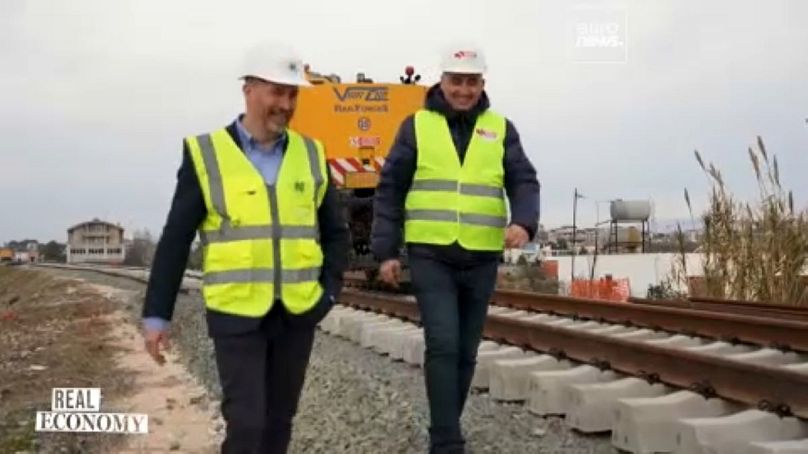
Albanian Railways Project Implementation Unit head Bashkim Kasoruhu euronews’e said that railway projects will have a major economic, social and environmental impact and significantly improve transport links within Albania, the wider Balkan region and Europe.
“Connection is the most important aspect. You can imagine the impact of connecting these largest ports. The port [Durres], [Tiran] airport and Tirana city center, where the public transport terminal is located, will gather all the infrastructure in one center, ” said.
AlbaniaThe new railway connection between Durres and Tirana, the two largest cities in ’, will cut the 40-minute road trip in half and reduce it to about 20 minutes when completed. In addition to the EU investment grant, the project is also financed by a loan from the European Bank for Reconstruction and Development (EBRD).
A tourism success story
Albania’'s coastline stretches 450 kilometers along the Adriatic and Ionian Seas. Tourists are interested in the country's Mediterranean climate, reasonable prices and natural beauty areas.
Located between Montenegro in the north and Greece in the south, this region is connected to the ports of Bari and Brindisi in ’, Italy, with relatively short ferry routes. Given these geographical factors, it may come as no surprise that Albania’ is quickly becoming Europe’'s hottest tourist destination.
Albania welcomed a record 8.3 million tourists between January and September last year; This figure is 0.8 million more than the 7.5 million tourists it received in 2022’. This upward trend is expected to continue.
Euronews also met with Albanian Prime Minister Edi Rama. Click on the video in the media player above to watch the entire interview.


