

What is the Black Swan Theory?
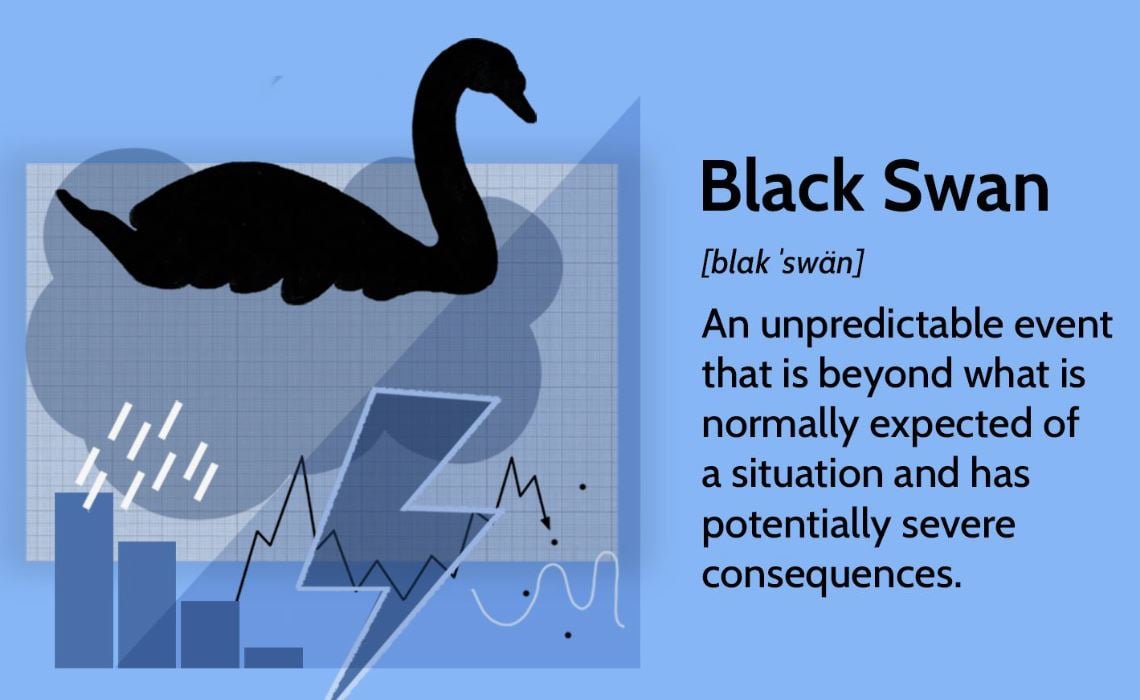
The Black Swan Theory is a theory that describes unexpected, rare, and often major events. This theory, popularized by Nassim Nicholas Taleb in 2007, takes its name from the fact that Europeans long believed that only white swans existed, until black swans were discovered in Australia. This event illustrates how a rare and unpredictable situation can upset known facts.

Black swans have three main characteristics:
1. The unpredictability of: The occurrence of events is unpredictable because the like has never happened before.
2. The big impact: The impact of these events is enormous and leads to far-reaching consequences.
3. Reverse rationalization: After the event happens, people try to find reasons to explain the event, but it is almost impossible to predict the event.

WHY IS IT IMPORTANT?
The Black Swan Theory is critical to modern societies because such events often profoundly affect the economy, politics, and social order. Events such as the 2008 Global Financial Crisis and the 9/11 terrorist attacks may be called the Black Swan. Understanding the causes of such incidents and anticipating their potential impact is vital in developing risk management strategies.

Nobel Prize-winning economist Daniel Kahneman states that the Black Swan Theory shows how unprepared humans are in the face of unpredictable events. Research in psychology and economics shows that people can make serious mistakes in assessing risks and rare events.

Many academic studies have examined the effects of Black Swan events on financial markets. These studies reveal how unexpected events can shake up markets and how investors can be vulnerable to such situations. For example, Mandelbrot and Hudson's work on chaos theory illustrates the sensitivity of financial markets to Black Swan events.
Ultimately, Black Swan Theory is a concept that emphasizes the importance of being more conscious and prepared to deal with uncertainty. It demonstrates the need for individuals and institutions to be more flexible and harmonious in the face of unforeseen and rare events. Therefore, it is considered an important concept from both a theoretical and a practical point of view.
HOW CAN THIS THEORY BE APPLIED IN BUSINESS LIFE?
The Black Swan Theory aims to be prepared for unexpected and unpredictable events in business life and to minimize the effects of such events.
Here are some suggestions on how this theory can be applied in business life:

1. RISK MANAGEMENT AND DIVERSITY
Black Swan events should be central to risk management strategies as they are unpredictable. Companies can distribute risks by diversifying their investments and operations. This prevents unexpected events that may occur in an industry or geographic area from negatively affecting the overall performance of the company.

2. FLEXIBILITY AND ADAPTATION
The fact that companies are flexible and have a high ability to adapt allows them to respond quickly and effectively to unexpected events. For example, during the COVID-19 pandemic, many companies were able to resume operations by quickly switching to a remote working model.

3. SCENARIO PLANNING
Scenario planning involves assessing the different possibilities and the potential impact of these possibilities on the company. This allows companies to be more prepared for unexpected events. For example, working on various scenarios such as natural disasters, economic crises, or technological changes can help companies develop strategies against such events.

4. INFORMATION AND DATA ANALYTICS
Data analytics and big data use can help companies spot potential Black Swan incidents earlier. This allows companies to take proactive measures and minimize the effects of unexpected events.

5. CRISIS MANAGEMENT AND COMMUNICATION
Effective crisis management and communication strategies help companies maintain reputation and maintain operations during Black Swan events. Providing fast and accurate information flow during the crisis increases the trust of employees and stakeholders.

6. CONTINUOUS EDUCATION AND DEVELOPMENT
The participation of employees in continuous training and development programs ensures that they are more prepared for unexpected situations. This increases the company's overall resilience and helps produce more effective solutions in times of crisis.
The Black Swan Theory aims to be more prepared for uncertainties in the business world and to minimize the effects of unexpected events. These strategies make companies more sustainable and resilient in the long run.

COMPANIES THAT APPLY THESE STRATEGIES
I can give examples of some companies that have successfully applied the Black Swan Theory in business life:
1. History of AmAZON
Amazon is a company that perfectly implements risk management and diversification strategies. The company started out as an online book seller and today operates in many areas such as e-commerce, cloud computing, artificial intelligence and logistics. This diversification has enabled Amazon ⁇ to withstand unexpected market changes.

2. the Apple Apple
Apple is known for its flexibility and adaptability. While the company was known only as a computer manufacturer in the early 2000s, it revolutionized the electronic device market with innovative products such as iPod, iPhone and iPad. This ability to adapt has enabled Apple ⁇ to respond quickly to unexpected market changes.

3. Neflix is Neflix
Netflix has been prepared for Black Swan events using scenario planning and data analytics. The company has undergone a major transformation by transitioning from a DVD rental business model to digital publishing. In addition, making strategic decisions in content production by analyzing user data has ensured that Netflix ⁇ is resistant to unexpected market changes.

4. History of Toyota
Toyota has been prepared for the Black Swan incidents by effectively using its crisis management and communication strategies. After the massive earthquake and tsunami that occurred in Japan in 2011, Toyota quickly reorganized its manufacturing facilities and restructured its supply chain. This crisis management strategy has enabled the company to continue its operations.

5. JOHNSON & JOHNSON
Johnson & Johnson has prepared its employees for the unexpected with continuous training and development programs. During the Tylenol crisis of 1982, the company quickly withdrew its products and regained consumer trust by increasing safety standards. This crisis management strategy has helped the company maintain its reputation.
These companies have successfully applied the Black Swan Theory in business life, increasing their resilience to unexpected events and achieving sustainable success in the long term.


