

This week's Real Economy, Russia, examines how ’'s war in Ukraine affected the European economy and asks what's next.
The EU27 and eurozone economies were on track for a strong recovery and growth following the pandemic, but the EU recently lowered its growth forecast and raised its inflation forecast.
The economic impact
EuropeThe recent rise in energy prices in connection with ’'s dependence on Russian energy is driving inflation to record highs.
Ukraine and Russia produce almost a third of the world's wheat and barley and are major metal exporters. The disruptions in these supply chains, as well as the increased costs of many raw materials, have increased the costs of food and other essential goods and services.
This pushes businesses and puts less money in consumers' pockets. That's why the EU was cut off. economic growth forecast: Real GDP growth in both the EU and the Eurozone is expected to reach 2.7 percent ’e in 2022’e and 2.3 percent ’e in 2023’e, respectively at 4.0 percent and 2.8 percent ’e (2.7 percent in Eurozone’e), respectively. Winter 2022 provisional forecast.
Inflation, which was estimated at 3.9 percent just a few months ago, is now expected to average 6.8 percent.
GermanyThe cost of ’ya
The war is hurting some EU economies more than others. Germany’'s growth forecast is 1.6 percent and Europe is one of ’'s lowest growth forecasts.
Germany’'s Mittelstand’ or medium-sized companies form its economic backbone. But this eco-system of local firms is also heavily dependent on neighboring countries, including Ukraine.
In 2021, the European Union imported 760 million euros worth of Ukrainian cables. Most of them have gone to the automobile industry, but the aerospace industry depends on it as well.
During the the Rocket Factor Augsburg(RFA) does not buy its materials directly from Ukraine’, the entire supply chain of the company was turned upside down when Russia invaded its neighbor in February.
Jörn Spurmann, co-founder of RFA’, explains how the outage hurts.
Our “Suppliers have difficulty getting things. We see that logistics prices are rising due to the shortage of containers, we hope that this is a temporary problem. We also see that energy prices are clearly rising. I hope this is a temporary effect. But yes, there are some things that affect business, but they affect our supply chain more than we do.”
Spurmann and RFA will launch the company's first rocket into space in 2023’te. If they're going to stick to this program, they're going to have to be creative. The company is now adapting parts and components made for other industries for use in its rockets, as they are easier to obtain.

Spurmann, “There are suppliers who come back with higher prices or longer delivery times … And then we need to find alternatives. There are always alternatives. We don't have a single source, but it certainly takes more time and more effort in terms of supply chain management, ” explains.
The aerospace industry is not the only one affected by this supply chain disruption. After the two-year pandemic, the long-awaited economic recovery is now in equilibrium, especially in Europe, where people in ’ are suffering due to the rising cost of living.
The European Commission forecasts an inflation rate of 6.5% for Germany this year; This is a record figure since the country's reunification in 1990’.
Joachim Schallmayer, head of capital markets and strategy at Dekabank, says these price pressures have hit consumer confidence.
The “ Household is losing power in consumption. So they're going to have to scale down. For companies, this is a relative loss of competitiveness, especially for companies based in ’, Germany. We have to bear the brunt of these high energy prices, and they can, to some extent, pass it on to others, but not all of them. - ”
As growth stalls and prices rise, the EU hopes its 800 billion-euro pandemic recovery plan will help bring the situation under control.
But as the war in ’ continues to rage, clouds of economic uncertainty are expected to continue in the coming weeks and months.
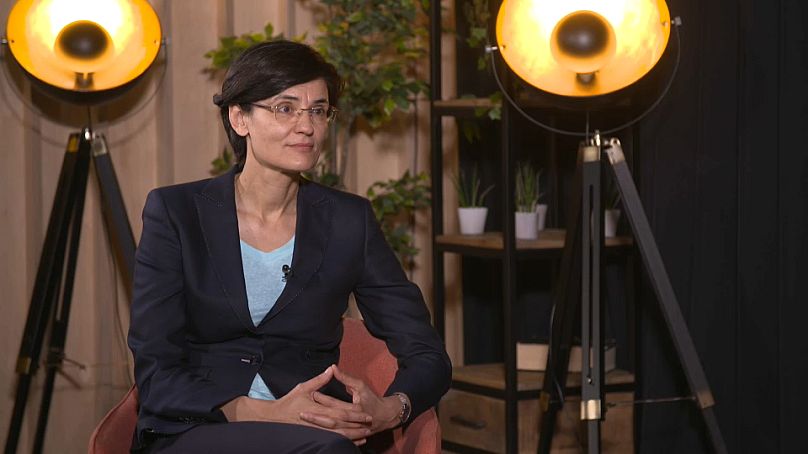
To learn more about the current economic turmoil facing Europe’, Naomi Lloyd of Real Economy’ spoke with Maria Demertzis, economist and Deputy Director of Financial Affairs. Brussels-based think tank Bruegel.
Naomi Lloyd, euronews:
“UkraineWas the war in ’ a fundamental change in ’'s economic outlook, or did it exaggerate already existing economic problems?”
Maria Demertzis, Deputy Director, Bruegel:
“, I'm probably thinking about the latter. It's definitely exaggerated when it comes to inflation. The reason we see all this inflation is because energy and energy come from Russia ’. Europe influenced ’ much more than the USA ’ because we, Russia, are much more dependent on ’ than others. It depends, of course, on the outcome of the war and how quickly we can find alternatives in the European ’. Honestly, we can't do this overnight. Looking at the growth outlook, I think we're coming out of an epidemic. I'm still saying we're in the pandemic, but at least the economy is coming out of the pandemic. As a result, we've seen huge increases in growth, but we don't see any drastic change in that.”
Naomi Lloyd, euronews:
“The cost of living, the price of food is rising. Should we be prepared for more of this?”
Maria Demertzis, Deputy Director, Bruegel:
“, I think so. I think we will definitely have another year in terms of inflation being abnormal. In Belgium, where I live, we saw an increase in flour, a doubling of flour, which of course also has an impact on bread prices, which is quite important. We'll feel it in our pockets as we fuel our cars, pick up our weekly groceries. And I can tell you, things have to get a little worse before they get better. So in that respect, I really think we are, we need to prepare ourselves a little bit more for that. - ”
Naomi Lloyd, euronews:
“Is this high inflation a real concern, or is it because we are tense after such a long period of low inflation?”
Maria Demertzis, Deputy Director, Bruegel:
“Eh, I guess it depends on what you're comparing it to. If you compare it to the last decade, yes, it's kind of accustomed to very low inflation rates. But it's okay if you compare it to the 1970 ’s, where we talked about real stagflation, 15 percent ’ inflation rates, and negative growth. We don't have those numbers right now. Even in the worst-case scenario, I don't expect to see these numbers. But of course we have to be brief. It's hard to imagine that kind of thing. - ”
Naomi Lloyd, euronews:
Do we need to see interest rates rise?“
Maria Demertzis, Deputy Director, Bruegel:
“I think it will be very difficult for the ECB’ not to increase the interest rates of other central banks that have to manage interest rates or interest rates when we see the inflation of the magnitude we see.”
Naomi Lloyd, euronews:
“How worried are you about the European economy right now?”
Maria Demertzis, Deputy Director, Bruegel:
“I think the European economy has survived the pandemic crisis quite well. Now, of course, the new crisis is of a very different nature, and it will also affect the way we cooperate globally, which of course will have economic implications. I think the European economy is in a good position to get through this. Now, whether we can manage it depends, of course, on how the war itself develops. - ”


